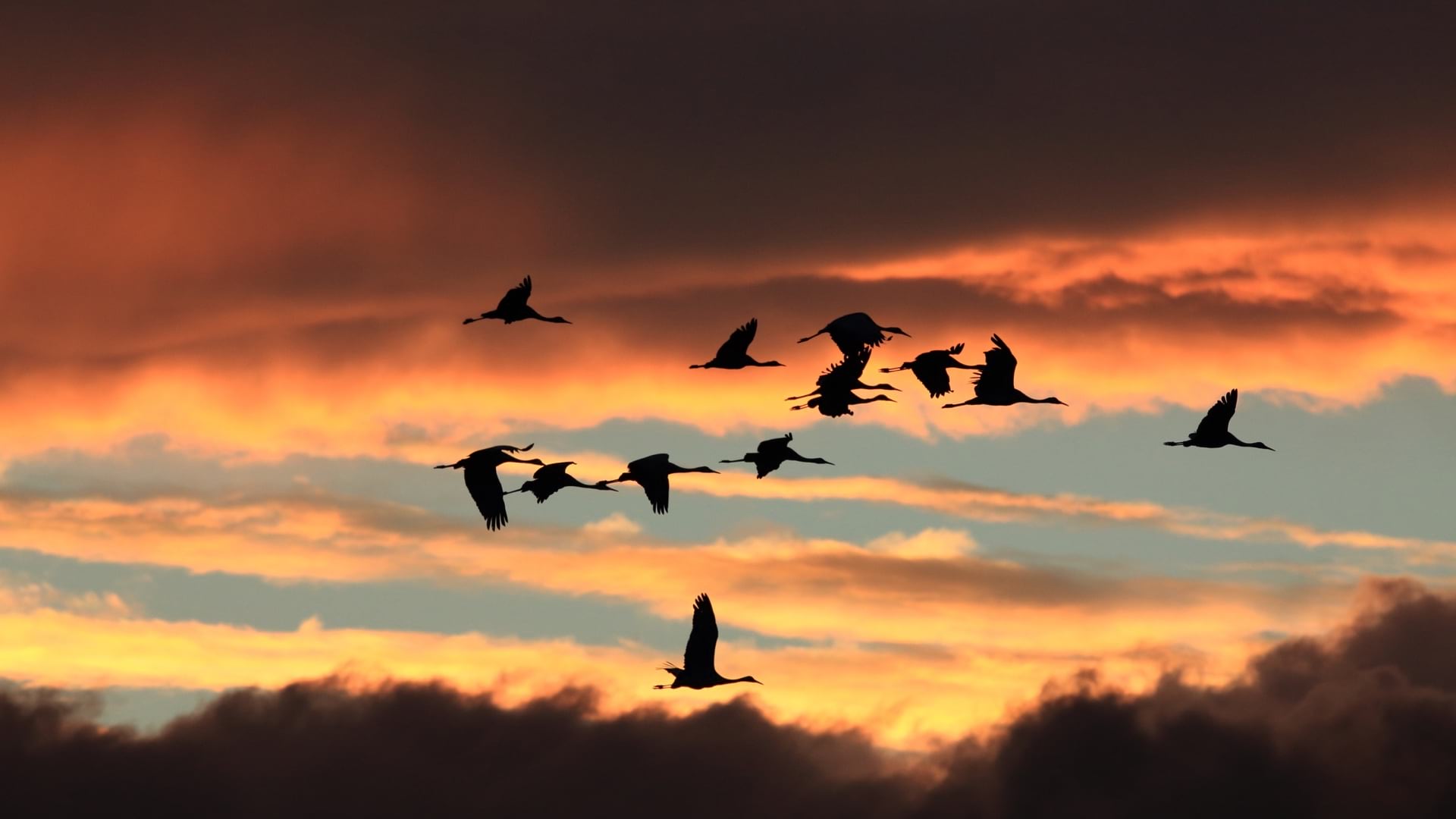
Allison Vogt, chief strategy integration officer at the National Audubon Society, explains how bird data reveals the health of our environment.
If you liked this episode, please share it with a colleague.

June 30, 2026
livingsensorswhatbirdsrevealaboutourplanet
===
Speaker: [00:00:00] Welcome to the Esri and the Science of Our podcast. Birds are living, moving sensors. By studying their migration, we're learning about the health of the planet itself. Their patterns reveal where our landscapes are thriving or in trouble. Allison Vogt, Chief Strategy Integration Officer at National Audubon Society, thinks that that's why every observation of these creatures is a signal worth understanding.
Speaker 2: I love using this line. It's the canary in the coal mine that we've all heard about. You know, it was a canary for a reason. Birds are incredible indicators of what's happening in the environment around us. When their numbers and the diversity of birds go down, it's a warning signal that, that things aren't right.
At the same time, and the good news is that they will bounce back when we restore and protect the places they need.
Speaker: Allison Vogt talks with Esri's Jarle Anaheim about how bird data reveals the health status of our environment.[00:01:00]
Speaker 3: Hi Allison, and welcome to Ezra and the Science of Where podcast.
Speaker 2: Hi John. Thank you so much for the invitation, and I'm looking forward to our conversation.
Speaker 3: Absolutely. It's great to have you here. Birds are dying at an increasing rate. Can you give us an idea of the scale of the problem? Why are so many dying?
Speaker 2: Yeah, these are some sobering statistics. Um, since 1970, we have lost 3 billion, with a B, uh, birds in North America alone. Uh, so if you're 55 years old, that's one in three birds lost during your lifetime. Um, and so what that tells me is that we are at a very urgent and important moment for birds and for us as people and communities, and we haven't been doing enough.
Uh, we haven't been smart enough about how we're protecting the places, whether forests or streams or deserts or wetlands, you know, that birds need. [00:02:00] And it's not, it's not really just about birds. It's, uh, you know, the... I love using this line, it's the canary in the coal mine that we've all heard about. You know, it was a canary for a reason.
Birds are incredible indicators of what's happening in the environment around us. When their numbers and the diversity of birds go down, it's a warning signal that, that things aren't right. At the same time, and the good news is that they will return, they will bounce back when we restore and protect the places they need.
And for, as for the reason, h- it's really habitat loss, land use change worldwide. And it's not just birds on that either. That's what's driving the, uh, the biodiversity loss that we're seeing worldwide. You know, scientists warn us that we're really on the brink of, of what could be a mass extinction. And so in our strategy, we are very much focused on a network of connected habitats that, that run from Tierra del Fuego in Chile up through the boreal of Canada and Alaska [00:03:00] so that, you know, the full life cycle of birds throughout their entire migration is, is covered.
And so when we say Audubon's a conservation organization powered by birds, what we mean is that we listen to those signals that birds are giving us, and we use them to inform where and when and how to take conservation action, uh, wherever they lead us across the Western Hemisphere.
Speaker 3: So Allison, you talk about the risk to birds primarily or, or one of your focus areas being habitat loss.
I think a lot of listeners might think of planes or buildings or other natural, um, risks to birds, but is it really more about habitat loss in terms of the true risk?
Speaker 2: It is. I mean, those direct losses are a big deal. There's, you know, there's literature about cats in, in buildings and things like that. But what, as Audubon, we feel the greatest value add we can bring to the conservation sector is to tackle those things like [00:04:00] habitat loss.
That's the lane we think we can make the biggest long-term difference. Uh, we have a- A phrase that kind of encapsulates our vision that says we wanna, we wanna bend the bird curve. And so if you, if you can envision the 3 million bird loss in a graph going down, down, our goal is to halt it and ultimately reverse it, so to bring birds back.
Speaker 3: So the stakes are huge. I know birds are obviously huge pollinators, but can you tell me more and tell the audience more about what are the stakes of all this, uh, of this impact?
Speaker 2: Yeah. This is a, a great question. I feel like there's sort of a head answer and, and a heart answer for me on this one. Um, I'll, I'll start with the head.
When we think about what are, what's the trickle-down impacts of losing birds, it's not only that they pollinate some crops, they eat pest insects, they disperse seeds, but as a group, they are these sort of remo- I think about them as a, a network of remote sensors that tell [00:05:00] us how things are going on the planet.
And if, if we don't have them, we're losing a really critical tool in conservation. And I think my heart answer is, is that I just fundamentally believe, and I've, you know, certainly working at Audubon has increased this, that when you hear a, a bird sing, when you watch them fly or build a nest or a, something bright like a cardinal or a blue jay catches your eye, it's really a, an important part of the universal human experience, and it's existed for millennia.
And it really doesn't, you know, matter where you are, cities, suburbs, forests, everywhere you can find birds, and there's something sort of magnetic and magical that birds, that draw people to birds, and then it's Audubon's job to translate that, that connection with birds into a connection for conservation.
Speaker 3: So translating information into action takes careful [00:06:00] strategy. How has Audubon made an analog activity, like quietly watching birds, into a technologically sophisticated crowdsourced solution?
Speaker 2: That's a great question and, and a really exciting area of, of the work that we do. I would say we have made that analog, those binoculars, we have we have added a digital layer onto that bird-watching experience, which is
And certainly with the leadership of the Cornell Ornithology, uh, with their eBird app, what you do now is when you go out and watch birds, you don't just keep a list or a kind of check, you know, make a check mark next to the picture in your, in your hard copy bird guide, but you log in to an app like eBird or, or something else, and you document what birds you're seeing, where you're seeing them, when you're seeing them.
And collectively, over thousands of bird walks, hundreds of thousands of people, we now have this really amazing crowdsourced community science data [00:07:00] set that tells us really more than we've ever known before about where birds are, when they're there, and how, how long they're there, which is a big part of unraveling the mystery of migration.
And so what Audubon has done in partnership with Esri, in fact, and nine other founding partners, is create what we call the Bird Migration Explorer, and this is ... It essentially brings the magic of bird migration to anybody with an internet browser. Um, encourage you and others to, to go take a look. But what, what our scientists did was really serve as the collector of all of the available data for migratory birds, and this includes those crowdsourced eBird data points.
But it, it, at, at present, it's roughly 12,000 migratory tracks from about 200 species, and I think something like 450 scientific studies. It represents this huge body of work, and what, what we've been able to do [00:08:00] using the spatial tools that we have is create maps to see, you know, take these individual data points from bird lists and put them on a map.
And when you do it, you see this hemisphere just awash in all of these connected lines that represent how birds are migrating season by season, and it, it really, it's, it's, it's fairly awe-inspiring. I think even if you don't, even if you don't like birds, you have to appreciate the connectivity across borders, across countries, across languages that, that these birds provide, that the same bird that I might be looking out my window at right now in a, in another month might be preparing to spend the winter in Belize or Mexico.
It's, it's really quite incredible.
Speaker 3: Allison, I've spent hours on the Bird Explorer- ... or Migration Explorer. Shared it with my kids, and, and we've just, it's just been amazing. It's such a beautiful way to communicate that information. So thank you for-
Speaker 2: Oh, I love hearing that. Thank you. [00:09:00]
Speaker 3: So, uh, I've heard you talk, Allison, about the idea of soft science versus hard science, let's say.
Can you expand on that?
Speaker 2: Absolutely. I came up through a track of pretty, pretty standard biology, ecology, what we considered, you know, quote-unquote, "the hard sciences". And the, the longer I've spent, uh, in the conservation profession, I realize that the social sciences, you know, a- and all that they represent, from sociology to economics to anthropology to psychology, uh, human behavior, uh, all of those things are really absolutely critical to incorporate into the strategies of how we do conservation.
I have a, a social scientist friend, and she would always say, "You know, it's not bird behavior we need to change, it's human behavior." And I think that just hits it, it right on the head, that we have to think about conservation is not something you do to people, or [00:10:00] even for people. You have to do it with people.
And so figuring out through the, the, through the lens of social science how to inc- be increasingly effective and strategic at engaging in that work, I, I think it's key to, to our ability to meet, to meet our long-term goals.
Speaker 3: So speaking of science, what does Audubon get right in your use of geospatial science, and what are the lessons that you think you can share with others?
Speaker 2: Yeah, I think y- one of our folks on our science team says that geospatial science and GIS is in Audubon's DNA. We don't do conservation without thinking in a geospatial sense, because conservation is inherently a, a spatial activity. Birds don't exist in the abstract. They live and, and migrate through very specific places.
And so we have to think about place, uh, in order for our work and our impact to become real. And so we think about the... [00:11:00] We, we think about where just as much as we think about the what and the how i- in, in how we approach our work.
Speaker 3: Taking that question a little further, Allison, does the use of geospatial help with getting buy-in for decisions or, or, uh, directions you're asking the organization to take?
Speaker 2: Absolutely. You know, a picture's worth a thousand words, right? A map might be worth even more uh, in our work to be able to connect the bird data or the habitat data, to be able to see that and see layers, you know, overlapping that, that are pointing us to the importance of, let's say, uh, the wintering grounds in Latin and South America.
You know, Audubon started as a, as a US-based organization in 120 years ago, so we have a long legacy of doing work in one country. And what we've embraced over the, the past decades and, and increasingly over the past few years through [00:12:00] Flight Plan, is that we can't be successful just sticking to those old ways.
And when you see, you see the maps of birds on the ground in Latin and South America during migration and when in winter, the imperative to sort of have that, that strategic shift in our business strategy towards a more hemispheric approach, it's ju- It... You don't need to really say anything because it's all laid out for you through the vis- through the data visualization.
Speaker 3: So what results have you seen from some of the actions of Audubon and, and broader bird conservation, uh, in general?
Speaker 2: We are about midway through our current strategy, and we've, we are tracking our progress towards some pretty big milestones. And so on, in, in habitat conservation, our goal is by 2028 to conserve 300 million acres across the hemisphere.
And what we've seen in the last two years of Flight Plan is, uh, we've certified over three million acres, this is, uh, in the [00:13:00] United States alone, of bird-friendly ranch lands. One program I'm particularly proud of is the Audubon Conservation Ranching Program. And the way this program works is that Audubon provides technical and financial assistance to private landowners, to ranchers, um, to help them implement improved grazing practices.
We call them habitat management plans, but it's just a more eco-friendly way of, of raising their cattle, their, their beef on their lands. They enroll in our program, we certify them as bird-friendly land and bird-friendly beef, and we have the benefit of improved grasslands, uh, which is one of the most imperiled habitats across the, the Western Hemisphere.
And our science shows us that these changes, you know, they may seem subtle, but we see an annual year over year increase in bird abundance and diversity, and the overall resilience of bird populations through that work. So that's an example of a, a program that we deliver on, on private lands. Public [00:14:00] lands are incredibly important as well.
In Canada, the acreage, uh, the possibility and the opportunity is huge, and we've, uh, engaged with our indigenous partners there on some very large protected land, uh, in the millions of acres scale. And everything in between, down to 10,000 acres, hundreds of acres if they're critically important. But together, this mosaic is building, uh, a network of connected and resilient lands so that as birds travel, you know, north to south and south to north twice each year, they can be supported wherever- whatever habitat it is that they need.
Speaker 3: I love this idea of, of partnering with ranches and, and farmers. Can we talk about some of the financial aspects of birding and how you've helped farmers in California's Central Valley?
Speaker 2: Absolutely. That's another great program. That one ... Well, so for those of you who may not be familiar with the Central Valley, this is a, an agricultural area, a now agricultural area, uh, sort of [00:15:00] between the, let's say, the Bay Area and the Sierras, and running probably, you know, upwards of nearly a third or half of the length of, of California.
And it has been used for thousands of years by millions of especially ducks and geese and shorebirds as they migrate, you know, north, north and south each year. And they use it specifically as a place to rest and refuel so that they can make that journey. And what was once a really dynamic mosaic of habitats, wetlands, woodlands, rivers, grasslands, is really no more.
And- One stat is that 96% of the wetlands in the Central Valley have been lost. But it's been replaced by what is now our country's most important agricultural region, and provides huge benefits, uh, in terms of our food supply, economically. And so we had to find a way to, to have a both and solution. And so what we've done, uh, the, the program is called Bird Returns, and we implement it [00:16:00] in conjunction with two of our, our partner NGOs.
So one of the programs I think is most exciting is a partnership we undertake in, in 15 states, uh, with ranchers who raise beef cattle on grasslands across North America. We call it the Audubon Conservation Ranching Program, and what we do is provide technical and financial assistance to these ranchers so that they can implement better practices, rotational grazing, and other more eco-friendly practices that help the grassland habitat while continuing to raise cattle for their, for their ranch.
And what we found is not only do the ranchers have an economic gain from healthier cows that get more at market, but we see year over year an increase in the bird and plant diversity in the grasslands as well And what we, um, what we ask, farmers apply to the program, and we provide them financial incentives to temporarily flood their fields [00:17:00] during these key moments.
In the Central Valley, all of the water supply is, is ver- is highly controlled. And so what we ask is they leave water on their fields during these key moments when our data shows us that birds are coming through and need that place, that food supply to rest and refuel. And we use geo... This is a, this is another example where geospatial tools really come into every aspect of being able to design, to pick the right landowners, to, to, and to monitor how the birds are responding.
So it's, it's really, I can't think of a better example of what we think of science-based restoration. This is one that year after year delivers results both for the farmers who get a, an income stream during a time when they normally wouldn't, uh, and certainly for the birds and the other wildlife that depend on the Central Valley as well.
Speaker 3: Alison, what's one thing you would do to protect and to support the bird population in the cities?
Speaker 2: You know, I think the first [00:18:00] maybe the most important thing is just notice. Notice the birds around you. They're, they're there, and foster that, that appreciation for the natural world even in cities. You know, even pigeons can be beautiful in, in certain light, right?
That iridescent shine. We think that's a great way to start, you know, kinda kindle the, the environmental ethic, is to use birds as a gateway and a, a portal into conservation. Certainly we invite you to join our flock at Audubon. Follow us on social. Go to audubon.org. Get involved. You know, we do our work through the financial support of everyday members and donors.
And then more practically, you know, you asked about bird collisions. You certainly, native plant gardens in, in sub- in suburban and urban areas. All of those sort of individual decisions can, can help the overall, the fate of birds.
Speaker 3: Well, Alison, thank you so much for your time. Thanks for sharing with our [00:19:00] listeners.
But maybe more importantly, thank you for all you do and, and the Audubon are doing for, uh, safeguarding birds around the world.
Speaker 2: Thank you so much.
Speaker: Thanks for listening to the Esri and the Science of Our podcast. If you liked this episode, please share it with a colleague.
Allison Vogt, chief strategy integration officer at the National Audubon Society, explains how bird data reveals the health of our environment.
If you liked this episode, please share it with a colleague.
Listen to and subscribe on