Predicting housing prices has always been a balancing act between data and context. Traditional models rely on structured predictors such as a house’s age, the number of rooms, or the population of the surrounding census block group. These variables capture important characteristics of a property, but they only tell part of the story.
What they often miss is the broader spatial context. Two homes with nearly identical characteristics can have very different values simply because they exist in different social, economic, and geographic environments.
At this year’s Developer and Technology Summit plenary, Karthik Dutt demonstrates how geodemographic embeddings are changing that paradigm. By representing each location as a learned spatial signature derived from rich demographic, business, and economic data, these embeddings allow predictive models to access layers of geographic context that were previously difficult to encode. They also form the foundation for new ArcGIS Pro tools that help analysts explore and compare places interactively, uncovering patterns and similarities across spatial data.
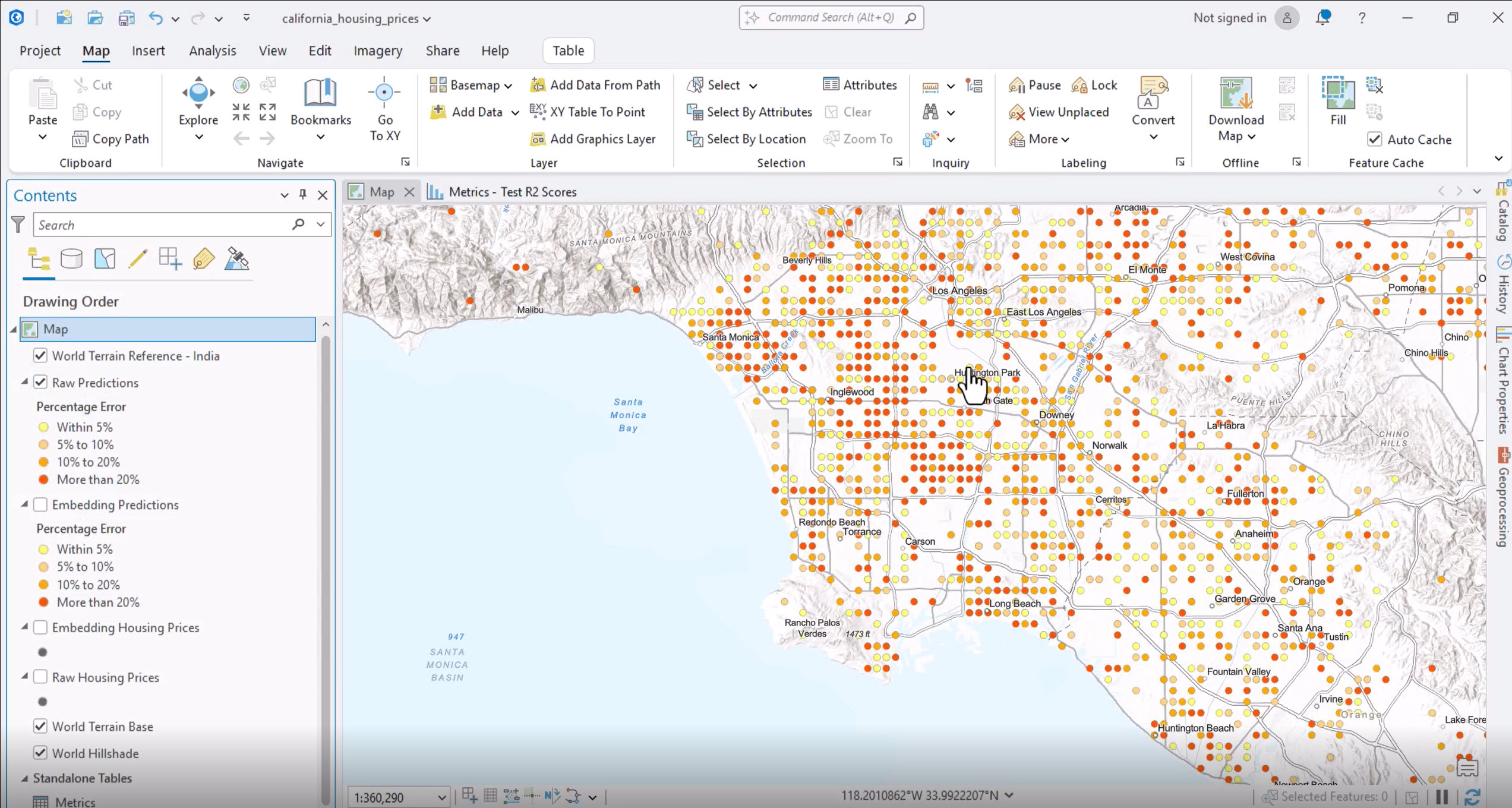
Before introducing embeddings, Karthik walks through a classic approach to predict housing prices in the Greater Los Angeles area: using structured predictors and feeding them into a standard gradient boosting model. The results are familiar: in some neighborhoods, predictions are close to reality, but across the map, errors quickly grow. Certain block groups deviate by 10%, 15%, or even 20% or more, highlighting how much variance traditional predictors leave unexplained. The model is doing the best it can with the information available, but the information itself is incomplete.
This is where geodemographic embeddings come in.
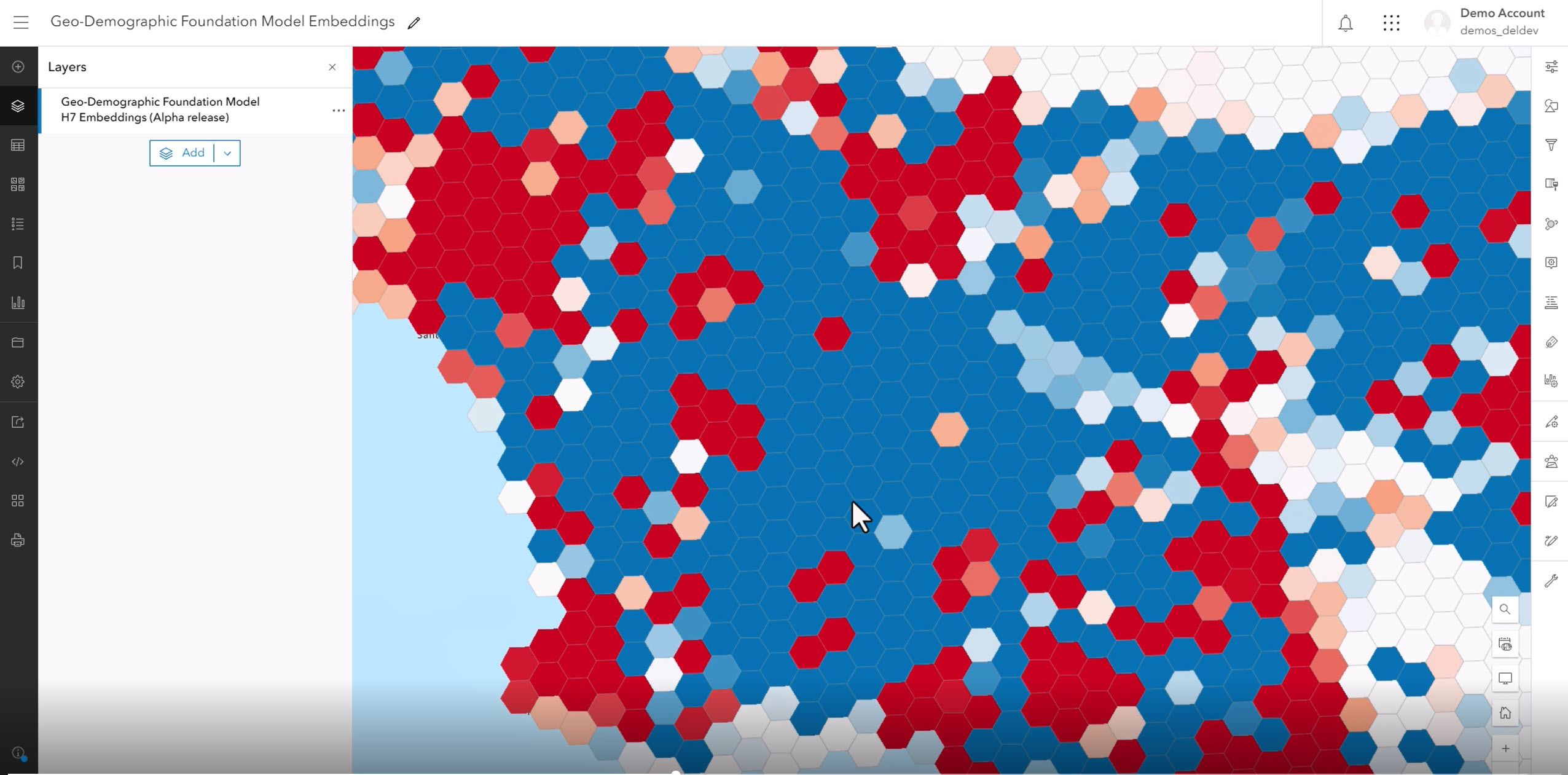
Karthik incorporates embeddings generated by the Geo-Demographic Foundation Model into his housing price model. These embeddings are computed at the H7 hexagonal resolution, where each hexagon covers roughly 2 square kilometers. Across the United States, this creates a grid of about 1.8 million hex bins, each with its own learned spatial representation derived from signals such as census characteristics, demographic patterns, business presence, and retail demand.
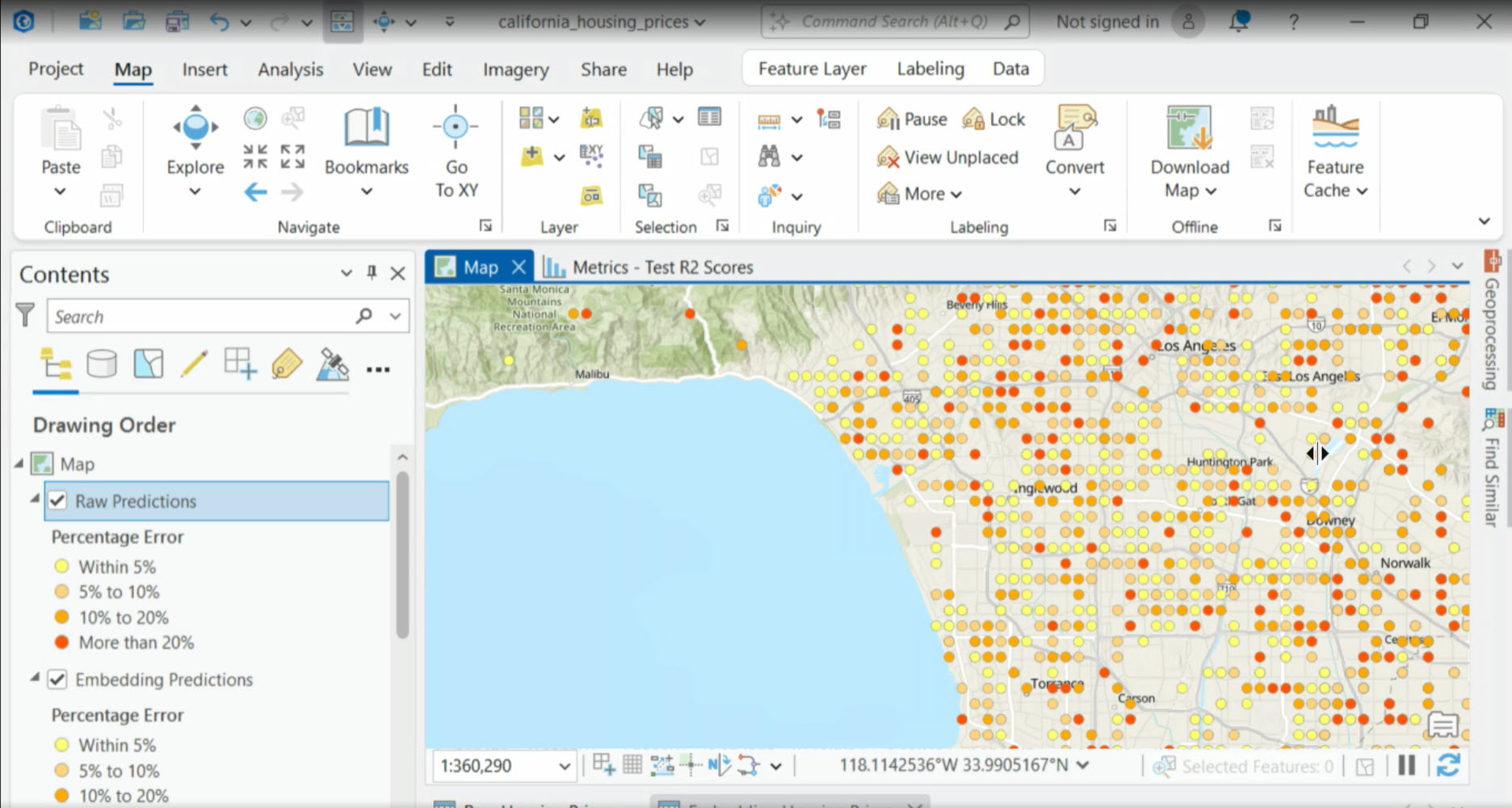
Once the model gains access to spatial features that capture the broader neighborhood context that traditional predictors alone cannot fully describe, the improvements are immediately visible.
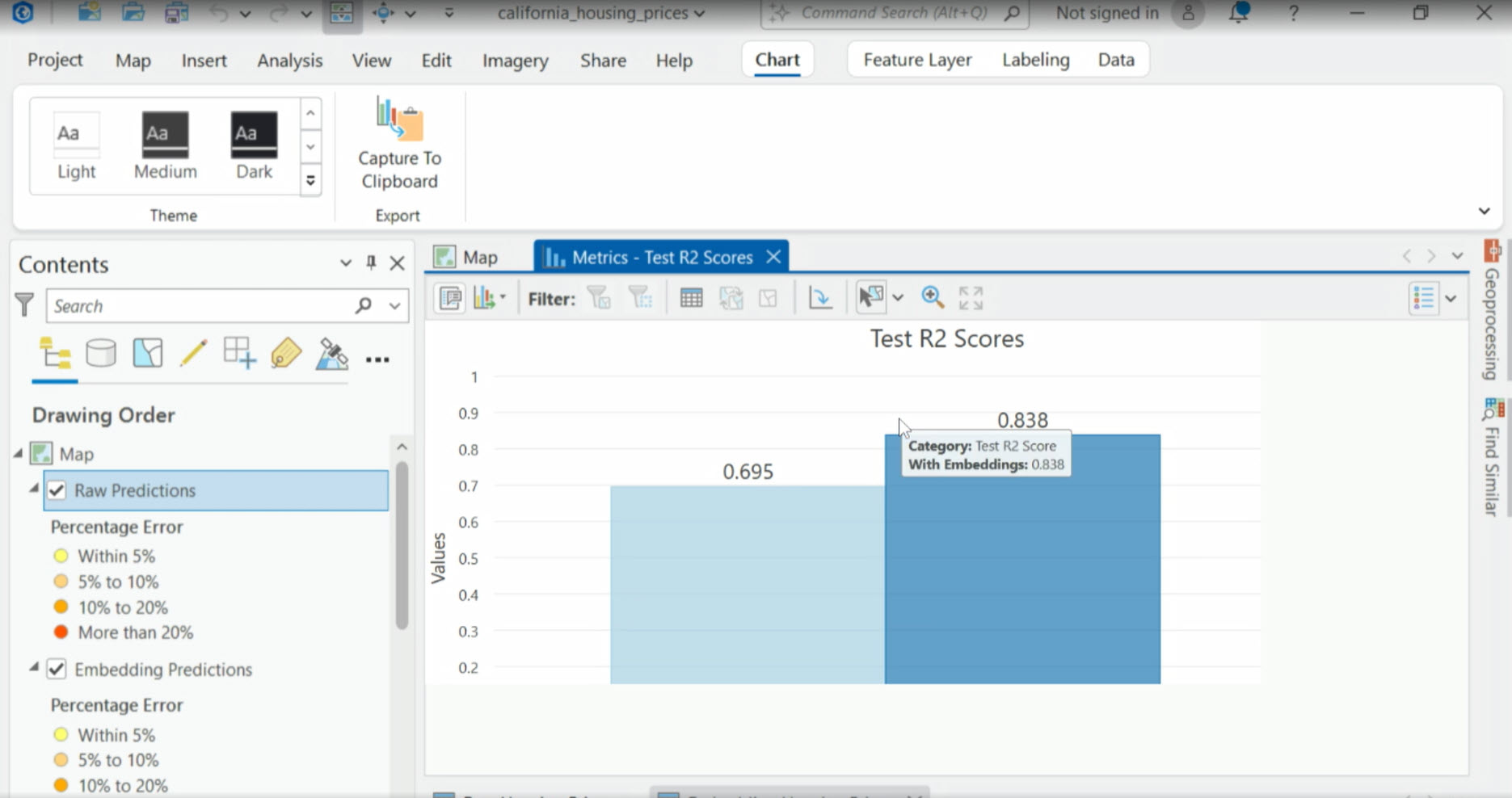
Locations that previously appeared in darker shades of orange and red, indicating large prediction errors, now appear lighter orange and yellow, reflecting smaller deviations from actual prices. And quantitatively, the test R² improves by roughly 15%, demonstrating how spatial context can meaningfully improve predictive accuracy.
While Karthik demonstrated the power of embeddings, he emphasizes that they do not replace traditional predictors. Variables such as house age, number of rooms, and population remain critical because they describe the property itself. Embeddings extend that understanding by capturing the character of the surrounding neighborhood. Together, they can transform ordinary models into spatially aware ones.
Karthik then turns to another question: how can analysts directly explore and interact with embeddings within ArcGIS Pro?
He introduces a set of embedding-aware tools designed to help users discover patterns and relationships in spatial data:
- Generate Embeddings, which generates embeddings for a feature class or raster using foundation AI models.
- Merge Embeddings, which combines embeddings across larger geographic extents.
- Find Similar, which searches for locations that share similar embedded signatures.
In his demo, Karthik focuses on the Find Similar tool.
To illustrate how the tool works, he turns to imagery from Bradenton Beach following Hurricane Milton. In the imagery, signs of scattered debris and fragments of disrupted structures are visible. Instead of manually scanning the entire image for areas with similar signs of damage, he simply selects a few visible examples.
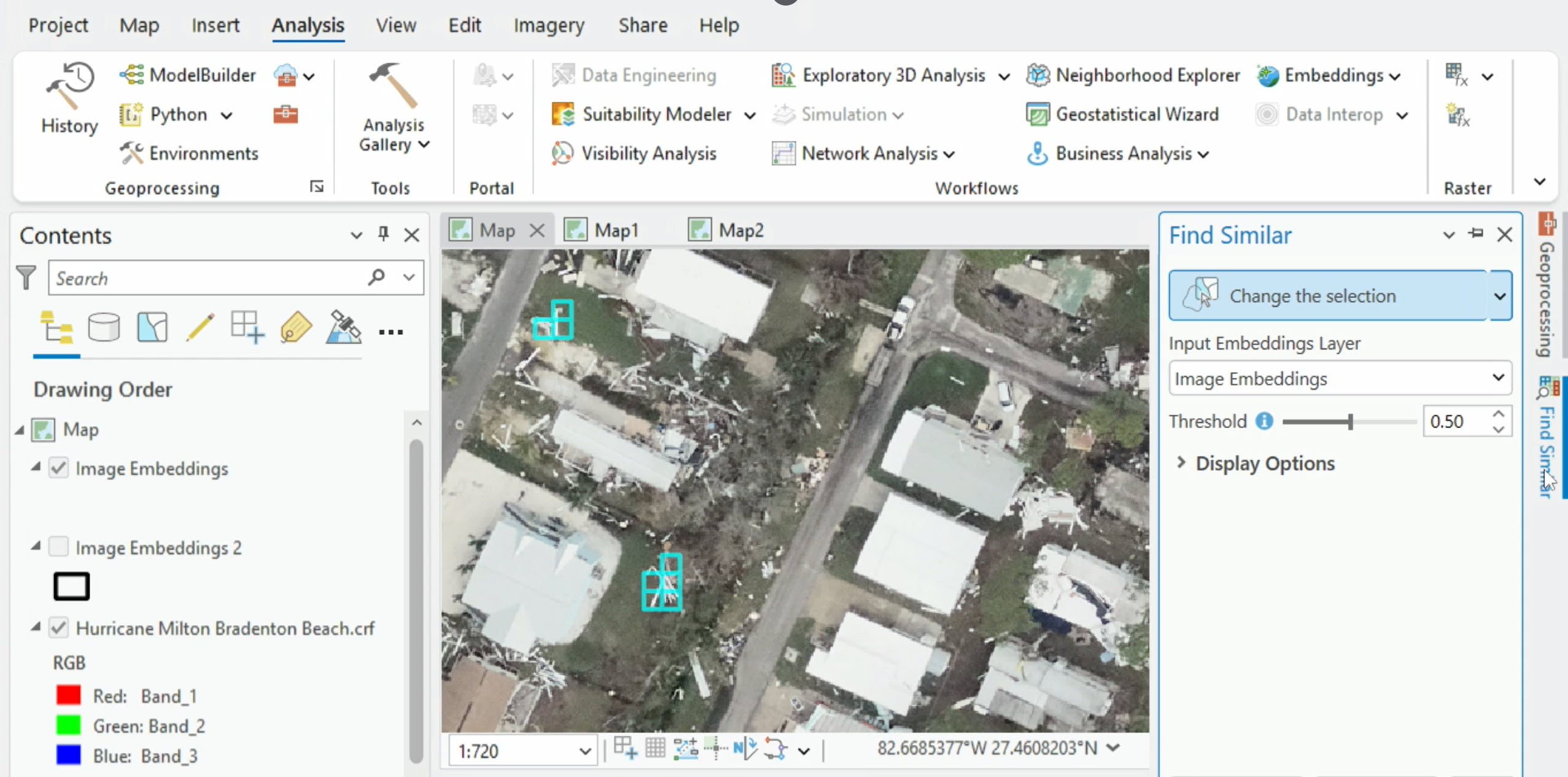
Instantly, the Find Similar tool highlights other areas with comparable visual patterns across the imagery, without the need for labels or training data—just embeddings that capture the underlying visual structure.
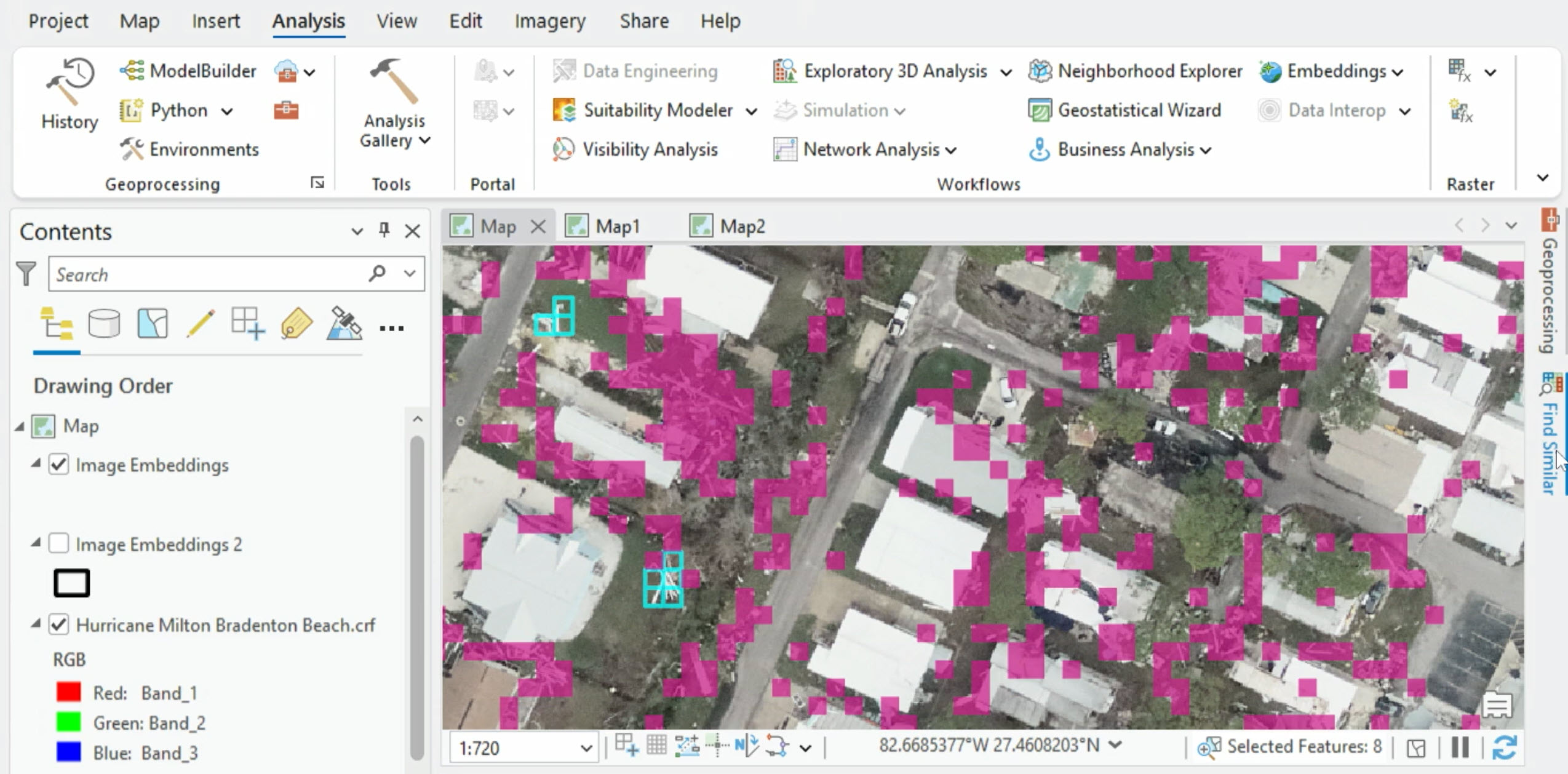
Karthik explains that behind the scenes, the imagery extent has been divided into small grid cells, each with a pre-computed vision embedding generated using Meta’s DINOv2 model, which encodes visual patterns into embeddings. When a user selects a pattern to search for, the tool compares the embedding of that selection against the embeddings of every grid cell and highlights those that most closely match.
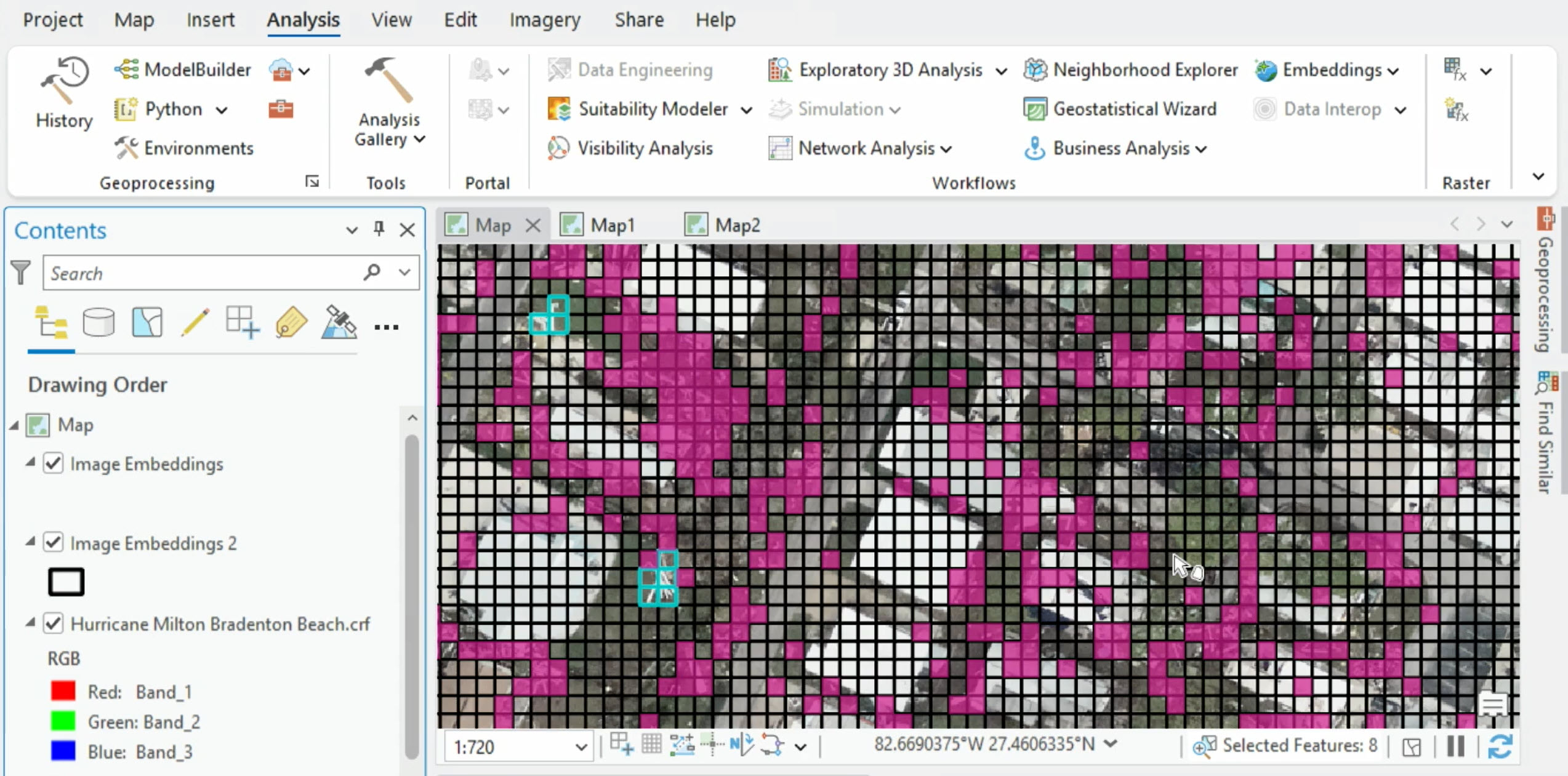
And just like that, a few observations quickly become a map of likely damage clusters, demonstrating how embeddings can accelerate tasks such as disaster assessment.
Karthik then shifts from imagery to a different dataset: disposable income patterns near Orlando. Using a feature class with embeddings generated by the Geo-Demographic Foundation Model, trained on census, retail, and business data, he selects a location with high disposable income and applies a similarity threshold of 0.90. The Find Similar tool immediately highlights other areas with comparable socioeconomic profiles, surfacing similar regions without requiring analysts to define variables manually.
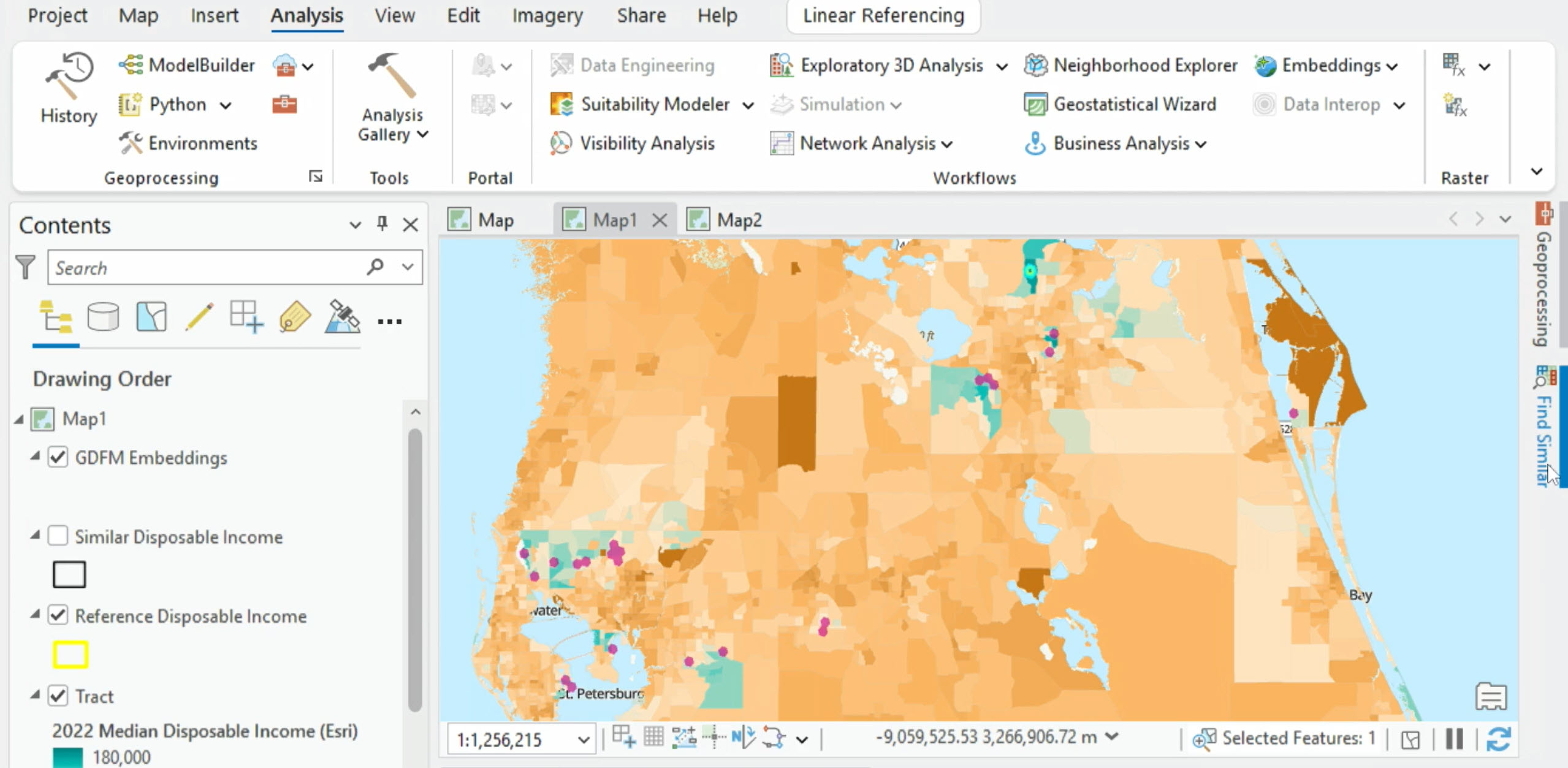
Finally, Karthik scales the analysis nationwide. Using Arizona State University as a reference location, the tool scans across the country to identify other places with comparable embedded signatures. Conceptually, it answers a simple question: Where else does the spatial context resemble this place?
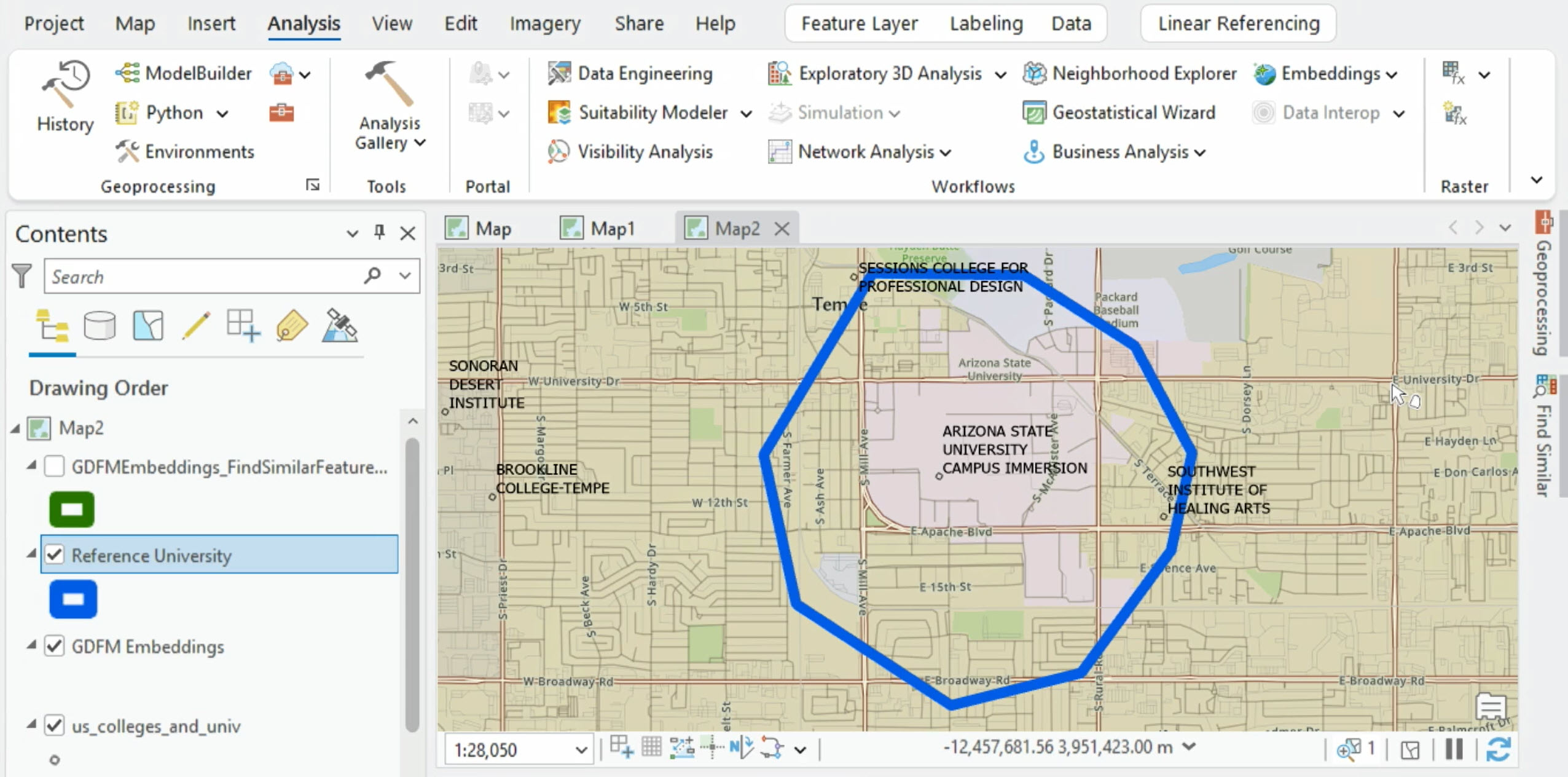
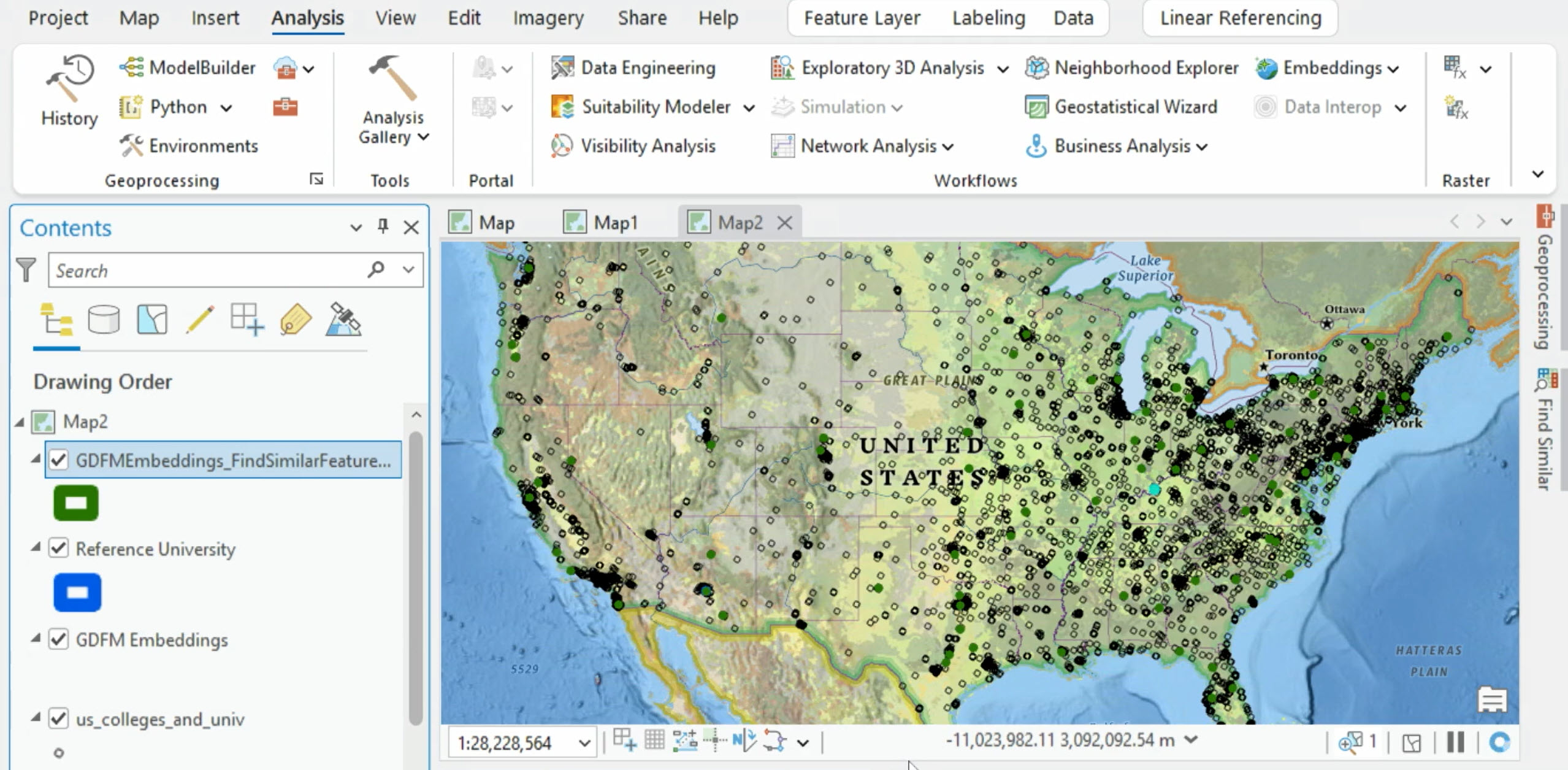
Karthik highlights an interesting detail: the model was never explicitly trained to recognize university towns. Yet the embeddings capture demographic and economic patterns associated with the selected location—student populations, housing dynamics, and surrounding business activity—allowing the Find Similar tool to surface other areas with similar characteristics.
What makes this workflow especially compelling is that all data types can be represented within the same embedding framework. Whether identifying storm-damage patterns in imagery, discovering neighborhoods with similar socioeconomic characteristics, or searching for places that share the spatial signature of a university town, embeddings make it possible to compare locations in entirely new ways.
Esri is actively working to make embeddings available for use in ArcGIS. Once available, how will you use them to uncover patterns in the places you study?

Commenting is not enabled for this article.