Shorten time to delivery
Automated, robust, and efficient distributed processing workflows reduce the time it takes to process large imagery collections to create 3D outputs.
Part of the ArcGIS Reality suite of products
Aerial reality mapping at scale
Load and manage data from multiple drone or crewed aircraft flights. Use control points and reuse existing measurements. Import polygons to improve results, improve waterbodies, or to set a region of interest. Add lidar to improve completeness and the quality of results in shadow or occluded areas.

Optimize the relative and absolute orientation of imagery from multiple flights. Measure control points to correctly georeference your results. Reestimate camera parameters if necessary.

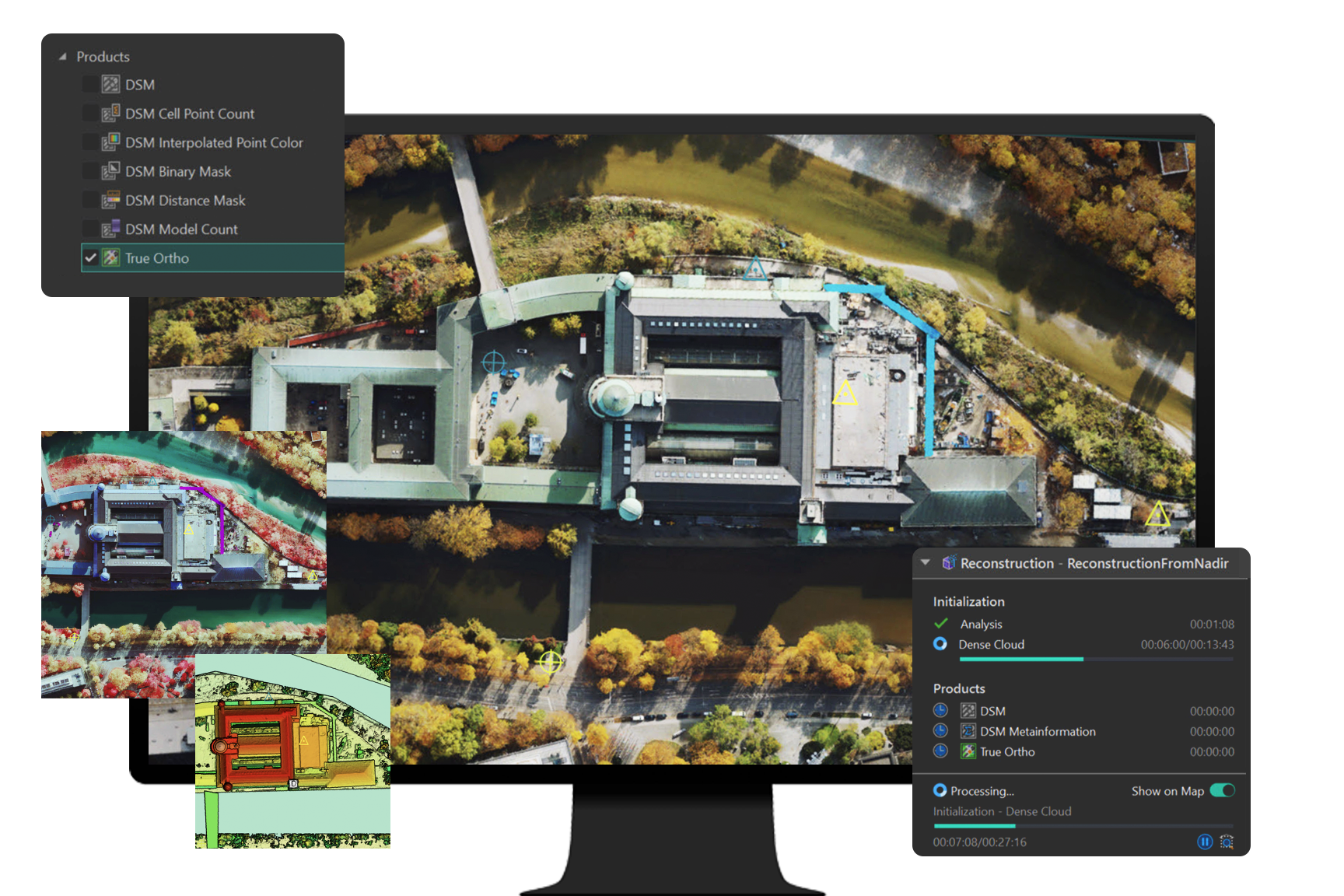
Turn large imagery and lidar data collections into high-quality 3D meshes, point clouds, digital surface models, true orthos, and Gaussian splats. Get results fast using distributed processing and automated workflows. Control the resolution of the output rasters and meshes. Track progress on the map.
Imagery dataset provided by ©Bluesky Ltd.

Iterate on the alignment and reconstruction to deal with problematic datasets. Use statistical insights to fine-tune out-of-the-box results and manage challenging data.

Use the web to efficiently share available results with your organization and clients. Results are provided in open standard formats and are ready for web streaming.

Explore the software applications that are a part of ArcGIS Reality. Find the reality mapping software that fits the size of your projects and the sensors you work with.
Use this extension to generate large-scale true DSMs, true orthos, DSM meshes, point clouds, and 3D meshes from satellite, aerial, and drone imagery.
Explore the extensionProcess large volumes of drone imagery faster with cloud-based data processing and create 2D and 3D maps and models that you can quickly share across your organization.
Explore Site Scan for ArcGISProcess drone imagery while offline or in the field. Turn recently collected drone images into 2D and 3D models, even without an internet connection.
Explore ArcGIS Drone2MapDigital twins are representations of real-world objects and their processes and relationships. With ArcGIS Reality, users create highly accurate 3D meshes, true orthos, elevation models, point clouds, and Gaussian splats to use as an important piece when developing 3D digital twins of natural and built environments. Learn more about Esri’s 3D capabilities and how they relate to a comprehensive digital twin.
