
Hidden dangers lurk beneath the surface in dozens of countries worldwide, where human conflict has left behind a deadly legacy of land mines, cluster munitions, and improvised explosive devices. The Geneva International Centre for Humanitarian Demining (GICHD) is at the forefront of efforts to mitigate these threats, providing critical advisory services and support to affected nations. At the heart of its operations lies modern enterprise GIS technology, which has transformed mine action work around the globe.
The GICHD’s mission is to develop and professionalize solutions that help reduce risks from explosive ordnance. As an Esri Nonprofit Program member, the GICHD relies on ArcGIS technology to use and manage critical data and help mobile personnel, researchers, and others make evidence-based decisions.

“Because mine action is a geographic problem, the most important priority for us is determining the location of the explosive ordnance,” said program manager Noor Zangana, who leads the Information Management division’s Capacity Strengthening program.
The GICHD’s Information Management System for Mine Action (IMSMA Core) is an ArcGIS Enterprise system that facilitates data collection, storage, analysis, and reporting that complies with the Anti-Personnel Landmines Convention and other global treaties. Zangana oversees a training program for IMSMA Core and ArcGIS apps. Each year, hundreds of people around the world use ArcGIS to collect data and support demining activities, so training for IMSMA Core and other GIS technology must be scalable and accessible to diverse audiences.
“Every country we support has different needs and approaches to dealing with explosive ordnance,” Zangana shared. “They have experts and people new to the humanitarian action world.”
The Capacity Strengthening program offers in-person IMSMA Core training at the GICHD’s headquarters in Geneva, Switzerland, and in various countries. For many individuals, however, obtaining travel visas and funding to attend these events is challenging. Women, in particular, may face hurdles.
“In some affected countries that we support, it’s difficult for women to travel, even if they have financial support from their government. We are trying very hard to support all types of people, all types of countries, all levels of knowledge,” said Zangana.
To deliver training that’s accessible anywhere, and to anyone who needs it, Zangana partnered with Esri’s Training Services team to develop custom e-Learning courses.
Fit-for-Purpose Training
The GICHD’s Information Management division works with up to 10 information management professionals in each supported country to provide an IMSMA Core portal provisioned with ArcGIS user types, data, and apps.
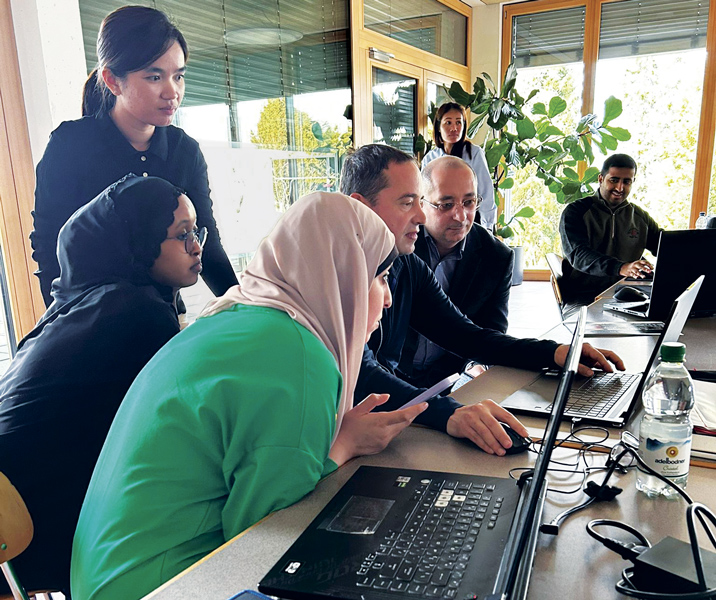
“We customize the portal and tools for each country based on their needs and to be fit for their purpose,” Zangana said.
Zangana firmly believes that training should be tailored to the needs of those who will be managing and using an IMSMA Core portal. When Esri training consultant Andrew Sandifer informed her that Esri could create and deliver custom training, Zangana saw value in developing e-Learning tailored to IMSMA Core and mine action workflows.
“Through the e-Learning modality, we have capacity to support all people who need training,” she said.
Zangana’s team and Esri’s custom training team worked together to create courses that introduce foundational IMSMA Core and GIS concepts, explain how GIS apps support mine action, and provide practical experience with the ArcGIS tools used to collect, visualize, analyze, and share data that supports explosive ordnance planning and removal operations.
Each course includes conceptual content, interactive activities, and step-by-step exercises using sample training data. Some courses feature videos from the GICHD’s Information Management staff. Quizzes are included to measure and reinforce knowledge.
Expanding Accessibility
Zangana’s strong focus on supporting each country’s unique training needs extends to language. The GICHD’s custom e-Learning courses were written in British English, which is widely spoken in the organization’s supported countries. But in 2024, Zangana noticed an increase in requests for support from French-speaking countries.
“A lot of French speakers are suffering from mines. The needs of those countries made us consider linguistic accessibility, and we wanted to have a plan to support them,” she said. “We care about all the people from the countries we support who are taking training. They have input because we want to make sure that we include everybody based on the objective of the training that we are building.”
Upon learning that Esri could publish e-Learning in French, Zangana commissioned French-language versions of courses covering data collection with ArcGIS Survey123 and data visualization using web maps and dashboards.
The GICHD translated the British English text into French and returned it to the Esri team. The team placed the French text into the instructional content sections and course interface elements to deliver a custom training experience designed especially for learners in francophone countries.
The Next Phase: Supporting Field Operations
More than 2,000 people have taken the GICHD’s e-Learning courses, and the educational content has been well received.
“They are so excited and really interested to learn about IMSMA. They are asking us to develop more topics,” Zangana said.
To that end, she and her team are planning to add another custom e-Learning course. It will have a French-language version as well, since that’s now considered a best practice at the GICHD. The primary audience for the course will be mobile operators, and the content will focus on using IMSMA Core and ArcGIS software and apps to conduct holistic mine action workflows.
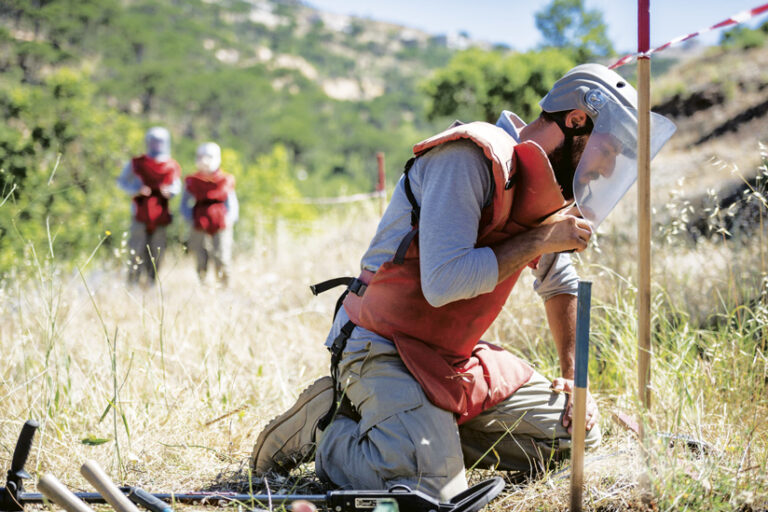
“We’re going beyond information management professionals to train operators in each country,” Zangana shared. “Collecting mine data is very complex, and surveying a confirmed hazardous area is very expensive. Accurate data is so important because in the next stage, operators will do clearance,” meaning they will remove the mines—many of them unexploded—from their hidden locations.
By providing customized enterprise GIS systems and training, the GICHD leads in helping countries take informed action to clear threats from past conflicts and raise hopes for a safer future.
Learn more about the GICHD’s programs. For more information on Esri’s custom training program, email GIStraining@esri.com.