
With deep experience implementing cutting-edge GIS solutions, Esri partners help their customers achieve wide-ranging goals. Find out how four Esri partners used ArcGIS technology to build a national atlas to document a country’s history and shed light on its future; centralize data to make a water utility more agile; move an architecture, engineering, and construction (AEC) firm’s GIS to the cloud; and help a school district show families their enrollment options.
Chronicling Progress and Showing Vision
To celebrate the United Arab Emirates’ (UAE) 53rd National Day, the country’s Federal Geographic Information Centre (FGIC) launched the Union Atlas, a landmark national reference that not only documents the country’s transformational journey over five decades but also captures its vision for the future.

Developed by the FGIC in close coordination with government and academic organizations—and using cutting-edge ArcGIS technology with help from iSpatial Techno Solutions—the Union Atlas combines geospatial and business information with development indicators, portrayed via aesthetically enhanced aerial photographs, satellite imagery, and maps. The information contained in the atlas covers a wide range of sectors, including education, health, energy, water, transportation, telecommunications, population, environment, culture, heritage, and geospatial information. Available as both a digital platform and a printed book, the atlas offers a rich, immersive experience supported by ArcGIS Enterprise, ArcGIS Dashboards, ArcGIS Hub, and ArcGIS StoryMaps.
The Union Atlas is designed to support decision-makers, planners, researchers, and the public. It integrates interactive maps, time series data, and multimedia to visualize national growth, promote data-driven governance, and inspire innovation.
The initiative aligns with the United Nations Committee of Experts on Global Geospatial Information Management (UN-GGIM) working group’s Integrated Geospatial Information Framework (IGIF), which seeks to strengthen national geospatial data management. It also reinforces the UAE’s leadership in building a modern spatial data infrastructure.
The Union Atlas has been featured at key events, including at the International Society for Photogrammetry and Remote Sensing’s (ISPRS) GeoSpatial Week in Dubai, where the FGIC showcased its strategic role in organizing the geospatial sector at the national level. The atlas has also helped the FGIC demonstrate how geospatial intelligence, national vision, and Esri technology can collectively empower nations to preserve their history while planning for a smarter, more sustainable future.
Centralized GIS Data Makes Water Pollution Utility More Agile
The Greater New Haven Water Pollution Control Authority (GNHWPCA) operates and maintains an extensive sewer system in New Haven, Connecticut, including 555 miles of pipeline, 30 pumping stations, and an advanced secondary wastewater treatment plant with a capacity of 40 million gallons per day. At times, GNHWPCA staff found it challenging to manage this extensive infrastructure due to outdated plans, inaccurate database information, and limited methods for data sharing and collaboration.
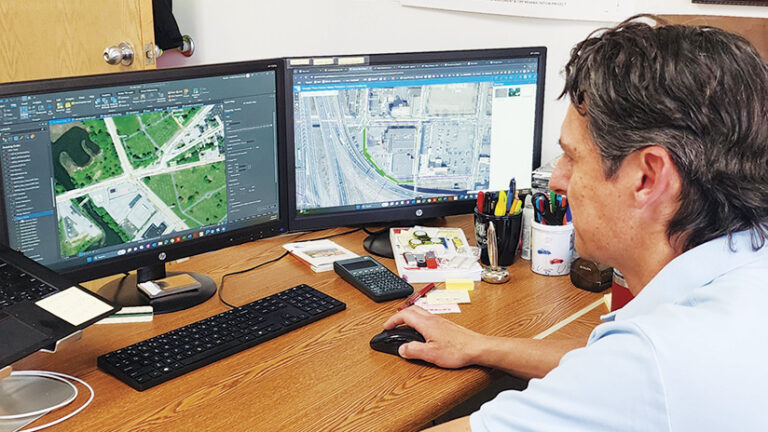
As part of a comprehensive long-term plan, GNHWPCA leadership decided to create a primary GIS database for hydraulic modeling and pipe risk assessments. The authority hired Langan to centralize its GIS data. According to Ricardo Ceballos, GNHWPCA senior engineer and GIS manager, it was important to partner with a responsive firm that is familiar with the latest ArcGIS technology for stormwater and sewer utilities.
Today, the GNHWPCA uses ArcGIS Enterprise and ArcGIS Utility Network to manage Call-Before-You-Dig requests, daily inspections for manholes and pipes, videos from closed-circuit television (CCTV) inspections, outage planning, and maintenance records. Overall, the GNHWPCA’s integration of GIS technologies has greatly improved its wastewater infrastructure management, leading to more efficient operations and better public service.
“We are continuously finding new ways to streamline our business workflows and deliver easy-to-use decision-support apps and tools for our stakeholders,” said Ceballos.
Using ArcGIS Enterprise and ArcGIS Experience Builder, the authority has launched web and mobile apps that enable a broader audience—both internal users and the public—to access and understand the data. This has improved reporting and given staff greater insight into daily operations.
For example, the GNHWPCA Public Viewer provides customers with a simplified view of the data, while the Plan Review and Flow Metering app gives staff the tools they need to monitor the system, and plan developments and expansion. Apps like these, combined with ArcGIS Utility Network, now allow staff to complete tasks that once took days in as little as one hour.
Ticket processing for the Call-Before-You-Dig program is now automated, allowing contractors to receive accurate maps of the sewer system. This has helped the GNHWPCA reduce its Call-Before-You-Dig staffing by 75 percent while increasing efficiency and improving compliance, data consistency, and cost avoidance. Additionally, staff can now identify which customers are affected by an outage with just a few clicks rather than performing manual upstream traces. Staff can also more easily locate the source of fats, oils, and grease discharge by quickly identifying food processing facilities upstream from a sewer backup.
GIS Department Transforms from Cost Center to Revenue Generator
For many architecture, engineering, and construction (AEC) firms, managing both internal and client-facing GIS IT infrastructure is a continual challenge—especially when trying to build and scale client-facing solutions.
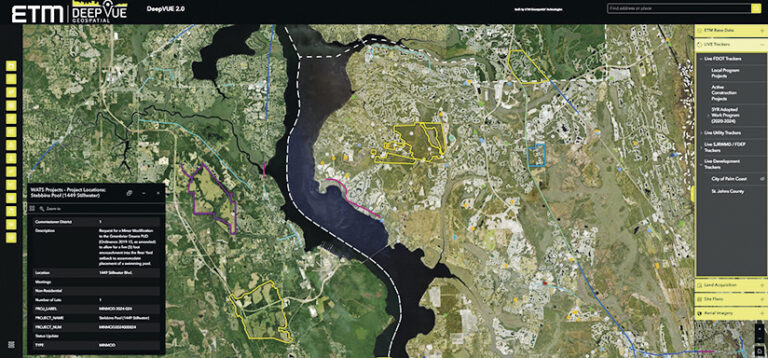
England-Thims & Miller, Inc. (ETM)—an AEC firm (and Esri partner) specializing in infrastructure development, engineering, planning, construction, and asset management—sought a reliable, secure, and scalable environment to support its growing suite of GIS-based client services. Leveraging the Esri Partner Network, ETM turned to fellow Esri partner ROK Technologies to modernize its GIS infrastructure. In doing so, ETM transformed its GIS department from a cost center into a revenue-generating business unit.
First, the team from ROK Technologies migrated and deployed ETM’s solutions to ArcGIS Enterprise. The team also implemented ArcGIS Monitor on Amazon Web Services (AWS), paving the way for ETM to focus on client-facing services and apps. This fully managed cloud-hosted environment ensures operational continuity and data security while offloading IT overhead and improving performance and availability.
Now, ETM’s GIS team can create highly customized geospatial analytics and asset management tools for clients, giving them more actionable insight and operational efficiency. For example, ETM developed DeepVUE Geospatial—which is built in ArcGIS Enterprise and integrates with OpenGov, a financial management solution for local governments—to provide users with customized geospatial analytics and asset management tools.
By migrating to the cloud and adopting ROK Technologies’ GIS managed services, ETM has shifted its focus from infrastructure management to solution development. As a result of this modernization effort, ETM’s GIS department has accelerated solution delivery and enhanced service offerings, allowing smarter decision-making both internally and for the firm’s clients.
This effort highlights ETM’s commitment to delivering the best possible solutions to its customers. And the company’s collaboration with ROK Technologies serves as an example of how GIS modernization can streamline business operations, encourage innovation, and drive profit generation.
Helping Families Make Informed School Enrollment Decisions
Plano Independent School District—one of the largest in the Dallas-Fort Worth, Texas, metro area—serves over 48,000 students across more than 70 campuses. When the district recently made significant changes to school boundaries, families inundated administrators with questions about where their children should be enrolled. The district didn’t have an easy way to match home addresses to school zones, leaving families frustrated during the critical annual enrollment period.
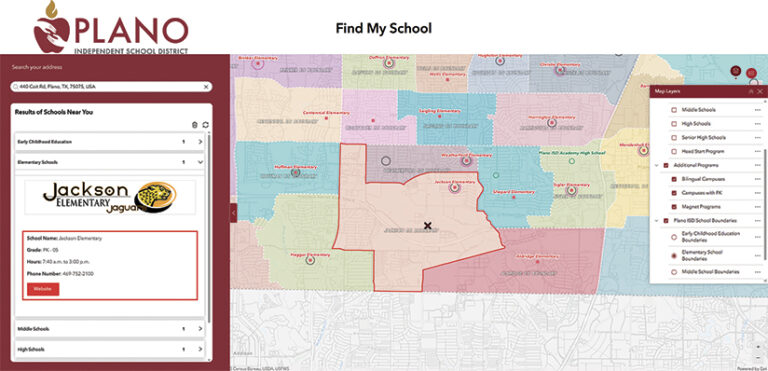
To address this challenge, Plano Independent School District partnered with Blue Raster to develop an intuitive, web-based school locator tool. The goal was to create a spatial solution that would streamline the enrollment experience and reduce the administrative burden on district staff. The solution needed to meet the needs of students, families, and district staff—and be quick, accessible, and flexible in the long term.
The Find My School app that Blue Raster developed allows families to view their children’s current school enrollment paths and how those could change if students enrolled in a magnet program or moved to another location within the district. Built using ArcGIS Experience Builder and ArcGIS Online, the app is available on desktop and mobile devices. It integrates the ArcGIS World Geocoding Service and a custom-configured Near Me widget to match home addresses with school assignments. Blue Raster’s design team created custom pop-ups that show each school’s name and its grade levels, along with its phone number, hours of operation, website link, and logo—all wrapped in a custom HTML color-coded box based on grade-level breakdowns. The solution also allows district staff to easily update boundaries and program offerings as they evolve.
Since its launch, the app has received over 25,000 views and averaged more than 200 visits per day. By centralizing school boundary information in a user-friendly format, Find My School has dramatically reduced frustration and empowered families to make informed decisions. The app also supports the district’s broader goals of providing equitable access and fostering student success. District staff plan to integrate Find My School with other student information systems to create a more seamless experience for students and families.