For nations in the Asia-Pacific region—including Japan, South Korea, China, Australia, New Zealand, Indonesia, the Philippines, and a host of small island developing states (SIDS)—there is little debate about the realities and dangers of rising sea levels, changing weather patterns, increasing temperatures, and other human-caused climate anomalies. In 2022, this area, which has been called the world’s most disaster-prone region, experienced a disproportionately high number of natural disasters, causing over 7,500 deaths and impacting 64 million people. Most of the debate surrounding these events focuses on how to make communities in the Asia-Pacific region more adaptable and resilient.
Climate resilience is a top priority for the Pacific SIDS, and island leaders are vocal about the international support their communities need. Regional organizations such as the Pacific Community (known by the acronym SPC) and the Secretariat of the Pacific Regional Environment Program (SPREP) foster collaboration among member nations on cross-sector scientific and technical projects focused on climate change mitigation and adaptation, disaster resilience, sustainable ocean management, sustainable tourism, and cultural preservation. Esri, its distributors, and some business partners are working with SPC and SPREP, helping members leverage geospatial technology more effectively as they prepare for and adapt to evolving climate realities.
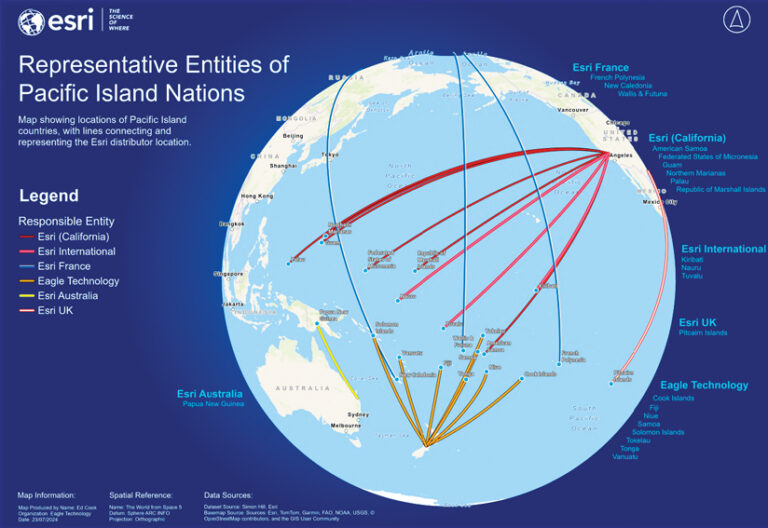
While all these nations experience the acute impacts of climate change, they vary in their commitments to adapting and building resilience. To help, Esri emphasizes the importance of spatial analysis and effective information sharing, implemented within an integrated geospatial infrastructure of hubs, dashboards, ArcGIS StoryMaps stories, and mobile apps. Geospatial apps for SIDS support a range of uses, from siting marine protected areas and deciding on optimal locations for offshore renewable energy infrastructure to promoting tourism with compelling maps and planning local resilience strategies. Esri often provides consulting services to governments of low- and middle-income SIDS to help them modernize official statistics for land administration, national mapping, and health information systems, as well as their national disaster response management efforts.
None of these issues can be tackled by governments alone; rather, they are matters that affect whole societies and require significant cooperation between the public and private sectors. Yes, governments should lead, but the private sector frequently offers the greatest innovation, funding, and motivation to make climate action a sustainable reality. Simon Hill, the leader of Esri’s national government and public safety team in the Asia-Pacific region, often talks about the powerful duality of people and processes that ultimately makes the difference: Strong leadership drives process change.
What’s happening in the Asia-Pacific region is a huge opportunity for spatial technology. People there need integrated geospatial infrastructure to connect disparate data so they can analyze it in context and make critical decisions. For island nations, it is now possible to integrate environmental data with demographic and census data, and map detailed aspects of everyday life, various ecosystems, and more. This is key to tackling the current challenges that SIDS face and seizing opportunities in the future.
To that end, Esri is deeply involved in the SDG Data Alliance, an open, community-driven, multi-stakeholder partnership led by Dr. Greg Scott of the PVBLIC Foundation that aims to bring GIS to developing nations around the world to help them achieve the 2030 Sustainable Development Goals, or SDGs. For SIDS in particular, the SDG Data Alliance has evolved into one of the world’s leading initiatives for creating open datasets, maps, and web apps—and, hence, brings opportunity, access, and equity to underserved communities. The SDG Data Alliance does this by supporting the creation of country-level geospatial action plans ensuring that geospatial information is developed, maintained, and accessible. These plans are supported by SDG Data Hubs, which enable governments and other organizations to report and monitor progress toward achieving the SDGs.
Since the inception of the SDG Data Alliance in 2021, Esri—as a founding partner—has provided grants of ArcGIS technology, suites of SDG-specific GIS solutions, and in-kind Esri Professional Services support to bolster the geospatial capacity of developing nations. All these efforts assist governments and other organizations in building their own tools to report progress on the SDGs, support national development priorities, and communicate the status of those priorities to key stakeholders and the international community.
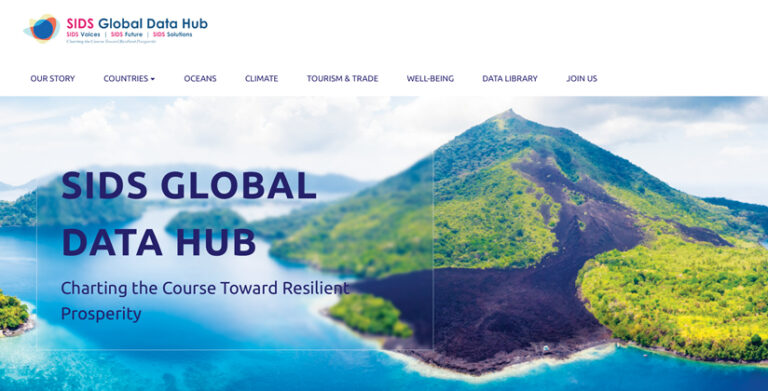
The SIDS Global Data Hub aids island nations in using geospatial technology to build a more resilient future. A major accomplishment for the SDG Data Alliance is the planned rollout of 10 country-level SDG Data Hubs for SIDS, including Fiji, Palau, Tonga, and Tuvalu, as well as Antigua and Barbuda and Grenada in the Caribbean, and the Maldives, Mauritius, and Seychelles in the Indian Ocean. This is thanks to the continued technical support of Esri, along with a renewed grant from the W.K. Kellogg Foundation. Scott has also led a concerted effort to add more partners to the SDG Data Alliance, resulting in a new partnership agreement with the SPC to support collective SIDS initiatives and a new agreement with Esri partner Fugro to support the needs of SIDS—initially in the Caribbean but eventually extending to Asia Pacific.
These are just a few of the many climate action developments that Esri is involved in with users and partners across the planet. At Esri, we remain in a mode of what I call “purposeful frenzy” as climate change continues to pose a critical challenge requiring immediate and effective action. I hope these developments will encourage and inspire you to participate in some of these programs or spread the word about them whenever and wherever possible, especially if you reside in or advocate for the Asia-Pacific region.