In the world of government technology, management often gets confused with leadership. We manage data, servers, licenses, and vendor contracts. But we don’t manage culture shifts or cross-departmental collaborative ecosystems. To do those things, we must lead a movement.
As the enterprise geospatial technologies administrator for Cuyahoga County, Ohio, my role isn’t solely to ensure that the servers are running; it is to foster a regional spatial data infrastructure (SDI) that serves more than 1.2 million people. And it is wrapped around an initiative called the North Coast GIDE (pronounced like “guide”)—the Geospatial Information and Data Exchange—a continuously expanding resource hub for Cuyahoga County.
Esri president Jack Dangermond talks about GIS as a planetary nervous system—a distributed infrastructure that connects isolated datasets. In Cuyahoga County, we are building the local nerves of that system. Our North Coast GIDE is establishing a community on a federated common operating platform that is informed by high-level standards from the Federal Geographic Data Committee (FGDC), the National Emergency Number Association (NENA), and robust data governance best practices.
Cuyahoga County has 59 different entities, each with its own politics, budget, and priorities. So how have we convinced these departments to opt in to this nervous system? By not dictating policy but, rather, building and sustaining a movement.
The “Lone Nut” and the First Follower
There is an oft-cited video in leadership circles that features a shirtless man dancing at a music festival. At first, viewers see one person dancing wildly on a hill. He looks ridiculous—like a “lone nut,” as the narrator, entrepreneur Derek Sivers, calls him. For a long time, the shirtless man is alone, and the crowd ignores him.
In the GIS world, most GIS practitioners have been that lone nut. We’ve stood in meetings, waving our arms and proselytizing the importance of topology rules, unique IDs, and schema standards. To the uninitiated—city managers, police chiefs, mayors—we might look like we are dancing wildly, alone on a hill.
But in the video, something happens. A second person starts dancing with the shirtless man, and the original dancer embraces this person as an equal. Crucially, the focus shifts from the leader to the follower. Sivers notes that the first follower is an underestimated form of leadership itself. The first follower is what transforms a “lone nut” into a leader. In the video, it doesn’t take long for dozens of other festivalgoers to join the two men in their wild dancing.
This aligns with Dangermond’s view of the modern GIS leader. He argues that today’s leaders must facilitate rather than control—and build an ecosystem in which partners can specialize and extend the work.
For the North Coast GIDE, success didn’t come from one person standing at a podium demanding compliance. It came from nurturing our first followers.
We identified the municipalities that were ready—the innovators that understood the vision of a federated platform—and we treated them as partners. We started a movement and then made it public, showing other municipalities that it wasn’t the county demanding that everyone move to an enterprise system; it was their neighbors building it up.
When leaders embrace their first followers, they make joining the movement look easy. They show that contributing to an enterprise platform isn’t a burden—it’s a party that no one wants to miss.
Crossing the Chasm: The Innovation Adoption Curve
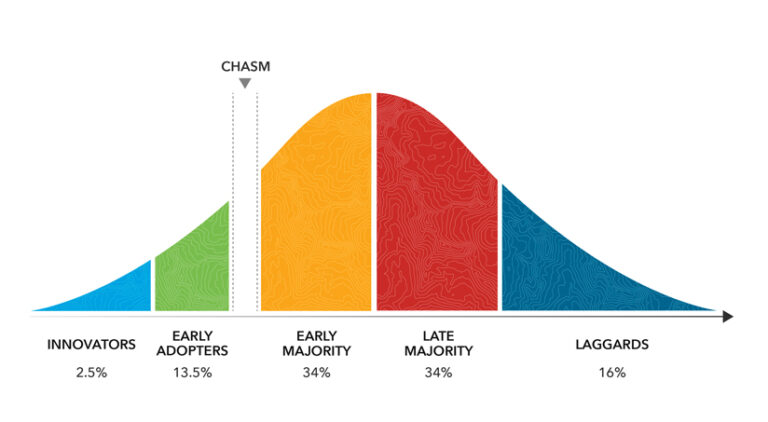
After the first followers come on board, how does scaling work? This is where the Innovation Adoption Curve, first introduced by Dr. Everette Rogers in 1962 and, more recently, popularized by leadership speaker Simon Sinek, comes in. The curve demonstrates that the mass market (68 percent of the total target audience) can’t be reached until the innovators (2.5 percent) and the early adopters (13.5 percent) are captured.
In Cuyahoga County, if I had tried to force the North Coast GIDE on the most resource-strapped, skeptical municipalities first, the project would have failed immediately. Members of the mass market are pragmatic; they want proof that a new system works. In GIS, they don’t care about the theory of FGDC metadata standards. They want to know if the address points will help ambulances get to emergencies faster.
So we focused our energy on the 2.5 percent of municipalities that are innovators. We worked with them to build a federated common operating platform that solved the problems they were encountering when preparing their authoritative data for the State of Ohio’s implementation of Next Generation 911 (NG911). We demonstrated that by aligning with NENA standards, we weren’t just checking boxes—we were saving lives by ensuring that emergency services have interoperable data.
With the early adopters, we validated the why—that we needed to do this to build a safer, more connected region. From there, the what—the technical specifics of the platform—became easier to sell to the majority.
We didn’t have to push the technology on the remaining municipalities. The tipping point occurred naturally. They saw the success of their peers and wanted in.
The Technology Is the Easy Part
While the Innovation Adoption Curve explains the macro strategy, the micro strategy is grounded in personal relationships. A federated system requires immense trust. Municipalities need to trust the county to steward their data responsibly, and the county needs to trust municipalities to maintain data fidelity.
The only way to build this trust is via personal, one-on-one, in-person communication. In an era of video calls and emails, showing up in someone’s office makes a statement. It says, “I value your partnership more than my convenience.”
This is where empowerment meets accountability. In Cuyahoga County, we empower our partners by giving them the tools they need—simple web apps, licenses, and cloud infrastructure—to manage their own geospatial destiny. But we also hold them accountable to uphold the standards we agree on.
Accountability is sometimes viewed negatively, as a form of control. But in a healthy culture, accountability is a form of respect. When I sit down with a municipal stakeholder and review their data governance workflow, I am telling them, “Your work matters too much for us to let data governance slide.” We nurture our followers by setting a high bar and then helping them reach it.
The GIS Leader’s Mandate
As we look to the future of the North Coast GIDE, we know things will change: the technology, the software, the standards. But our leadership principles will remain constant.
We’re willing to be the shirtless guy dancing on a hill—standing up for the vision of a connected, data-driven region, even when that feels lonely. We will always embrace our early followers and turn them into the true heroes of the story. We will also have the patience to build momentum with the willing rather than battling with the resistant.
Most importantly, we will remember that our regional SDI—our local slice of the planetary nervous system—is not built on fiber optics and servers. It is built on handshakes; shared visions; and the trust that’s established during quiet, one-on-one conversations.
By leading with empathy and governing with standards, we aren’t just making maps or managing systems. We’re building a community.