
While the world of AI is vast, the technology’s practical application in GIS becomes more accessible every day. For many professionals, the primary barriers to using AI are the challenge of gathering large amounts of training data and the extensive time required to train a model from scratch.
But what if you could bypass much of that effort? Tucked within ArcGIS Living Atlas of the World are more than 100 pretrained GeoAI models, ready to extract features and classify pixels from imagery and other geospatial data.
Intelligent Pattern Recognition Meets Spatial Analysis
At its core, GeoAI combines the spatial analysis capabilities of ArcGIS technology with the pattern-recognition power of AI. The pretrained models in ArcGIS Living Atlas exemplify this synergy, performing specific tasks such as detecting trees, extracting roads, and classifying land-cover features.
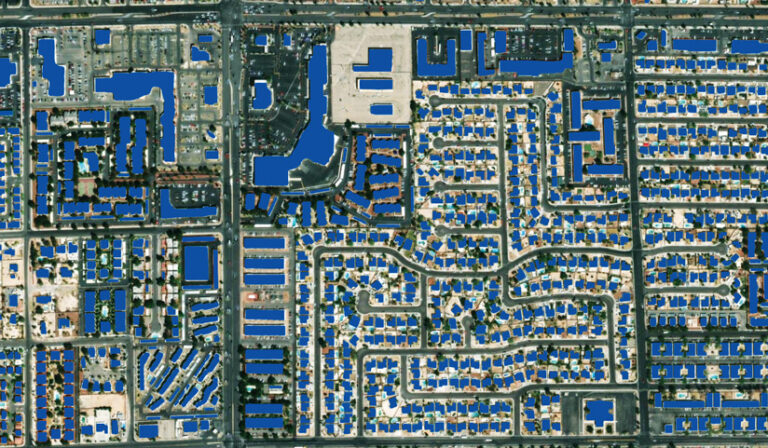
Consider the Building Footprint Extraction – USA model, which can identify structures in high-resolution satellite imagery, and the Road Extraction – North America model, which automatically digitizes transportation networks. Each model is built on established deep-learning architectures and documented with information about required inputs, training data, and expected performance.
Rapid Response in Critical Situations
In the high-stakes industries of public safety and insurance, timely and accurate information is a priority. After a hurricane or wildfire, a GIS user can run a pretrained Damage Assessment (Drone Imagery) model on aerial imagery recorded after the event to rapidly identify and classify damaged structures.
This automated process provides first responders with a clear operational picture, highlighting impassable roads and areas of greatest need. For insurance carriers, this same data accelerates the claims process, allowing policyholders to get financial disbursements more quickly and efficiently.
Infrastructure at Scale
Transportation departments can use pretrained models to automate road condition assessments by, for example, looking at drone imagery to identify cracks in the pavement. This data helps organizations prioritize repairs and plan long-term infrastructure investments. Similarly, utility companies use GeoAI to inspect extensive networks of poles, wires, and transformers.
Another critical use case involves vegetation management. Models can analyze aerial imagery or lidar data to identify trees and other vegetation, and utilities can employ additional spatial analysis techniques to verify if the plants are encroaching on power lines—a leading cause of outages.
Authoritative Data for Government
For national mapping agencies and state and local governments, maintaining authoritative and current geospatial data is a core function. Pretrained models can extract building footprints, road centerlines, and land-cover classes from high-resolution imagery, accelerating map production and updates.
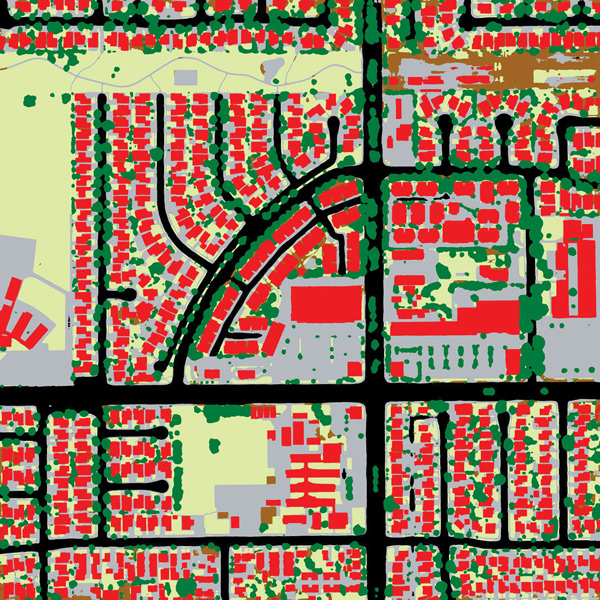
An accurate building footprint layer is essential for tax assessment, population estimates, and emergency response planning. High-resolution land-cover data, which can be generated using models such as the High Resolution Land Cover Classification – USA model, is critical for monitoring urban growth and identifying areas suitable for conservation or development.