When Typhoon Halong devastated western Alaska in October 2025, Faith Espinosa never left Anchorage. Working 16-hour days for weeks, the Alaska Department of Transportation and Public Facilities (Alaska DOT&PF) special projects coordinator helped build the operational maps, damage assessments, and field tools that guided the response. After so much time spent poring over high-resolution drone footage and 360-degree imagery capture of the 40 damaged villages, Espinosa felt like she’d been there.
“This is the worst day you could probably imagine,” she said of the damage to homes and villages that appeared on her screens each morning.
Growing up in Alaska, with plenty of friends from remote villages, the tragedy felt close to home, regardless of where Espinosa was. Her focus was on housing the now homeless, dealing with the logistics of repairing homes, and getting community members back on their feet before winter set in.
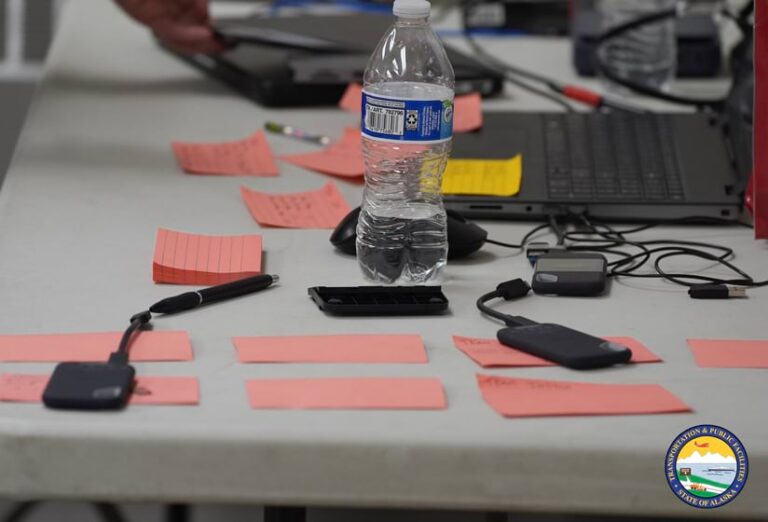
In the aftermath of the typhoon, Espinosa’s days started at 6:00 a.m. and most ended at 10:00 p.m. Every morning, a hard drive arrived via GoldStreak, Alaska Airlines’ cargo service. Espinosa and her team members would pull the drone footage off the drive, make a static copy, and run the files through a georeferencing script before uploading everything to the mapping platform.
What came off those drives was immersive. Field staff captured ground-level walk-throughs with 360-degree cameras and rode four-wheelers up and down board roads. Drone footage traced every roofline and foundation. An image comparison tool let anyone slide between pre- and poststorm imagery—buildings present on one side, gone on the other. In Kipnuk, houses had rotated, vanished from between neighbors, or drifted miles inland in the surge. With winter coming fast, staff knew they had to act.
Espinosa reviewed all of it. She used a large language model to generate building polygons and assign them house numbers to give each structure an identifier. These communities often don’t have street addresses—a house is known by the family inside it. That polygon was the foundation for every assessment and repair record that followed. Few people who had actually walked those board roads knew the structures as well as Espinosa did.
Go Bag
Many Alaska DOT&PF staff members, including Espinosa, relocated to Anchorage to better coordinate emergency response. When the call came, she had a go bag already packed. Construction work had made her comfortable jumping into the unknown. She was used to ever-changing field conditions.
“I’m pretty small, pretty lightweight,” she said. “It’s easy to throw me on a charter plane because they’re not really worried about my weight.”
This time she was Anchorage bound, working out of a command center that was set up in real time, living out of a hotel room, and facing a response unlike anything the department had run before.
Barge operators had already pulled their boats for the season. Construction crews had moved on to their winter work sites. There was no ready way to move goods or people into roadless communities, and the window for doing anything before freeze-up was measured in weeks.
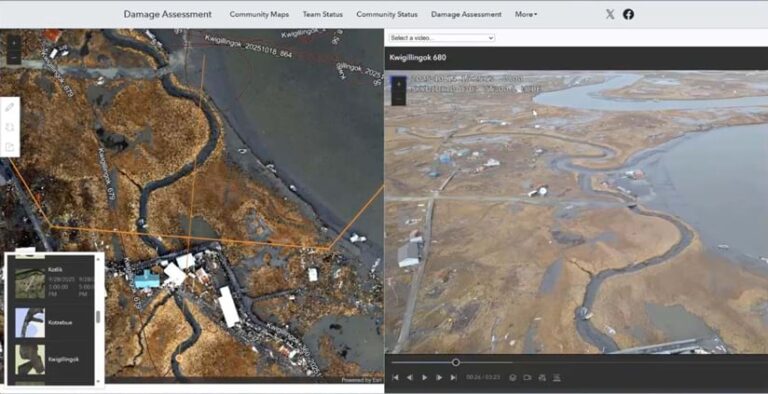
Recovery funds don’t flow without proof of damage, and proof required data that only existed if someone could get there to capture it. Hard drives took roughly 24 hours to travel from the field to Anchorage. Espinosa processed them in three to six more. Within that 30-hour window, raw footage was processed and uploaded into damage assessment tools. The ability to view drone footage for impacted communities made the case to decision-makers thousands of miles away in Washington, DC. The federal disaster declaration was approved on October 22, and money began to move.
With funding unlocked, the next problem was getting supplies in. Planes threaded short gravel runways in low visibility. Cargo flights dropped building materials directly into villages. Every flight and every GoldStreak run was part of the same improvised chain: Capture the conditions, document the need, gather supplies, deliver goods, and bring workers to put everything back.
“How Long Do I Have?”
More than 1,500 residents, most of them Indigenous Alaskans, had been evacuated from their villages with nothing but a backpack and the clothes on their back. For people whose lives are organized around seasons—when to fish, when to hunt, when to store food, when to gather—the displacement went deeper than losing a home. It was losing a way of being.
The responders working alongside Espinosa understood this in a way that outsiders couldn’t. Many had friends and family in these communities, and knew what it meant to be cut off from the land and the rhythms that make a place home. It was the reason nobody watched the clock.
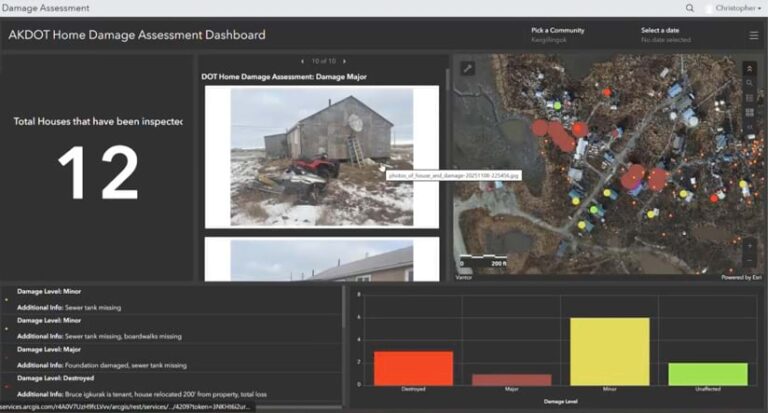
The goal was to get them home. Espinosa and her team built the tools people used to report damage, managed access permissions for some 300 users across state and federal agencies, trained field staff in 10-minute bursts on software they’d never touched before, and fixed bugs in real time as teams called in from villages. When designers needed a new tool in an hour, they built it. When contractors replaced field staff and needed something simpler, she rebuilt it. “It wasn’t a no,” she said. “It was, well, how long do I have?”
As conditions worsened, the tools had to keep up. Rain, snow, wind, and the particular misery of a touchscreen in near-freezing temperatures with wet gloves meant field teams were missing data fields because their fingers wouldn’t cooperate. Espinosa enabled voice input. “Just hit the little microphone and talk straight to your phone,” she told them. Grammar didn’t matter. Completeness did.
A large language model that was trained on federal damage criteria and western Alaskan building practices generated notes on damage to the structures to ensure that no damage went undocumented.
The model also had to learn what wasn’t damage. Outside assessors flagged peeling paint and worn siding. In rural Alaska, that’s normal. Paint can run $70 a gallon at minimum. Houses sit on stilts with insulation underneath; in a flood, that insulation becomes a waterlogged block of ice that won’t drain or dry in below-freezing temperatures. What you’d fix with a tarp in Georgia is lasting damage in Alaska.
“Don’t worry if you break it,” Espinosa told field staff who were new to the tools. “It’s probably something I can fix. Let’s move forward.”
Becoming the Map
Ask Espinosa about the villages of western Alaska and she can describe them in operational detail. She knows which houses were upturned in Quinhagak, where the boardwalks had washed out in Kipnuk, and which structures had foundation damage and which ones have since been repaired. As repair photos come in, she recognizes the structures. “They fixed the foundation on that house,” she’ll think, comparing the current image to what she first saw in those early hard drives.
That kind of awareness didn’t exist before the event. Through months of drone footage, GoPro 360 walkthroughs, and repair documentation, she built something closer to a lived understanding of places most Alaskans have never seen. What it means when the landscape that people have known their entire lives is suddenly unrecognizable. Structures gone, board roads washed out, the physical markers of a community erased. For the families still waiting in Anchorage hotels, home had become a place they could no longer picture.
She has never been to any of these places. But after months inside the data, Espinosa became the map, a conduit for what changed, what was lost, and what still needs doing. The engineers, contractors, federal assessors, and emergency planners who depend on that picture to act are better equipped because of the detail Espinosa’s GIS tools can provide.
“I’m starting to understand how much more information one could want,” she said. If another storm comes—and in western Alaska, another storm will come—she has a go bag. She knows what to pack.
“It didn’t matter where you put me,” she said. “I would willingly be there again.”