When a utility technician needs to locate an underground valve buried beneath snow and vegetation, or when a construction inspector must verify that a newly installed water line matches design specifications within a few centimeters, basic GPS accuracy isn’t enough. Today’s GIS professionals need positioning precision that ranges from submeter- to centimeter-level accuracy. Understanding the correction methods that deliver this precision—and knowing which method fits your project requirements—can mean the difference between efficient operations and costly mistakes.
What Is GNSS?
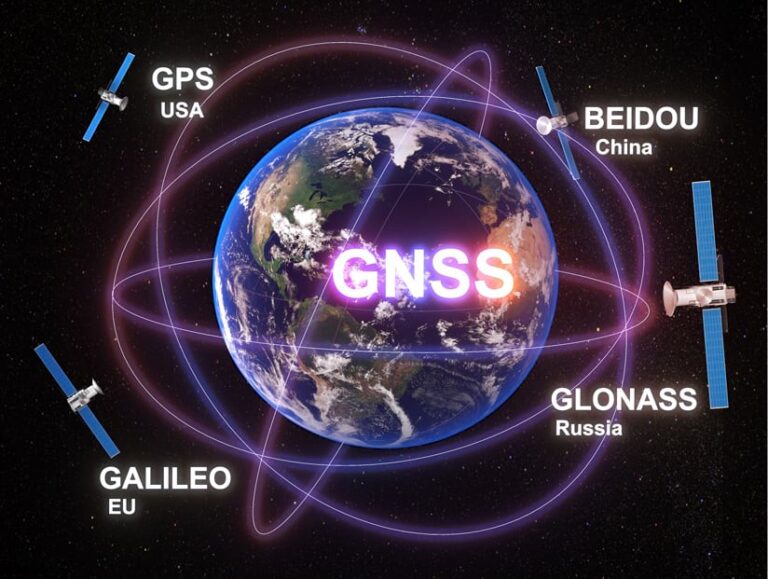
GPS has become the common technology for determining outdoor location using smartphones or specialized receivers. However, GPS is just one component of a broader positioning infrastructure, the Global Navigation Satellite System (GNSS). Many countries and regions now operate their own satellite navigation systems, including GLONASS (Russia), Galileo (European Union), BeiDou (China), QZSS (Japan), and NavIC (India).
The original GPS constellation, established in 1973 by the US Department of Defense, maintains about 31 active GNSS satellites out of the more than 100 operational satellites that orbit the Earth. In California, a multiconstellation GNSS receiver typically tracks more than 25 satellites simultaneously—a dramatic increase from the early days when users had to carefully plan collection windows to ensure adequate satellite visibility.
Why More Satellites Matter for GIS

To calculate a three-dimensional position, a GNSS receiver must track signals from at least four satellites. More satellites provide several advantages for GIS data collection, including the following:
- Improved availability in difficult environments. Urban canyons and dense forests that once blocked GPS signals now allow positioning, thanks to multiple GNSS constellations providing alternative satellite coverage.
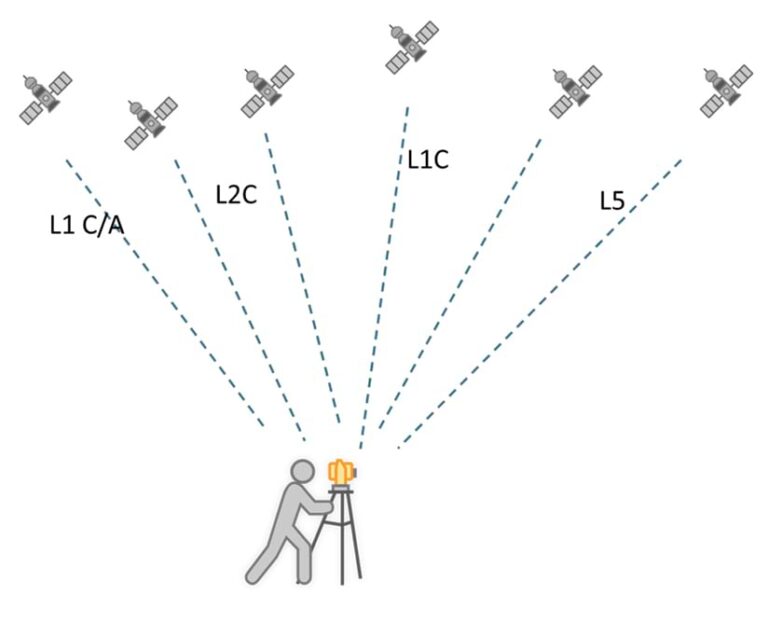
- Enhanced accuracy via multifrequency signals. Modern GNSS satellites transmit multiple radio frequency signals. For example, GPS now broadcasts L1 C/A, L1C, L2C, and L5 signals for civilian use, expanding from the original single L1 C/A signal. These multifrequency signals help receivers reduce ionospheric delay, which is the largest error source for stand-alone GNSS positioning.
- Better reliability for field operations. Field crews no longer need to schedule data collection around satellite availability, improving operational flexibility.
What High-Accuracy GNSS Can Do for GIS
Stand-alone GNSS typically provides two- to five-meter accuracy in open areas, but performance degrades in challenging environments with tree canopy, buildings, or other obstructions. For many GIS applications, this level of accuracy proves insufficient.
Consider these field scenarios where higher precision (submeter- to centimeter-level) matters:
- Utility location and maintenance—Precise positioning is required to efficiently locate underground assets hidden by snow, soil, grass, or vegetation. Higher accuracy helps technicians avoid delays, reduce excavation costs, and prevent damage during digging operations.
- Construction verification—Inspectors need centimeter-level accuracy to confirm that installed infrastructure matches design specifications. An out-of-tolerance installation that goes undetected due to poor GNSS accuracy can trigger project delays or expensive rework.
- Asset differentiation in dense areas—Where multiple trees, valves, signs, or utility points cluster together, precise positioning becomes essential for distinguishing between similar assets and maintaining accurate records.
What’s the Differential?
Differential correction techniques improve GNSS accuracy by calculating and removing systematic errors. The underlying principle has been the same for decades. Two receivers located relatively close together experience similar atmospheric and satellite errors. By calculating these errors at a precisely known location and applying corrections to a roving receiver, differential methods achieve higher accuracy.
However, today’s correction methods differ from methods of the past when it comes to implementation, coverage area, accuracy level, and cost structure. Understanding these differences helps you select the appropriate method for your projects.
RTK Positioning
Real-time kinematic (RTK) positioning remains the most popular correction method for achieving centimeter-level accuracy. It requires at least two GNSS receivers: a base station at a precisely known location and a rover collecting field data. The base station calculates errors by comparing its computed position against its known location, then transmits corrections to the rover.
RTK accuracy depends heavily on the baseline, which is the distance between base and rover. Manufacturers express baseline accuracy in parts per million (ppm). One ppm equals one millimeter of error per kilometer of distance. For example, a receiver with 8 mm + 1 ppm horizontal accuracy starts with 8 mm base accuracy, but at 30 km from the base station, accuracy decreases to 3.8 cm. As accuracy degrades with distance, initialization time also increases.
Network RTK (NRTK) and real-time network (RTN) technology use multiple base stations to cover wider regions, overcoming single-base RTK distance limitations. Virtual reference station (VRS) systems create a virtual base station near the user’s location by computing corrections from multiple reference stations.
Most GIS users rely on existing base station infrastructure rather than deploying their own stations. Options include permanent company-owned stations and third-party services from government agencies or commercial providers. In the United States, some state departments of transportation provide free statewide RTK services.
Understanding RTK Data Standards
Standardization plays a critical role in RTK operations. The Radio Technical Commission for Maritime Services (RTCM) Special Committee (SC) 104 standardizes RTK correction data protocols. In 2023, RTCM SC 134 standardized narrow-band ultra-high frequency radio data links, improving on earlier proprietary manufacturer protocols.
For internet-based corrections, Networked Transport of RTCM via Internet Protocol (NTRIP) serves as the widely adopted standard. Finding an RTK correction source means identifying an NTRIP caster—a server that broadcasts correction data. Each caster offers multiple mount points, which are unique identifiers for specific correction data streams.
Mount point selection matters because it determines which satellite constellations your rover can use. For example, Esri’s base station (a Trimble NetR9 receiver) in Redlands, California, provides three mount points: gisar23 (GPS only), gisar30 (GPS plus GLONASS), and gisaMSM5 (multiconstellation GNSS). Selecting gisar23 limits the RTK solution to GPS satellites, even if the rover supports additional constellations.
Satellite-Based Augmentation System
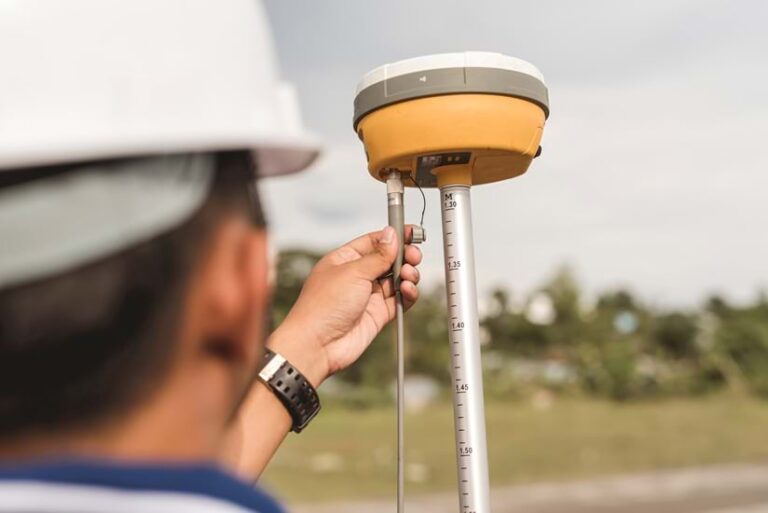
A satellite-based augmentation system (SBAS) provides free submeter-level accuracy in many global regions and commonly comes built into professional GNSS receivers. Government agencies operate SBASs, which collect corrections from multiple reference stations, relay data to a main station, and uplink corrections to geostationary satellites. Your GNSS rover receives corrections directly from these satellites. SBAS coverage regions include the following:
- Wide Area Augmentation System (WAAS)—North America
- European Geostationary Navigation Overlay Service (EGNOS)—Europe
- BeiDou Satellite-Based Augmentation System (BDSBAS)—China
- Multi-functional Satellite Augmentation System (MSAS)—Japan
- GPS Aided Geo Augmented Navigation (GAGAN)—India
- System for Differential Corrections and Monitoring (SDCM)—Russia
- Southern Positioning Augmentation Network (SouthPAN)—Australia and New Zealand
Each system covers a wide area—sometimes an entire continent. And because SBAS delivers corrections via satellite, it works in areas lacking cellular or internet connectivity.
Precise Point Positioning
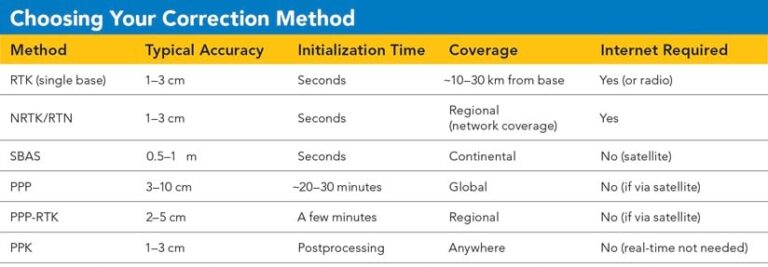
While differential methods compute differences between base and rover measurements, precise point positioning (PPP) takes a different approach. It models error-causing factors and estimates corrections from a global network of reference stations. PPP offers several advantages: global coverage, no baseline distance limitations, and better accuracy than SBAS. It typically achieves 3- to 10-cm accuracy after an initialization period of about 20 minutes.
PPP-RTK represents the latest evolution in correction methods, combining PPP and RTK techniques to reduce initialization time while maintaining near-RTK accuracy. It uses reference station networks to compute satellite and regional atmospheric errors, then broadcasts correction data. Unlike standard PPP, PPP-RTK provides regional rather than global coverage.
Both PPP and PPP-RTK can broadcast via internet or satellite. Satellite signal delivery makes these methods valuable for accurate positioning in areas without internet access. Beyond commercial PPP services, some governments provide free services including Japan’s Centimeter Level Augmentation Service from Quasi-Zenith Satellite System (QZSS) satellites and Galileo’s High-Accuracy Service (HAS). These services cover specific regions with varying accuracy and initialization performance.
Postprocessing Methods
All these methods provide real-time corrections, eliminating office processing work. However, some applications benefit from postprocessing approaches. For example, the Post Processed Kinematic (PPK) data processing technique commonly supports drone mapping operations. It records raw GNSS data during flight, then processes it after completion using measurements from a nearby base station with a known location. In remote areas or complex environments where signal loss might occur, PPK can improve the yield of accurate positions during missions.
Matching Methods to Your Project Needs
Determining your approach starts by defining your accuracy requirements. If submeter accuracy suffices, SBAS is a cost-effective solution that’s often free and built into professional GNSS receivers. When projects demand centimeter-level precision, RTK or PPP methods may be a better choice. Also consider these factors:
- Available coverage and baseline distance
- Data delivery options (internet versus satellite)
- Service ownership and infrastructure costs
- Initialization time requirements
- Need for real-time positioning versus postprocessing
Selecting the right correction method balances accuracy needs, budget, and operational constraints. Carefully evaluating project requirements alongside available infrastructure and service options can help ensure reliable positioning performance while optimizing efficiency and cost.
Expanded GNSS constellation and modern correction techniques have transformed field data collection capabilities for GIS professionals. Understanding these correction methods, as well as their specific strengths and limitations, can empower users to capture the high-accuracy spatial data that their projects demand.