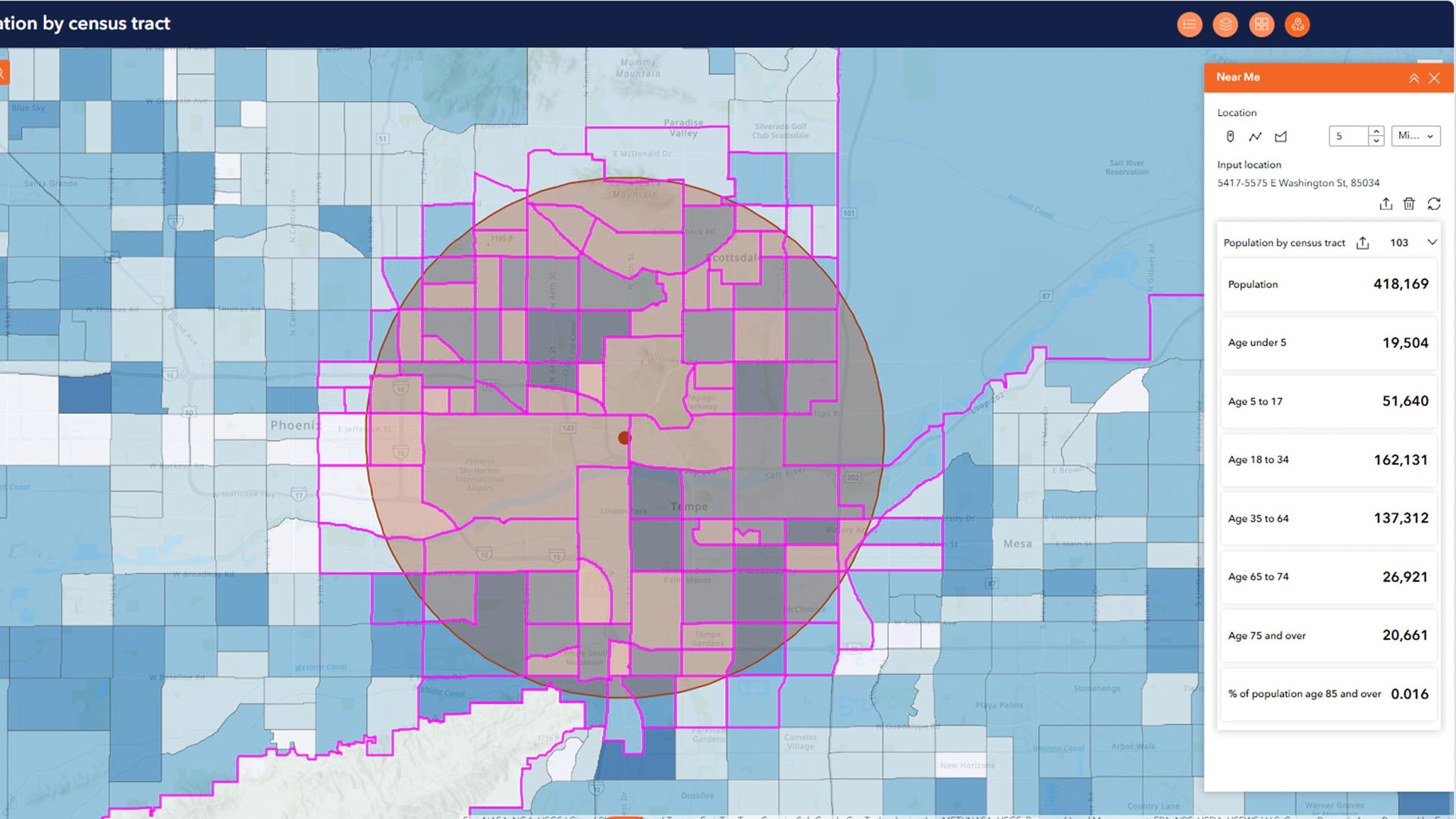
Cartographers rely on many design principles when compiling maps and constructing page layouts, whether on-screen or on paper. Five of these design principles form a system for seeing and understanding the relative importance of the content in the map and on the page. Without these primary principles, map-based communication is bound to fail.
Legibility and visual contrast provide the basis for seeing the contents within the map. Figure-ground organization and visual hierarchy lead the map reader to determine the importance of things and ultimately find patterns. And proportion lends aesthetic appeal to the map and its layout.
These five principles are essential in cartography. It’s worth noting that they are not applied in isolation but act complementarily. Together, they help cartographers create maps that successfully communicate geographic information.
1. Legibility
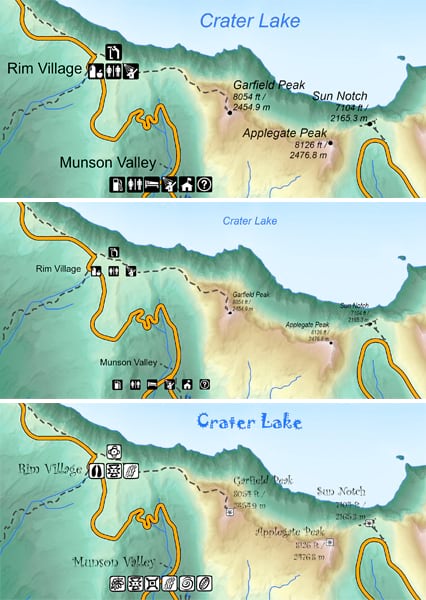
Legibility is the ability to be seen and understood. The size and complexity of text and symbols affect legibility. This becomes an even greater issue if the background is also complex. Readers effortlessly see and understand symbols that are appropriately sized and familiar. Geometric symbols are easier to read at smaller sizes, but their ambiguity often requires clarification in a legend. More complex symbols and text require more space to be legible.
2. Visual Contrast
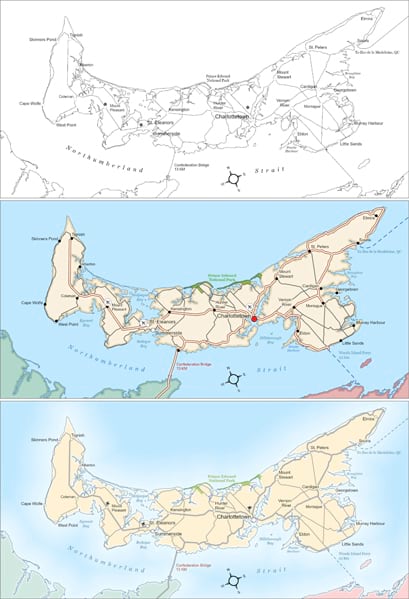
Visual contrast relates to how map features and page elements contrast with each other and their background. To understand this principle at work, consider your inability to see well in a dark environment. Because not much reflected light reaches your eyes, there is little visual contrast between the objects in your field of vision, and you can’t easily distinguish one object from one another or from its surroundings. Increase the illumination and you’re better able to distinguish between features and their background.
The concept of visual contrast also applies in cartography. Good visual contrast can result in a crisp, clean, clear-looking map. Visual contrast helps emphasize differences, highlight important features, and improve readability. It can be achieved by varying symbol and text sizes and using contrasting colors. The higher the contrast between features, the more some features will stand out (usually those that are bigger, darker, or brighter). Conversely, low visual contrast can be used to promote a more subtle impression, and lower contrast maps can be used as basemaps on which thematic operational layers can be overlaid.
3. Figure-Ground Organization
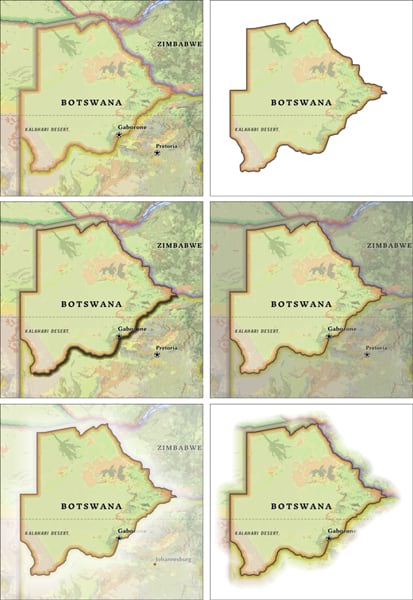
Figure-ground organization is the spontaneous separation of the primary area of interest in the foreground (the figure) from an amorphous background. Cartographers use this design principle to help readers focus on a specific area of the map. There are many ways to promote figure-ground organization, such as showing the map as a closed form that only includes the figure, or using the techniques illustrated with this map of Botswana (left). Some of the techniques can be used together, as well as other techniques that allow you to highlight your area of interest.
4. Visual Hierarchy
Visual hierarchy is the internal graphic organization or structure of the content in a map. Visual hierarchy helps cartographers communicate the relative importance of mapped features through a visual impression that prioritizes or orders the categories of features. This visual layering of information is fundamental to a reader’s ability to understand a map. Correctly applied, visual hierarchy reflects an appropriate intellectual order by graphically emphasizing the most important map features and de-emphasizing those that are less important.
The hierarchical organization for reference maps (those that show the location of a variety of physical and cultural features, such as terrain, roads, boundaries, and settlements) works differently than for thematic maps (those that concentrate on the distribution of a single attribute or the relationship among a few related attributes).
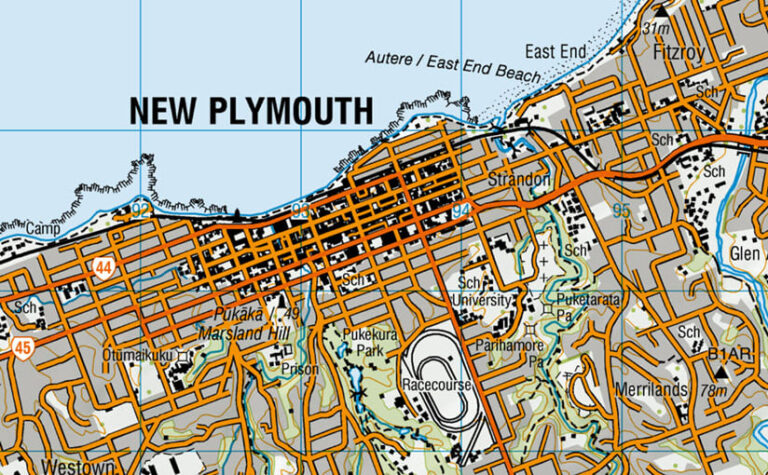
For reference maps, subtle differences order the layers. Often, the order depends on the way layers occur geographically, with physiography on the bottom, followed by hydrography, vegetation, and human-made features, then boundaries and administrative features on top. For thematic maps, reference layers recede to the background, allowing the thematic layer to ascend to a higher visual plane. Labels on the highest visual plane to ensure legibility.
5. Proportion
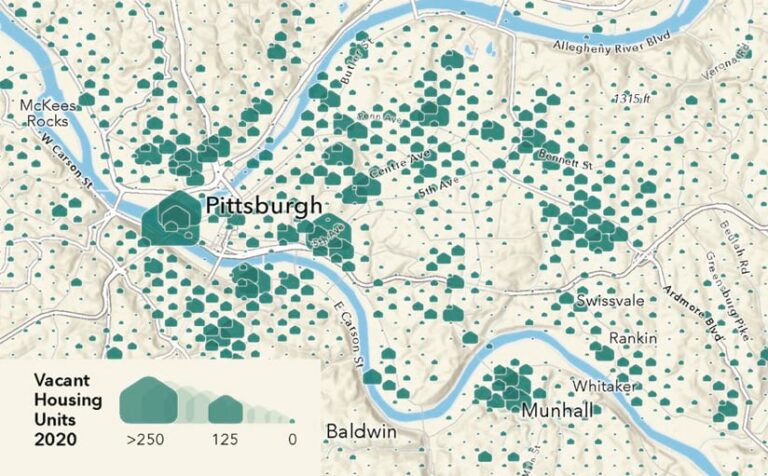
Proportion helps the map and its elements come together as a cohesive whole to form an aesthetically pleasing visualization. Proportion is the relationship between one element and another in the map and on the layout. Design concepts that relate to proportion include symmetry, balance, and harmony.
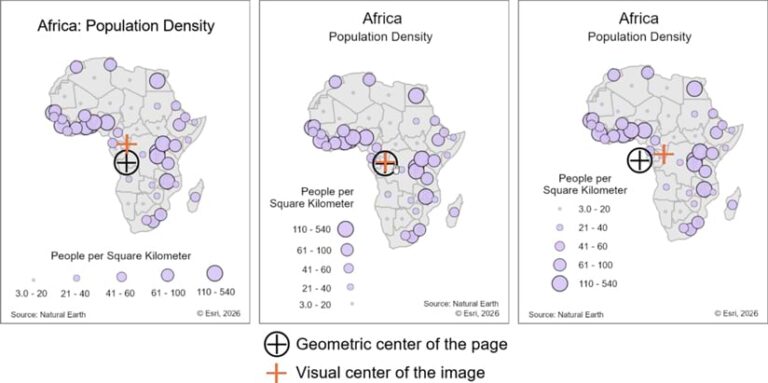
Balance is the distribution of visual weight within a map or on a layout. The impression of visual balance is controlled by the size, visual weight, and location of the contents in the map and the elements on the layout. Visual balance can be promoted by placing the map figure in the visual center of the layout, which is a point just above the geometric center. This is the point on which the eye first focuses, and it serves as the fulcrum, or balancing point, for the layout. The visual center of the whole image shifts as changes are made to the elements on the layout.
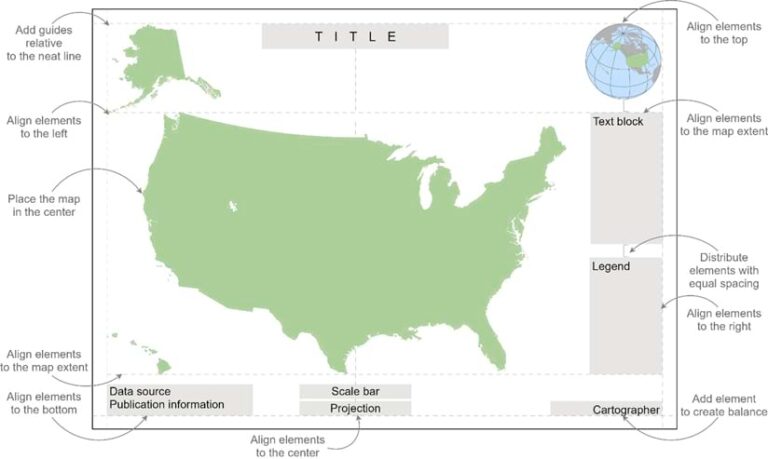
When a layout has harmony, the map and its elements have a cohesive arrangement and present a meaningful whole. Harmony can be promoted through alignment and distribution. Alignment positions elements relative to each other (left, center, right, top, bottom). Distribution spaces elements evenly between each other. Both can be employed with objects within elements, such as the parts of a legend, or with a set of related elements—for example, the locator map, text block, and legend in the layout of the map of the US above.