Everybody starts somewhere. Maybe you have a degree in GIS or are in the process of getting one. Maybe you stumbled into GIS and learned it on the job. Maybe you got your start taking Esri web courses, poring over ArcGIS documentation, or asking questions on Esri Community. Lots of vibrant resources exist to get people started in the geospatial technology industry, and many of them continue to prove useful throughout the career of a GIS professional. You’re always learning new workflows and tricks to simplify tasks and improve outcomes.
These workflows are important, but so is a framework: a way of looking at how any given task or piece of software fits into the broader scope of what you do. Often, our best work comes when we think in frameworks—when we plan not just where to start but also where we want to end up and how to get there.
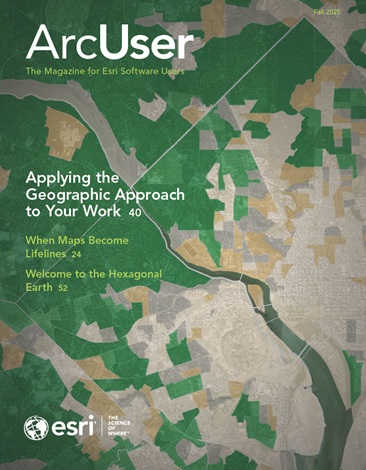
The fall 2025 issue of ArcUser is brimming with frameworks designed to help improve your work. Take the cover story, “Applying the Geographic Approach.” This article starts with a concept familiar to many readers of ArcUser (the Geographic Approach) and lays it out, step by step, as a coherent, consistent methodology. Using a framework like this can help you understand what exactly you’re trying to achieve, and the steps necessary to achieve it.
The article “Welcome to the Hexagonal Earth” considers this framework idea more literally. Spatial tessellation, as the article notes, is not a new concept for GIS professionals. Nor, at this point, is the H3 hexagon. But this hexagonal framework is being used in increasingly creative and useful ways that can inspire the work that you do. Similarly, “Rethink Your Strategy for the AI Era” asks GIS professionals to more deeply consider the role of generative AI in their work, or at least the role they will need to occupy as generative AI continues to produce seismic shifts in the world of GIS.
This issue is also filled with stories of GIS professionals leveraging these frameworks to better their communities. Consider the nonprofit organization Trout Unlimited, which uses ArcGIS tools to reconnect stream networks that support vital ecosystems. Or the City of St. Louis, where digital twins are helping revitalize economically underserved areas. Or the YMCA, which uses ArcGIS Business Analyst to tailor its programming to the needs of individual member communities.
GIS allows us to make sense of relationships between places and how decisions made in one location affect another. But the work you do with it needs a map, too, so that you can understand not only where you want to end up but also the best way to get there.