The ArcGIS API for Python released version 2.4.4 on September 21, 2026. The newest ArcGIS Python API version presents a release centered on making complex content-management workflows more complete, faster, resilient, and easier to use.
- Updates to the arcgis.ai module
- The Rust Geometry Library
- Expanded dependency analysis with reverse-dependency discovery
- Offline Cloning Work
- ArcGIS Video Server administration and automation
- StoryMaps content-management enhancements
You can read the full release notes here, which include a detailed list of bug fixes.
AI Capabilities
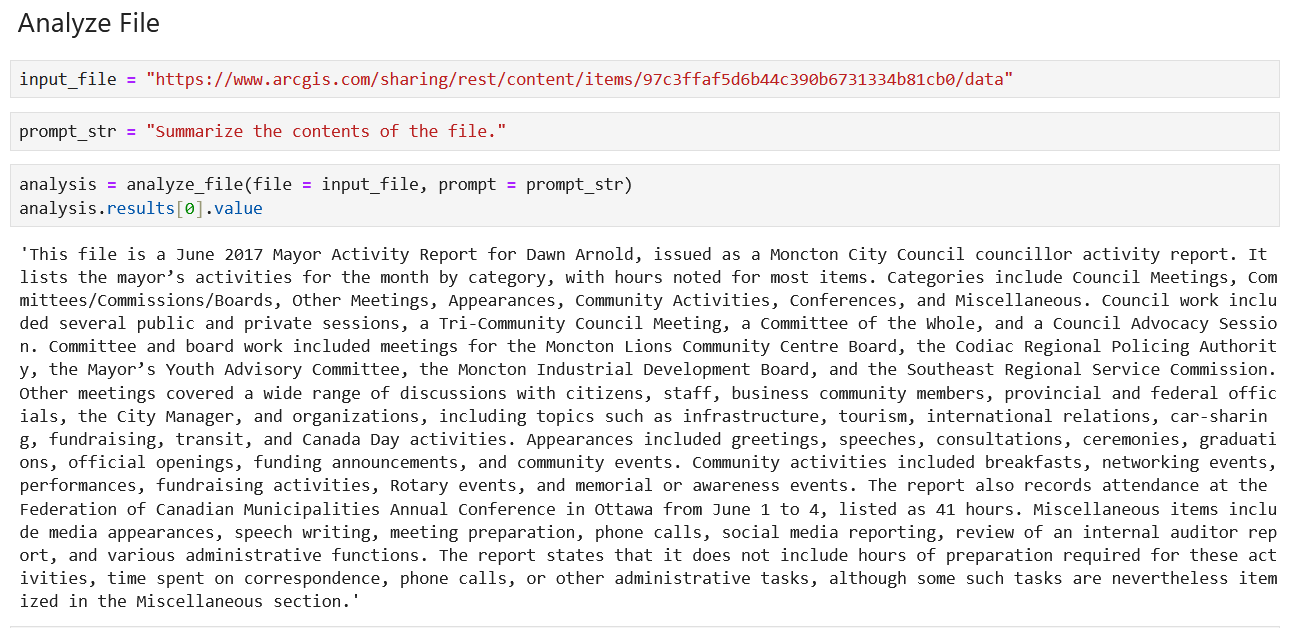
The arcgis.ai module of the API now comes with support for newer services that allow for analyzing files and documents, extracting text from images, transcribing audio files, and generating speech from text. These tools are currently offered via Beta release in ArcGIS Online. Also, for users of ArcGIS Enterprise, v12.2 of ArcGIS Enterprise will support these AI capabilities and can be used with the ArcGIS API for Python after the Enterprise release. Previously released AI services for analyzing images, analyzing text and for translation are now offered under General Availability in both ArcGIS Online and the soon-to-release ArcGIS Enterprise v12.2.
Rust Geometry Library
A platform-independent Python package for geometry representations and operations, powered by high-performance Rust core libraries has been developed. The arcgis_geometry package delivers a unified, faster geometry API across the ArcGIS ecosystem. The goal is to accelerate analysis of complex geometries, improve memory safety and stability, strengthen cross-platform integration, and create a consistent developer experience supported by first-class documentation.
Knowledge Graph sync support becomes a major differentiator
The release adds replica and synchronization operations for Knowledge Graphs, as well as a dedicated class for working with replica data, making the Python API the only customer-endorsed client for these capabilities. This is a substantial expansion rather than an incremental enhancement—it introduces a broad set of new classes and functions and establishes the API as the primary supported automation path for replicating and synchronizing graph content. Graph query results can also be returned as dataframes, reducing the work required to analyze results in standard Python data-science workflows.
Dependency analysis is broader, faster, and more actionable
ItemGraph now treats referenced service URLs as first-class dependencies. When an application is analyzed, its services are validated and included in the resulting dependency graph, providing a more accurate representation of how items, applications, and services are connected. Support for additional ArcGIS Online system relationship types also enables reverse-dependency discovery comparable to the ArcGIS Online interface—for example, starting with a feature layer and identifying every map or application that uses it. These enhancements are powered by asynchronous processing, delivering faster analysis and improved scalability.
Offline cloning is now more comprehensive and fault tolerant
OfflineContentManager has been broadened through a general fallback approach that supports approximately 98% of item types, significantly reducing failures caused by unsupported item-type restrictions. Optional asynchronous processing is now enabled by default, addressing another prominent performance complaint and making larger cloning operations substantially faster.

ArcGIS Video Server
The ArcGIS API for Python now comes with support for ArcGIS Video Server, as an administration and automation interface in Python. arcgis.video allows you to manage the services, machines, logs, data, server-wide resources, security resources for your ArcGIS Video Server configuration and implement available operations on them as an administrator.
Enhancements to StoryMaps
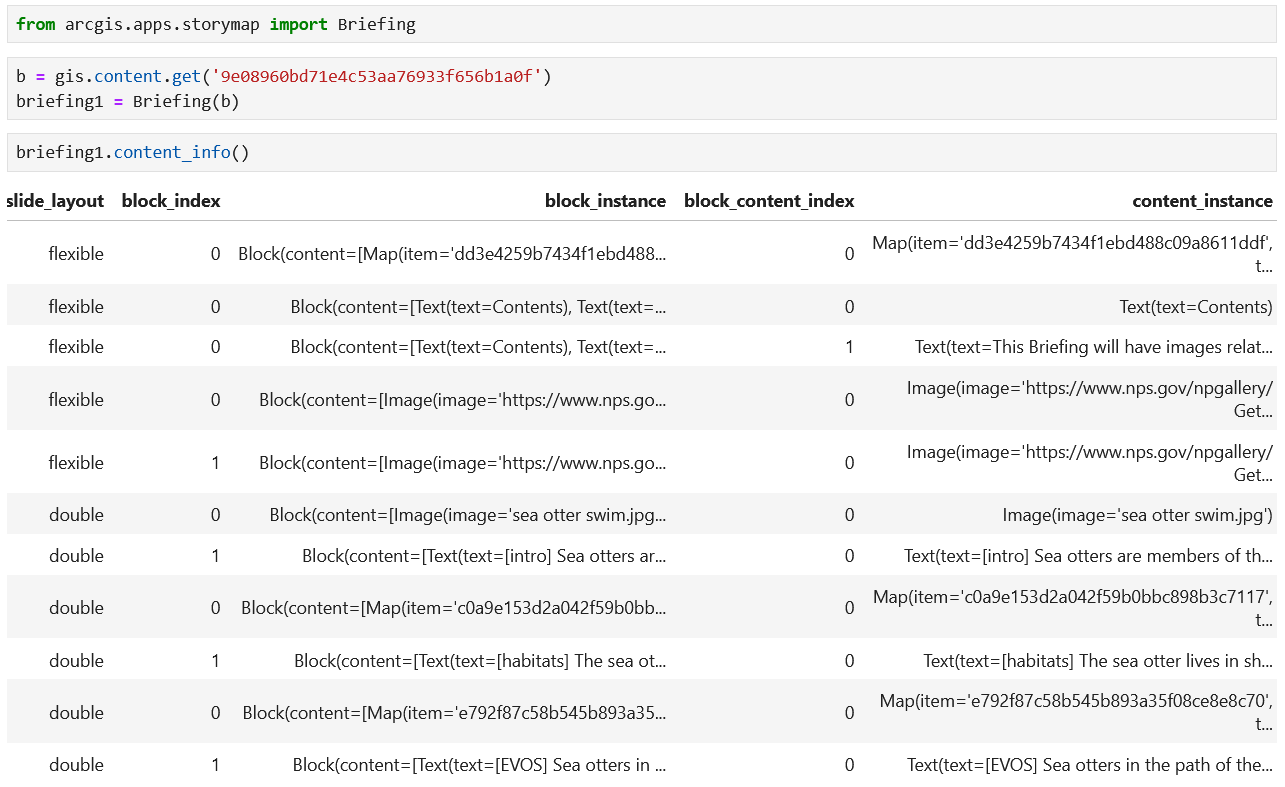
The apps.storymaps subodule of the API now allows for the easy visualization of complex contents of various StoryMaps objects in a clear, tabular representation using dataframes with the content_info() method. This feature is supported for objects such as StoryMap, Sidecar, MapTour, Timeline and Briefing, with an additional enhancement to also update thumbnails for items within a Collection. In this release, working with the credits and attribution section of a StoryMap has also been streamlined by the introduction of a Credits class. These minimalistic changes can significantly enhance usability and the process of creating and updating StoryMaps objects.
Key takeaways
- Version 2.4.4 expands the API’s reach and performance, pairing a new high-performance, cross-platform Rust geometry foundation with broader automation across content, analysis, and administration workflows.
- Knowledge Graph and dependency workflows receive major upgrades, including replica and synchronization support, dataframe-ready query results, service URL validation, and richer reverse-dependency discovery.
- Content migration is faster and more resilient, with offline cloning support for an expanded number of item types and asynchronous processing enabled by default for larger operations.
- New AI and Video Server capabilities broaden automation opportunities, supporting document and image text extraction, audio transcription, text-to-speech with the new beta AI tools, and Python-based administration of ArcGIS Video Server.
- StoryMaps authoring is easier to inspect and maintain, with dataframe-based content summaries, thumbnail updates for Collection items, and streamlined credits and attribution management.
Conclusion
There are excellent resources available for getting help with the API and sharing your feedback. You can use the ArcGIS API for Python Esri Community page to ask specific questions, suggest ideas for enhancements and improvements, connect with other users, and read recent blogs. You can also use the ArcGIS API for Python public GitHub repo to submit bugs, enhancement requests, and other issues. The team actively monitors these pages and greatly appreciates your feedback and suggestions, which guide our priorities for future API development. We encourage you to share your thoughts.


Article Discussion: