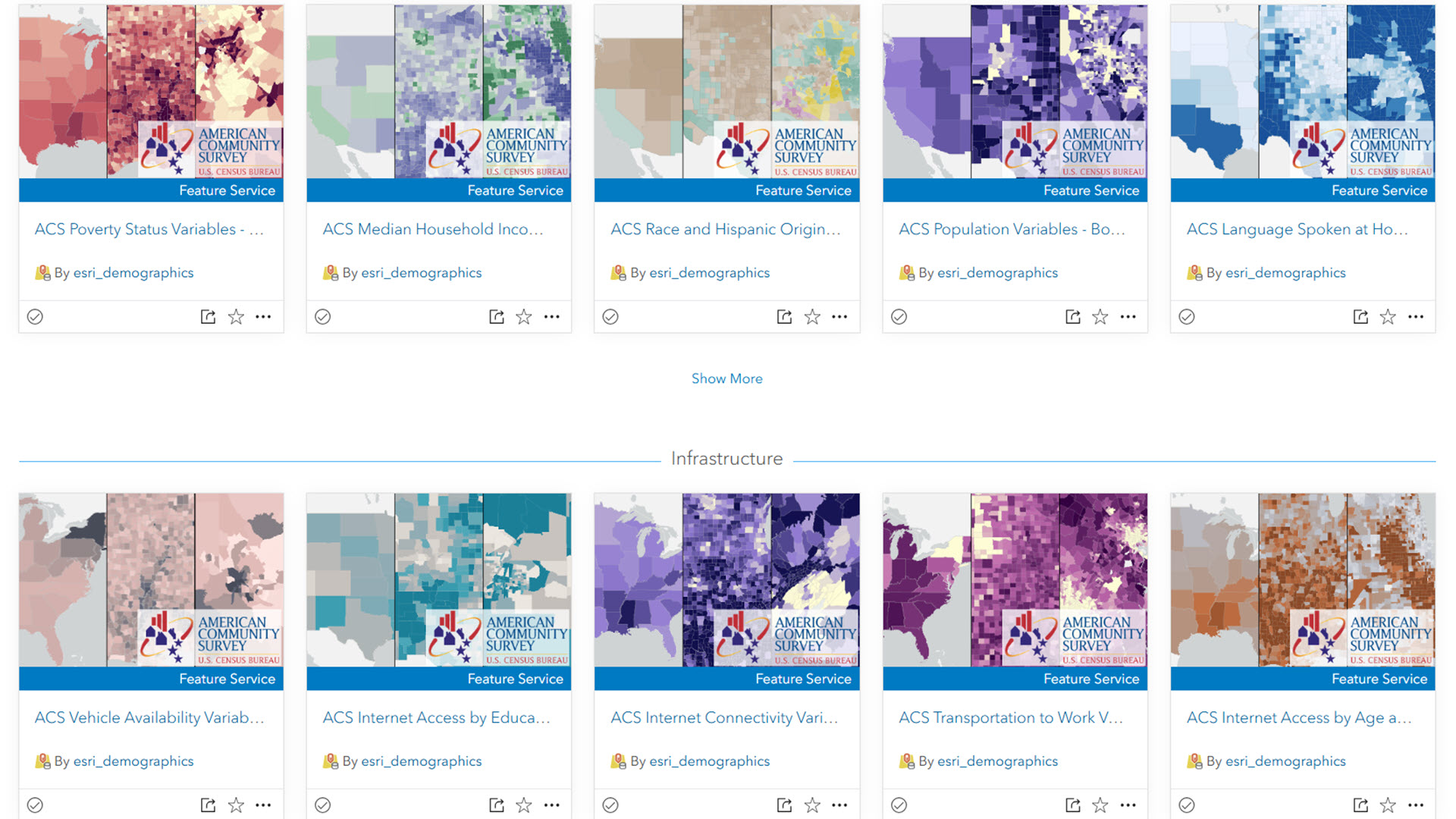
Since 2018, the ArcGIS Living Atlas Policy Mapping team has provided the GIS community a collection of free layers that contain a multitude of data from the U.S. Census Bureau’s American Community Survey (ACS). These ready-to-use layers enable GIS analysts to explore, map, and analyze many demographic, social, economic, and housing topics. The multi-scale layers have data for state, county, and tract levels. Within days of Census’ data release, the Policy Mapping team updates the set of ACS layers already available in Living Atlas with the newest data. Any maps and apps that already use these layers automatically update to reflect the most recent Census ACS data values.
The Census ACS enables local officials, businesses, and researchers to understand what is taking place in their communities and helps community programs allocate resources. Access to the latest American Community Survey (ACS) data is crucial. Numerous non-profits rely on it for grant applications, operations, and decision-making. A wide range of users, including regional planners, program administrators, entrepreneurs, and large companies use this data to look for new locations to establish their businesses, which can lead to more local jobs. Free access to these layers in ArcGIS Living Atlas significantly reduces the time GIS users spend on downloading and processing data.
We want to hear from you!
Over the years, we have added additional offerings and enhancements based on customer requests. For example, we added income-to-poverty ratio tables on to our poverty layers, as well as the vintage in the pop-up for all layers.
As we go into this year’s release, we want to be more proactive in hearing your input. We’ve launched a survey to give you the opportunity to provide us with feedback on your experiences with these layers.
How are you using the ACS layers in Living Atlas? How did you find out about them? What improvements or enhancements are you interested in? More vintages? More topics?
Take the feedback survey and make your voice heard.

Article Discussion: