As climate change continues to worsen, rising temperatures lead to increased heat stress. This poses a risk to human health and may have significant social and economic consequences. A crucial metric to evaluate heat stress and its impact on human health is the wet bulb globe temperature (WBGT). This comprehensive heat stress metric considers not just temperature, but also humidity, wind, cloud cover, and solar radiation, providing a more accurate representation of the heat stress that individuals experience.
To effectively evaluate the risks and impacts of heat stress, having accurate and reliable projections is essential. However, projecting WBGT far into the future presents challenges. Fortunately, researchers at Purdue University have developed a new methodology that uses various climate models and scenarios to calculate WBGT projections. The research team has contributed their WBGT projections dataset to the Living Atlas, where it is now available to all!
Why Wet Bulb Globe Temperature?
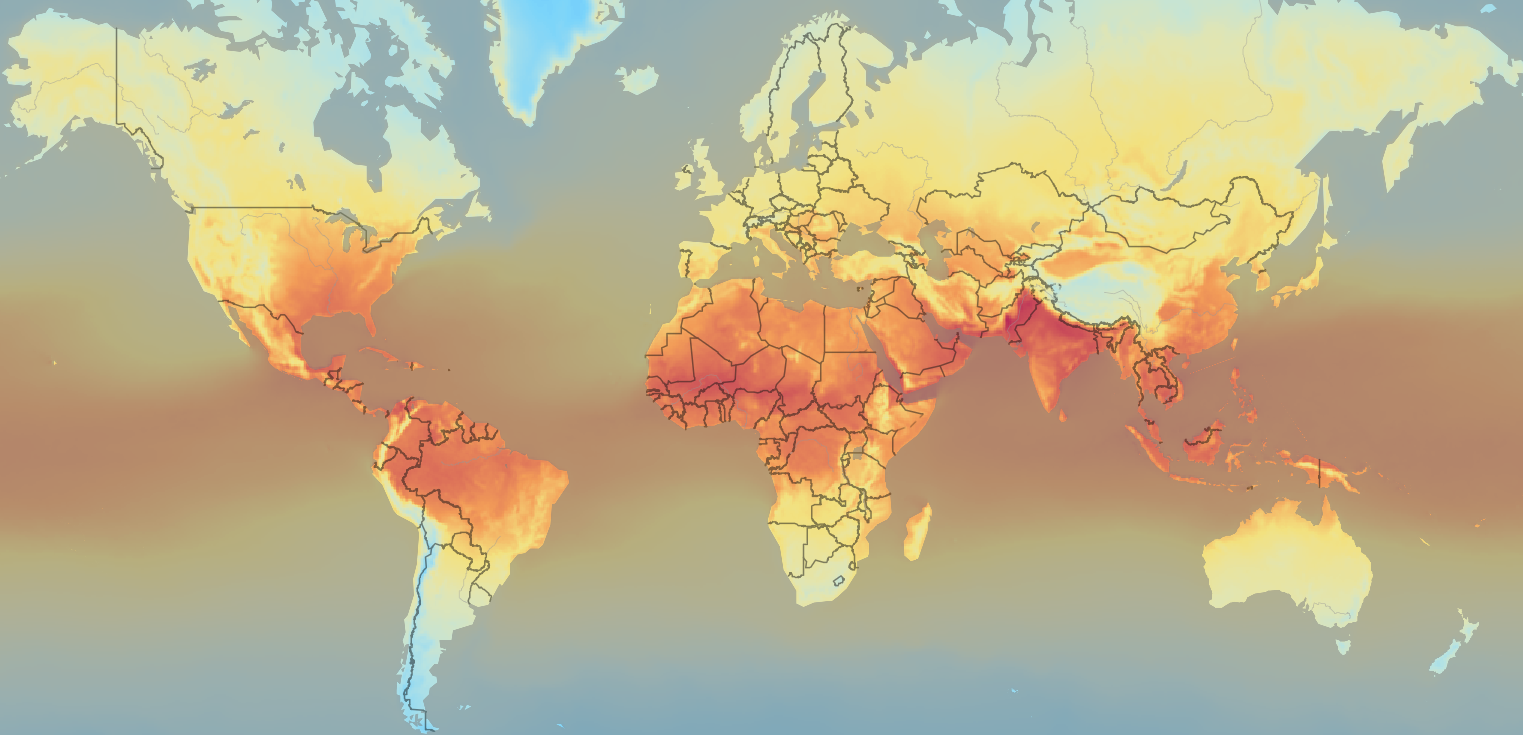
The WBGT is often used to analyze outdoor heat stress levels, such as for occupational safety, sports, and events. A classic air temperature (as you are most familiar with) of 25 °C (77 °F) in an arid and sunny region (like the Sonoran Desert) will feel somewhat warm to most people, but not prohibitively hot. The same temperature in a tropical and humid region (like southern India) can feel much more intense and can make outdoor activities more exhausting and dangerous. The WBGT aims to represent more uniform heat stress levels across the globe by accounting for additional environmental factors besides air temperature. Because of the dry air, 25 °C in the Sonoran Desert may be equivalent to a WBGT of 22 °C (71.6 °F), while it may be equivalent to a WBGT of 30 °C (86 °F) in southeast Asia where humidity levels are much higher.
While there are no set criteria and guidelines for WBGT and related risks and impacts, the National Weather Service has collected several resources with recommendations for different WBGT ranges.
Using the Wet Bulb Globe Temperature Projections
This layer is developed to support analysis and visualization of how heat stress levels and their impacts may change under different global warming levels (GWLs). The GWLs represent how local conditions may be affected by average global increases in temperature compared to the pre-industrial era. For example, an increase in average global temperature of 2 °C may not seem much, but it can manifest as well over 10 °C for certain areas, for instance in the Arctic. Select your GWL of choice to visualize the associated regional temperature variations and to learn how future conditions may impact human health and safety.
The multidimensional layer includes projections for daily minimum, maximum, and mean WBGT across the globe for four GWLs: 1.5 °C, 2 °C, 3 °C, and 4 °C. For each GWL, you can select your preferred day of the year for a more detailed analysis. For reference, the global mean temperature in 2024 was 1.46 °C higher than during the pre-industrial era.
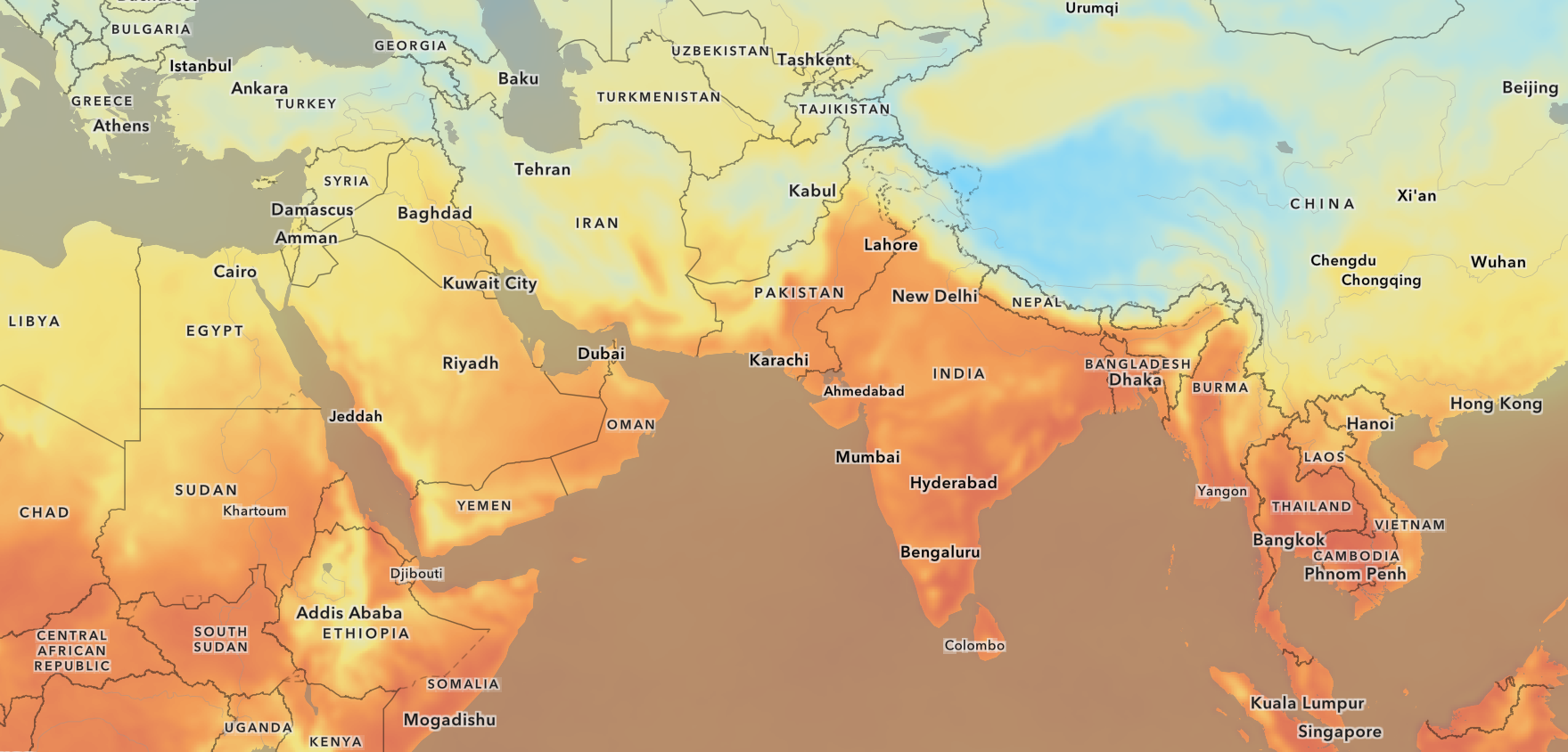
The new WBGT projections are crucial for planning and preparing for the impacts of climate change, helping communities and organizations to develop resilience strategies and mitigate health risks. For more info on WBGT and how it is calculated, refer to the NWS and this Nature Scientific Data article from Purdue University describing the data and methods used for this layer.
More Information
Join the Esri Community of experts and get inspired by others or get answers to your questions.

Article Discussion: