Discovering the Geospatial World
The world of GIS first became known to me when I was in a spatial data science course while earning my undergraduate degree towards Data Science at UC San Diego. I began with using ArcGIS Online APIs, and then moved forward to ArcGIS Pro, for which I had to prepare scripts in advance in order to get everything tested during the 1-hour session on the school’s virtual machine. That limitation didn’t hold me back—if anything, it drove me deeper. As I pored over documentation, each page revealed new dimensions of the geospatial world, unfolding its vast potential before me. So when I came across Esri’s internship openings at a career fair, it felt like recognizing an old friend I had never met. Two months later, I interviewed with the company, and received an offer after earning my Master’s degree in Analytics. That moment wasn’t simply about an offer—it was the gateway to a summer where long-held aspirations would finally take shape.
Summer Internship Projects
For my 12-week internship from May to August of 2025, I completed two projects using ArcGIS Pro and Python scripts with Arcpy. The main project of my internship was titled Optimizing Locations of Vertical Farms with Suitability Modeling. The idea was to answer a pressing question for the future of urban food systems: where should vertical farms, an modern kind of agricultural facility that takes up the entire buildings in cities, be placed to maximize their impact? Drawing on data about cropland availability, population distribution, housing affordability, and transportation infrastructure, I created a model that could identify both national-scale patterns and neighborhood-level opportunities. The final suitability map(Figure 1.) not only highlighted metropolitan regions where vertical farms could thrive but also revealed specific urban areas where they could address food insecurity—such as sites in New York City that aligned closely with the city’s Food Supply Gap report. The project revealed me how GIS can bring together diverse datasets to create insights that are practical, targeted, and relevant to real-world needs.
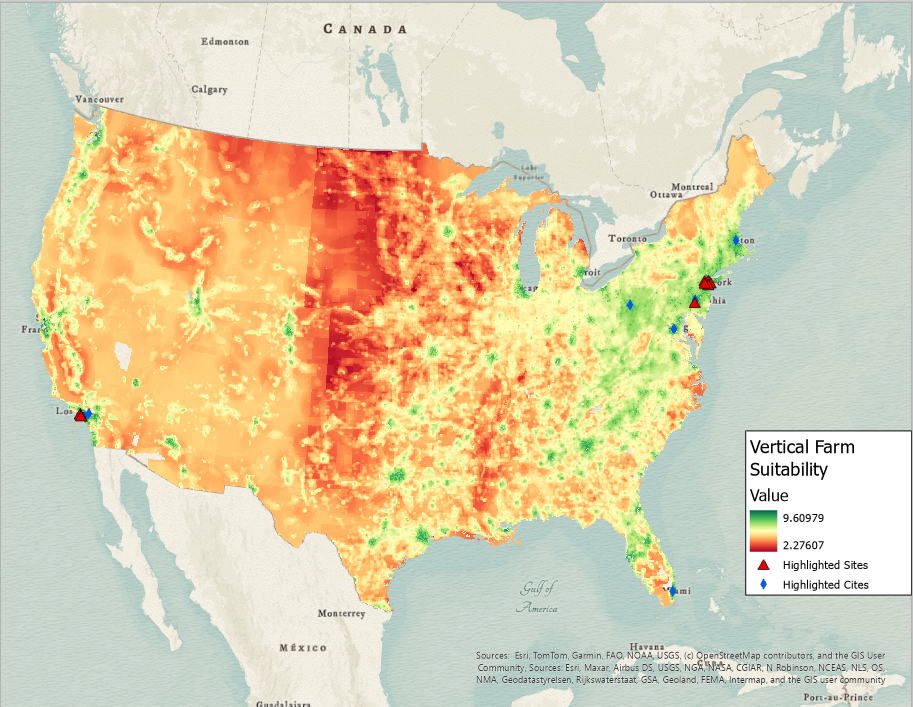
As part of the project deliverables, I chose to present my suitability analysis using ArcGIS StoryMaps, a powerful ArcGIS Online application for combining interactive maps with narrative text and visuals. You can access the full report through the link or directly at the window below. Use the top navigation bar to jump directly to each submodel, or freely browse the embedded interactive maps to examine areas of interest across the nation.
Vertical Farm Suitability Report
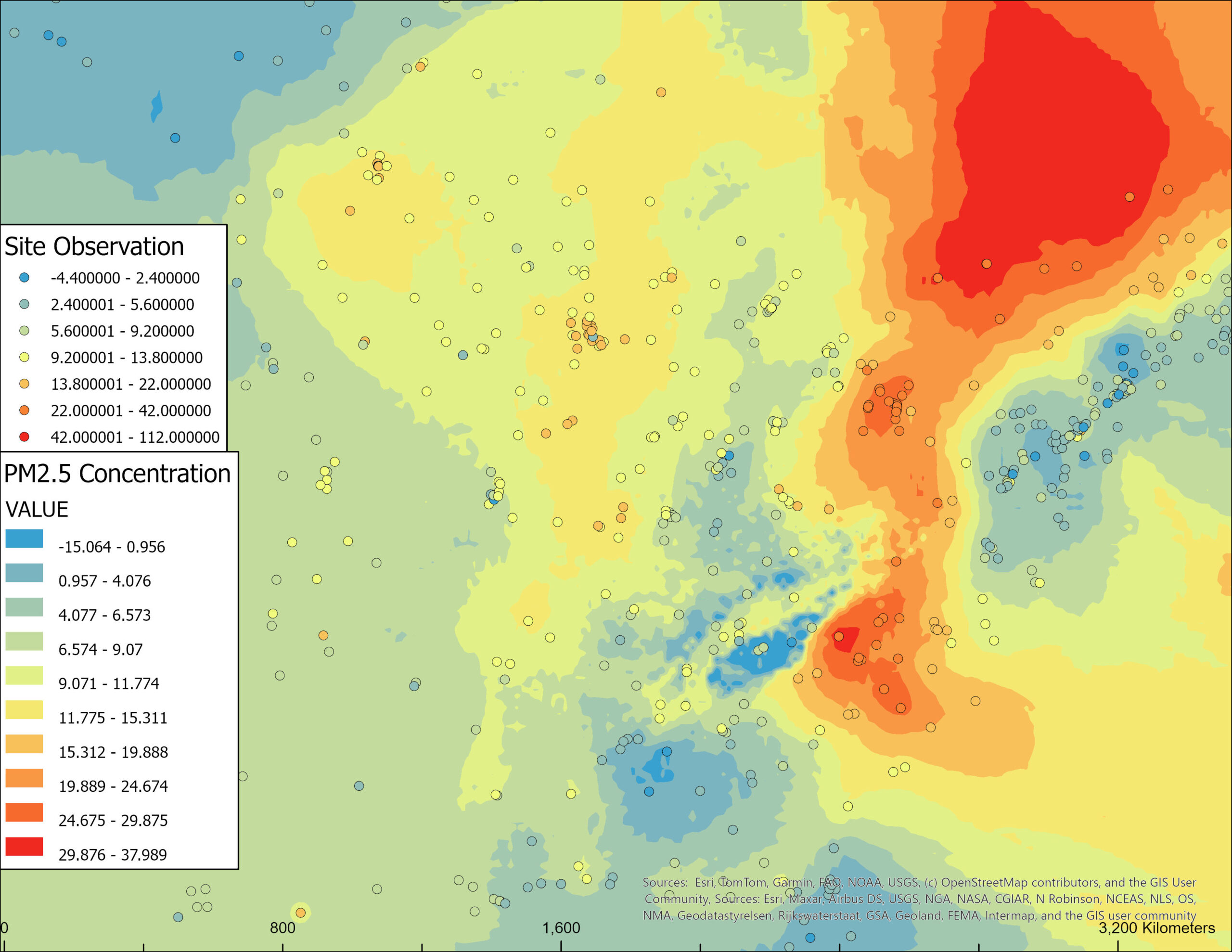
For my second project, I worked on Air Quality Interpolation with Geographically Neural Network Weighted Regression (GNNWR). The aim of the project is to demonstrate how neural-network-based methods can enhance geographically weighted regression to model air quality more accurately. Using environmental variables such as temperature, wind, and vegetation indices, along with air quality monitoring data, I developed workflows to integrate site-observational data with raster layers, process predictors, and run the models for prediction and interpolation of the PM 2.5 particle concentration(Fig 2.).
One of the biggest takeaways from this internship was learning how to work with large, complex datasets efficiently. Vertical farm suitability modeling required processing and integrating high-resolution population grids, agricultural data, and transportation layers—datasets that were not only large in but also different in structure, resolution, and source. Managing these dataset, preparing them for analysis, and ensuring that processing workflows could handle the scale of computation taught me techniques that will be valuable in any future data-intensive projects.
Equally important was the realization that developing GIS tools goes far beyond writing functional scripts. It means cultivating a coherent and precise methodology that holds up across multidisciplinary contexts—whether the subject matter is agriculture, transportation, environmental science, or urban planning. I learned to think not just about whether the code is functional but also whether the analytical design is robust, well-structured, and aligned with the needs of the end user.
Taking GIS Beyond the Desk
The internship wasn’t all heads-down analysis. I took part in Esri’s Hackathon, working with other interns to brainstorm, design, and prototype a GIS solution in just two days. The rush of moving from idea to implementation with a new team reminded me how much creativity thrives under a little time pressure.
I also had the chance to attend the Esri User Conference at San Diego. Walking through the sessions and showcases, I was struck by the breadth of applications for GIS technology—from conservation and public health to logistics and infrastructure—and by the shared sense of purpose in using spatial analysis to address global challenges.
Reflections and Looking Ahead
This summer gave me more than just new skills, it expanded my perspective on the role of GIS in solving complex problems. Through the vertical farming and air quality projects, I saw how spatial analysis can integrate data from vastly different domains into a unified framework for decision-making. From the hackathon and user conference, I experienced the energy and creativity of the broader GIS community. And through the daily work with my team, I came to appreciate the importance of precision, clarity, and collaboration in professional geospatial analysis.
As I look ahead, I’m excited to carry forward what I’ve learned: how to approach big challenges with structured thinking, how to manage and analyze complex data effectively, and how to design GIS workflows that are not just functional, but meaningful. This internship marked a step forward not only in my technical abilities, but in how I see myself contributing to the community of geospatial technologies.
References
Du, Z., Wang, Z., Wu, S., Zhang, F., & Liu, R. (2020). Geographically neural network weighted regression for the accurate estimation of spatial non-stationarity. International Journal of Geographical Information Science, 34(7), 1353-1377.
Yin, Z., Ding, J., Liu, Y., Wang, R., Wang, Y., Chen, Y., Qi, J., Wu, S., and Du, Z. (2024). GNNWR: an open-source package of spatiotemporal intelligent regression methods for modeling spatial and temporal nonstationarity. Geoscientific Model Development, 17 (22), 8455–8468.

Article Discussion: