ArcGIS Solutions helps you make the most of your GIS by providing purpose-driven, industry-specific configurations of ArcGIS.
Homelessness is a human tragedy that affects every community, from small towns to major metropolises. Programs and funding exist to help combat homelessness, but it can be difficult for local governments to quantify how many people are experiencing homelessness.
To ensure that funding is directed where it is needed the most, the U.S. Department of Housing and Urban Development (HUD) requires communities to conduct regular point-in-time (PIT) counts—surveys that capture a snapshot of the number of people experiencing homelessness on a single night. Although these counts do not reflect the dynamic nature of homelessness, they help communities assess shelter and outreach capacity needs. However, many communities rely on time-consuming, paper-based processes and lack real-time visibility into how the count is progressing.
ArcGIS Solutions created the Homelessness Point-in-Time Count solution to streamline the PIT count process. The solution integrates location intelligence to help local agencies better understand and address homelessness, enabling them to visualize homelessness hotspots, manage volunteers, allocate resources, and share required reports with HUD. For many organizations, the Homelessness Point-in-Time Count solution has transformed how they coordinate this largely volunteer-driven activity.
Collaboration
The Tucson Pima Collaboration to End Homelessness is a coalition of around 50 nonprofit and government partners working together to prevent and end homelessness in Tucson and the broader Pima County, Arizona, area. It plays a vital role in administering federal funding and coordinating housing services, outreach, and the annual PIT count. The City of Tucson is a key partner, helping with logistics, volunteer management, and data reporting.
A PIT count is a monumental task that depends on a volunteer workforce. For years, the City of Tucson relied on a manual, paper-based process for soliciting volunteers and conducting the count. Volunteer coordination was handled using complex spreadsheets and individual emails to volunteers to let them know their assignments. Volunteers couldn’t choose where they were assigned to participate, and changing assignment areas was difficult—an issue that led to fewer volunteers registering and showing up the morning of the count.
So, the City of Tucson adopted the Homelessness Point-in-Time Count solution, focusing on its volunteer management capabilities for its 2025 PIT count. This time, volunteers registered online through the solution’s ArcGIS Hub Premium site. There, they were able to select their preferred assignment areas on an interactive map, giving them the flexibility to choose zones near where they live or work. “This new approach increased engagement and ownership,” says Lead Planner Lena Porell. “And as a result, we saw a higher volunteer turnout on the morning of the count compared to previous years.”
The Volunteer Registration Manager [app] made assigning team leads and volunteers seamless.
“The [solution] has drastically streamlined our processes for the Point-in-Time count here in Pima County,” agrees Kyle Kerns, Continuum of Care Project Coordinator. “It simplified volunteer registration, allowed for a central library for volunteer resources and real-time data entry, and hastened our reporting timeline.”
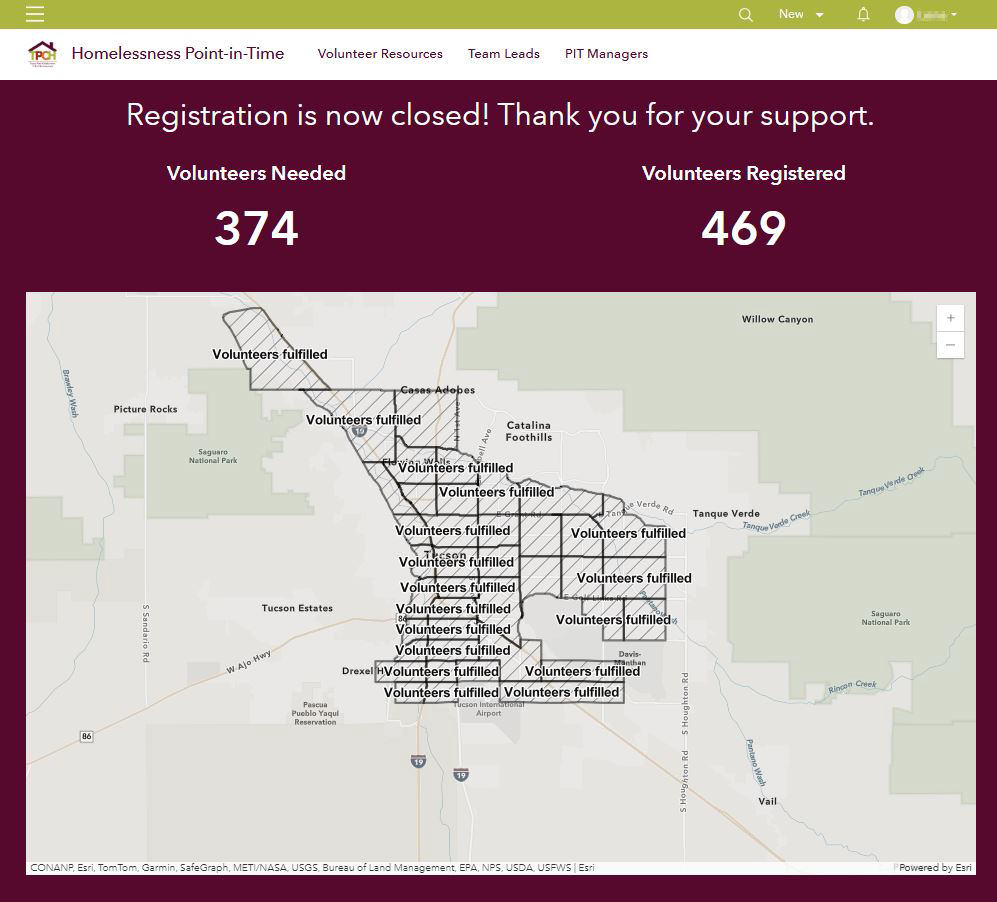
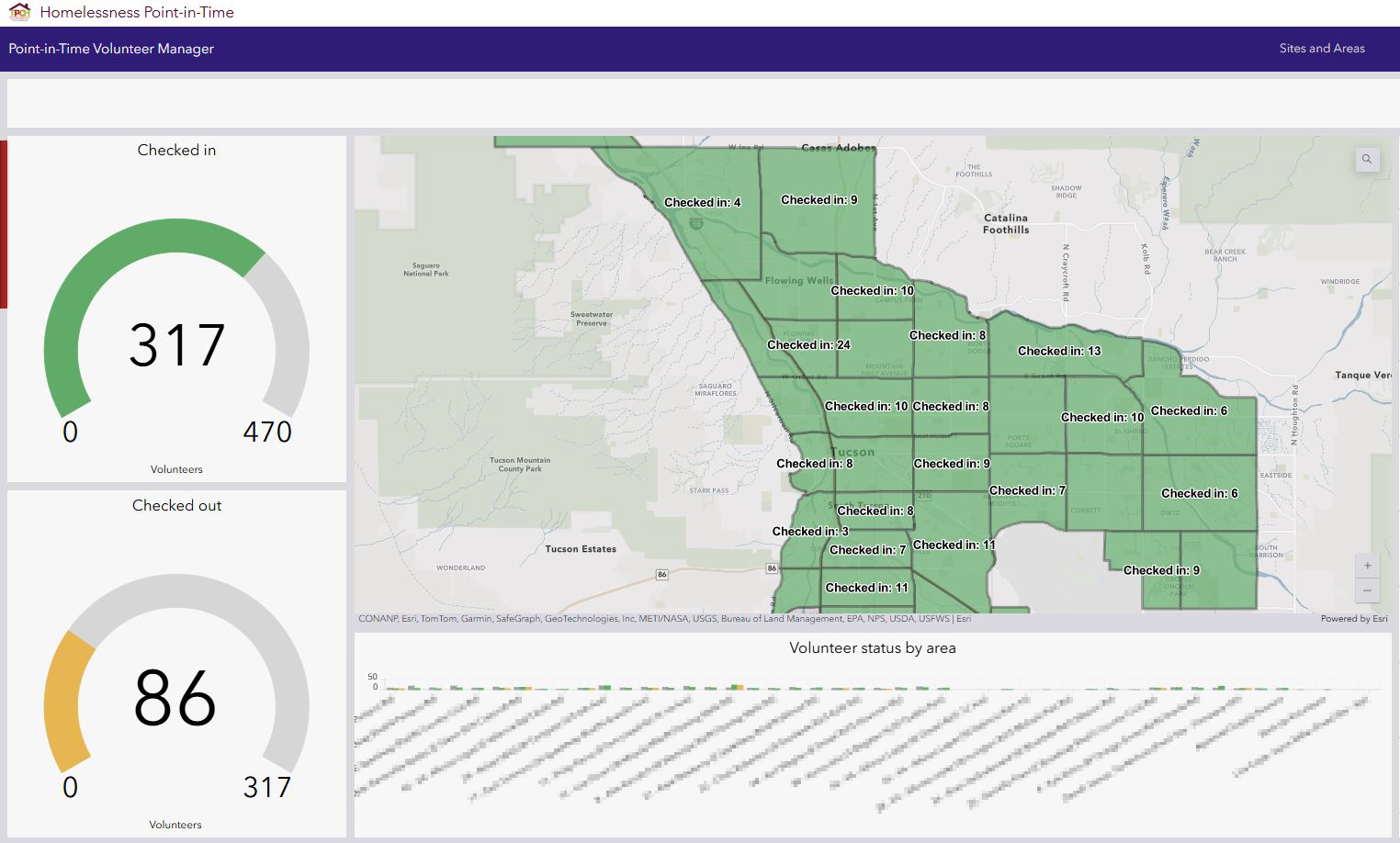
And, for the first time, PIT coordinators were able to track exactly how many volunteers showed up the morning of the count and where they were assigned. Not only did this information help ensure that this year’s count ran smoothly, but it improved the accuracy of their HUD reports.
Coordination
In fact, the Homelessness Point-in-Time Count solution has helped the City of Tucson cut back on nearly all manual and paper-based processes, replacing them with mobile apps and other digital tools that made the count easier for everyone involved.
On the day of the count, instead of filling out paper forms, volunteers completed their surveys using the solution’s ArcGIS Survey123 form on their smartphones. A quick tap submitted each survey, instantly sending it to a live dashboard back at headquarters. PIT coordinators monitoring the dashboard could easily track volunteer check-ins and survey submissions in real time.
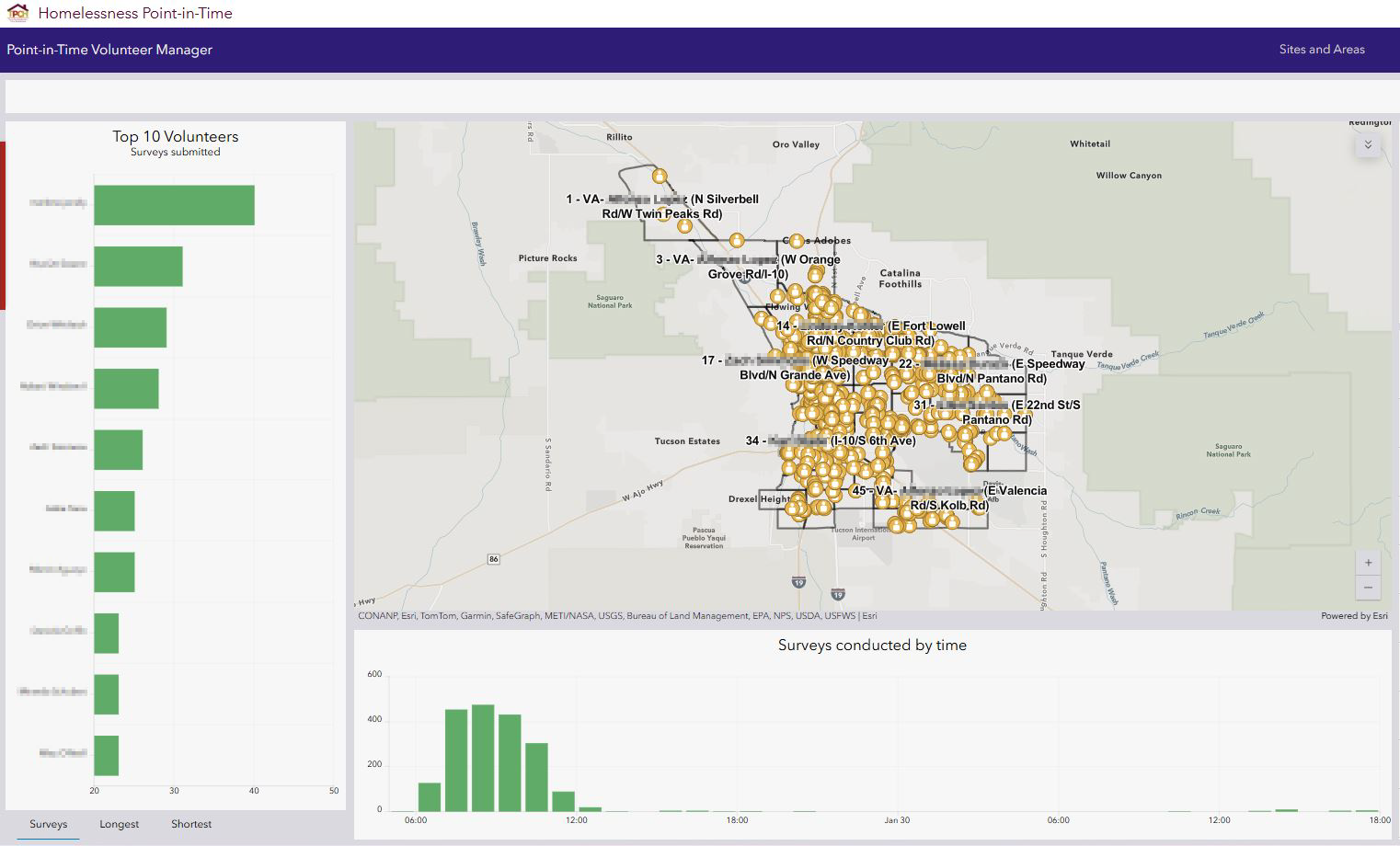
“The solution’s check-in and survey submission dashboards provided real-time visibility into participant check-ins and survey activity, enabling us to manage logistics more effectively and respond to issues as they arose,” says Continuum of Care Manager Kat Davis. “In past years, delays were common because we lacked precise, up-to-date information about where problems were occurring, making it difficult to support volunteers in the moment.”=
This year, coordinators were able to see in real-time where there were areas with low activity, allowing them to reallocate volunteers and ensure coverage across all sectors. It also helped PIT coordinators ensure that volunteers had an adequate supply of gift cards to incentivize survey participation, allowing redistribution of the gift cards from lower-activity areas to busier ones.
Community
City staff appreciated that the solution was largely self-service and required minimal IT support. Volunteers also reported a smoother process, noting that the digital tools were easy to use and that the training and communication materials were accessible and clear.
The City of Tucson is excited to use the solution again next year. And since many volunteers return year after year, their familiarity with the new process will make future counts even smoother. Now that’s something they can count on.
Learn more
For more information about the Homelessness Point-in-Time Count solution, check out the following resources:
- Learn how to deploy, configure, and use the solution.
- View a demo video.
- Discover related solutions:
- Learn more about ArcGIS Solutions.


Commenting is not enabled for this article.