Maps are powerful tools for communicating places and patterns — but only if readers can interpret them. That responsibility belongs to the cartographer. When designing maps, the cartographer must help readers interpret the information. The legend is one of the most important tools in that effort. It contains all the information a reader needs to decode the symbols and colors that give the map its meaning. But when a map is part of a story, the legend also supports the narrative.
When storytelling with maps, the legend becomes even more important. The map and story are so tightly intertwined that an ineffective legend can derail the reading experience. A well-crafted legend supports the map in reinforcing and advancing the story.
This two-part blog series aims to help you create and use legends that make your map-based storytelling clearer and more effective.
- Part I: Optimizing the basics
- Part II: Creative approaches
In this part, we’ll give a quick refresher on the legend’s role in maps, then demonstrate how to get the most out of the legends generated by Map Viewer, Scene Viewer, and Express Maps. These default legends are a natural starting point, but with a few adjustments, they can become more effective at telling your story.
In a future installment, we’ll explore more creative ways to make legends an active part of your story. Techniques such as custom graphics, color-coded text, map actions, and more open up new possibilities for weaving legend information directly into the story.
The role of the legend
Maps rely on abstraction. They generalize the world and represent it with symbols. The role of the legend is to communicate this encoded logic. The symbols, colors, and classification scheme should all be clearly explained, so viewers can interpret what they’re seeing.
In map-based stories, the legend is crucial to a reader’s understanding of the map. An effective legend means a reader can easily interpret the map and understand how it supports the story.
So how do we craft legends that serve both the map and the story?
Crafting legends for stories
The principles behind a great legend apply regardless of where it’s created. Whether you’re working in Map Viewer, Scene Viewer, or Express Maps, the starting point is always the same: know your audience. Understanding what a reader needs from the map and how the map relates to your story can help shape the legend’s design.
Asking questions such as: ‘What does my reader need to see?’ And ‘what do I want them to understand?’ can help to inform the process of creating an effective legend.
Less is more
On any given map, there may be a dozen layers that construct the basemap, provide context, or visualize data. And within a story, there may be several maps, each serving a different moment in the narrative. Our reader may spend only a fleeting moment with a single map, so succinctness and brevity are in our best interest.
This is where knowing exactly what your audience needs to see is invaluable. If the locations of specific points of interest are important to your story, ensure that those symbols are present in your legend. In the interest of clarity, all other non-essential layers should be candidates for removal.
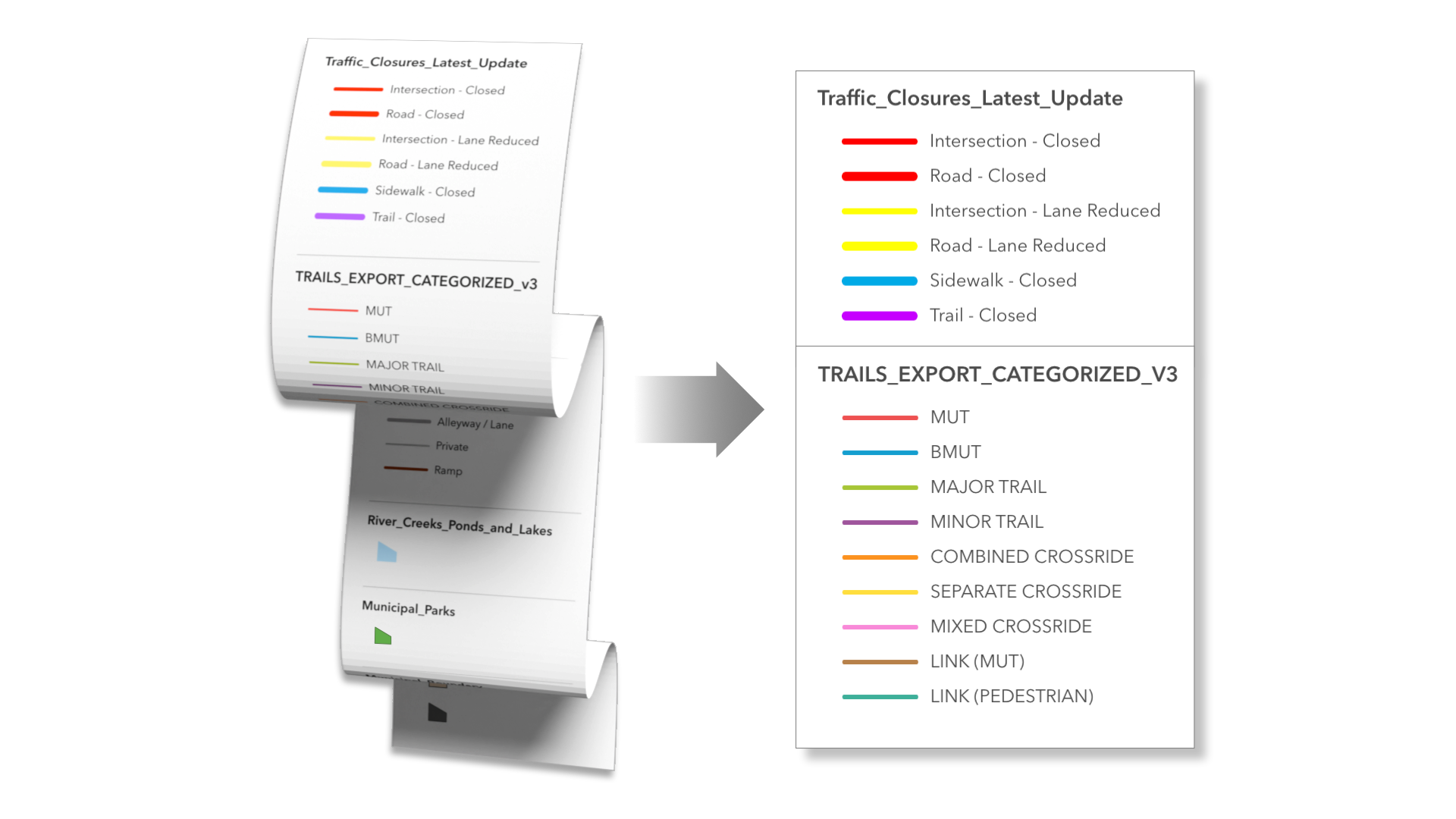
Some of this pruning starts with the map itself. If a layer doesn’t serve the story’s immediate needs, it’s best to toggle it off in the map. Omitting non-essential layers automatically excludes them from the legend. Less on the map means less to explain.
For layers that provide useful context but aren’t central to your narrative, ask whether you can rely on cartographic convention, such as blue for water and green for land or vegetation. If so, these layers can remain on in the map, but they can be trimmed from the legend. This kind of purposeful editing brings the legend down to only what the story truly requires.
Simplify
This concept of minimalism in legend design can be extended further to make our legends even more efficient. Our map layers, in their infinite complexity, likely contain many attributes describing in detail the phenomena they map. This data makes perfect sense to subject-matter experts but less to a general audience. As a cartographer and story author, your job is to bridge that gap. Simplifying the legend makes the map more accessible and easier to interpret for experts and non-experts alike.
This simplification should also be narrative-driven. Ask what your reader needs to take away from this particular map at this particular moment in the story. Whether that be distinguishing one set of features from another or visualizing a measure above or below a threshold, selecting the appropriate symbols or color ramp can make the map and the legend easier to interpret.
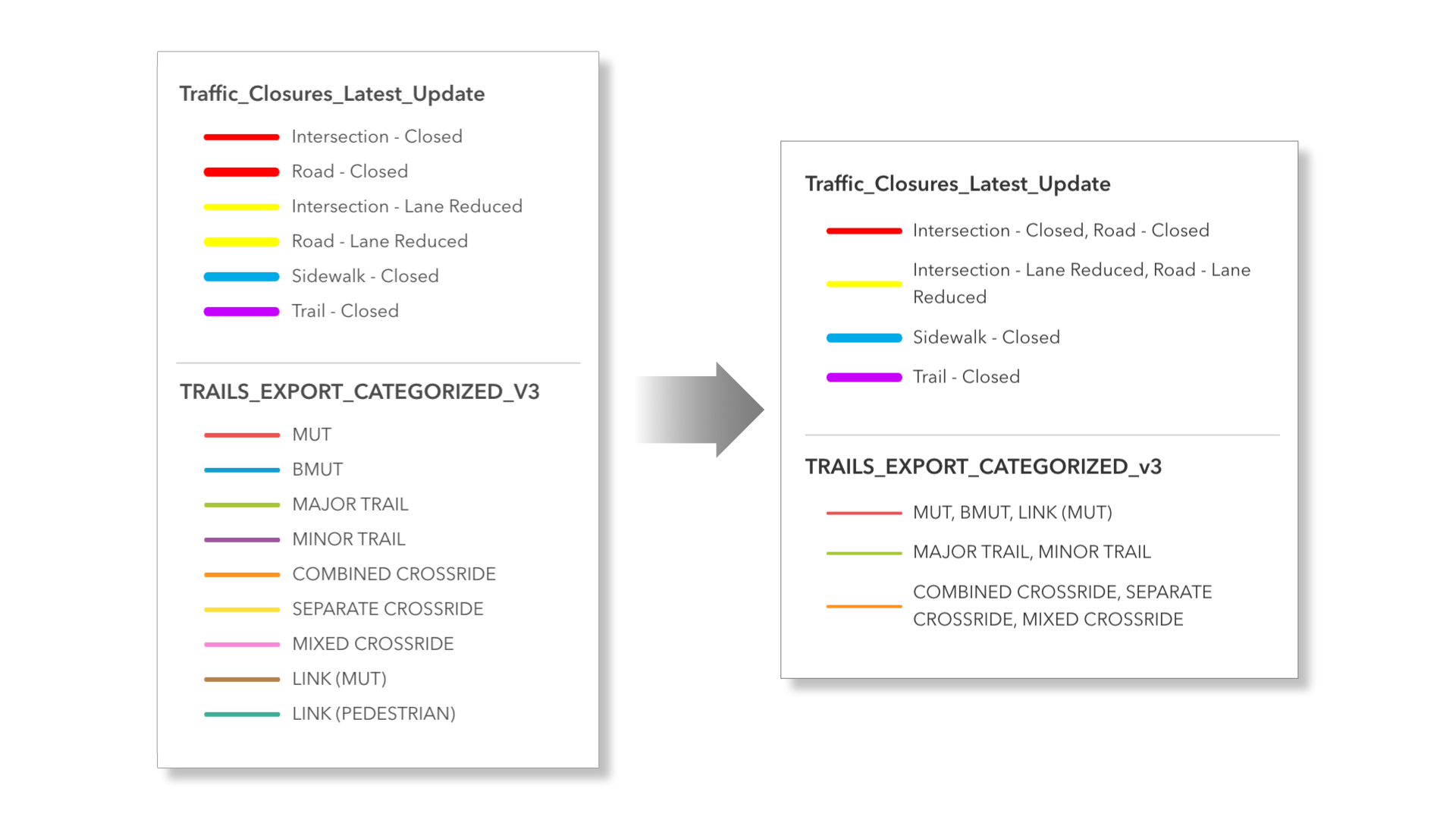
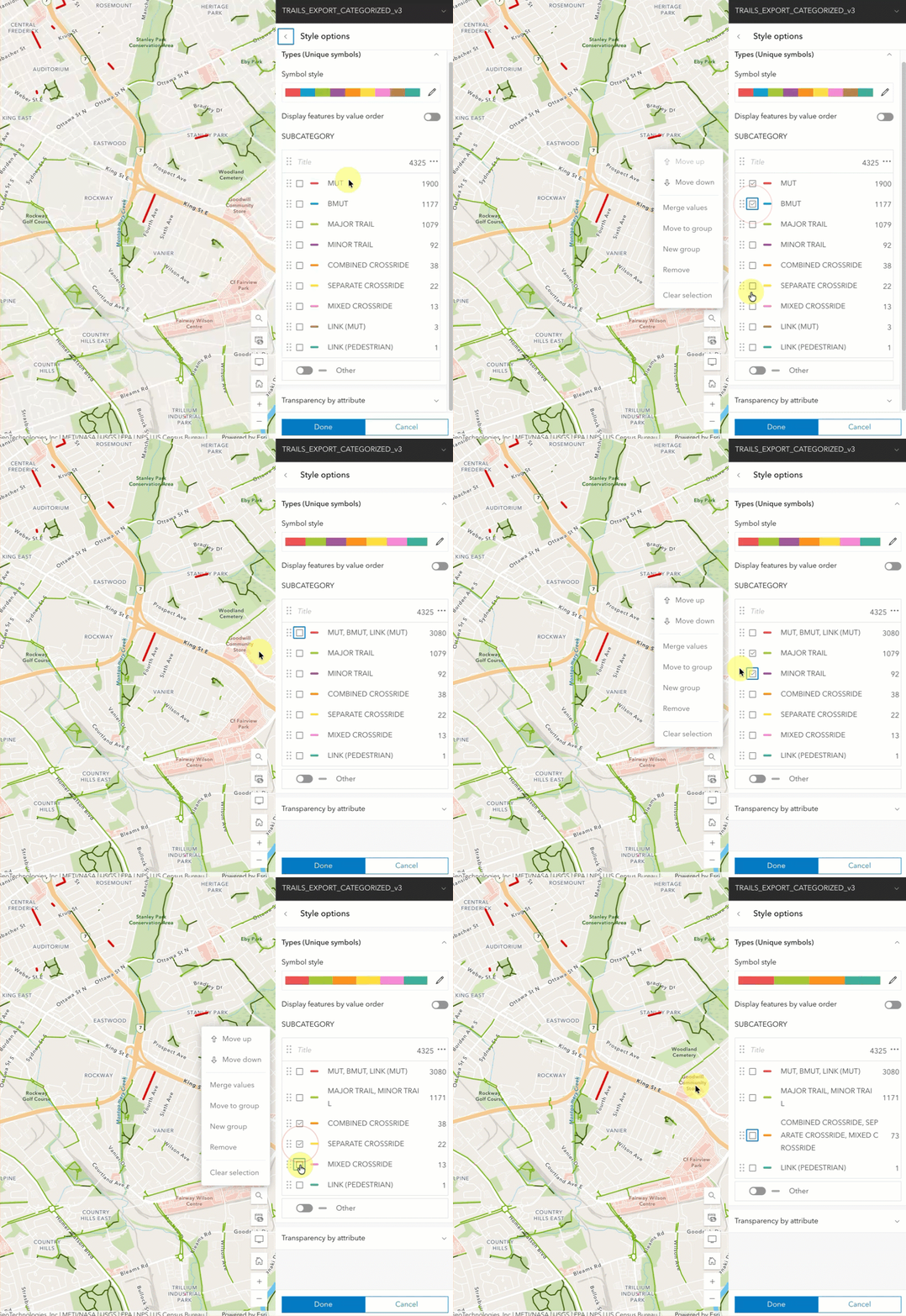
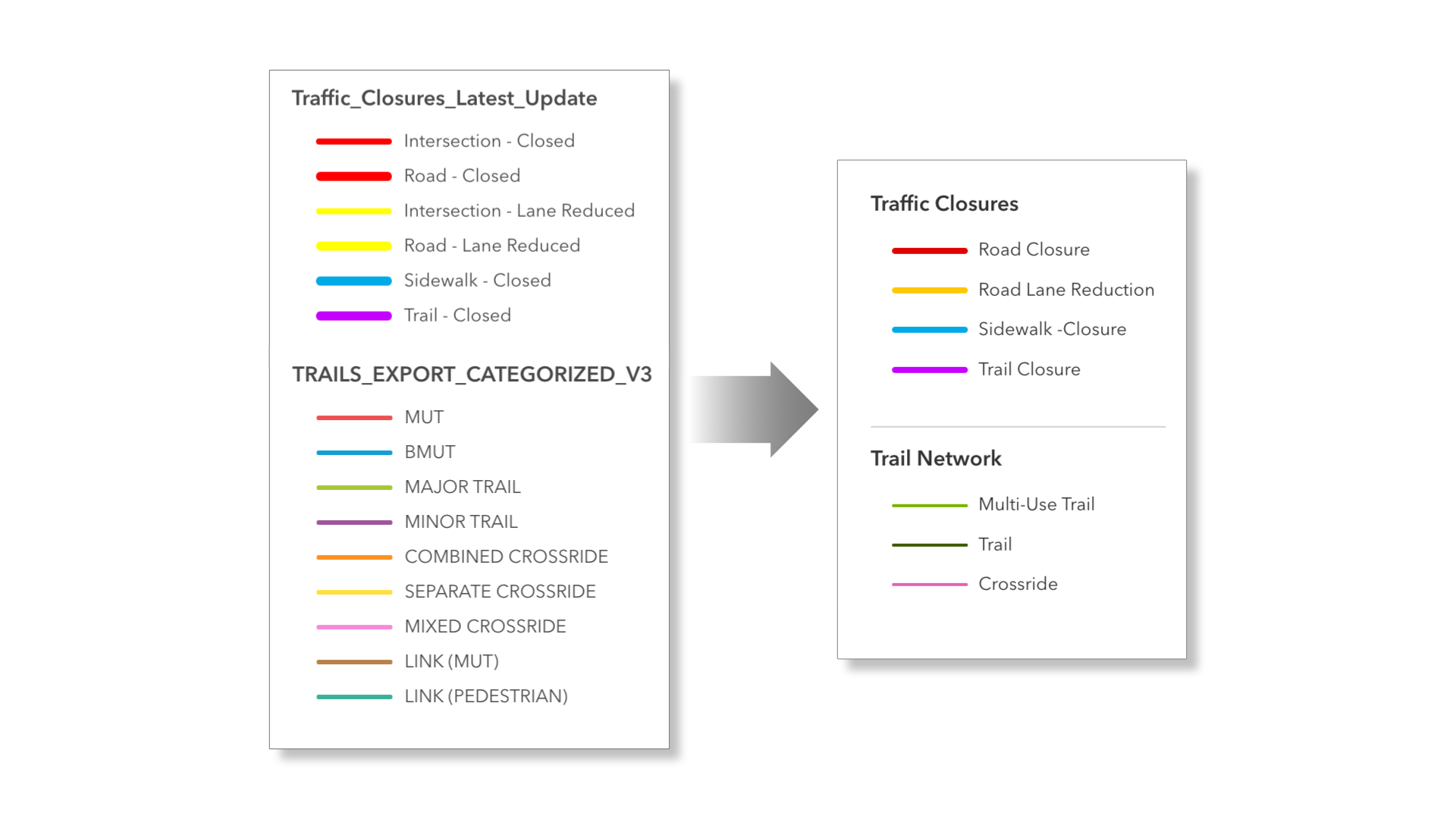
For instance, when confronted with a trail network layer visualizing the various granular types of infrastructure, consider your audience’s needs and adjust the categorization so they can readily understand what you want them to take away from your map. If they don’t need to know the agency responsible for maintenance or all the permutations of that asset class, we can aggregate many categories to better suit the story’s needs.
Name your layers
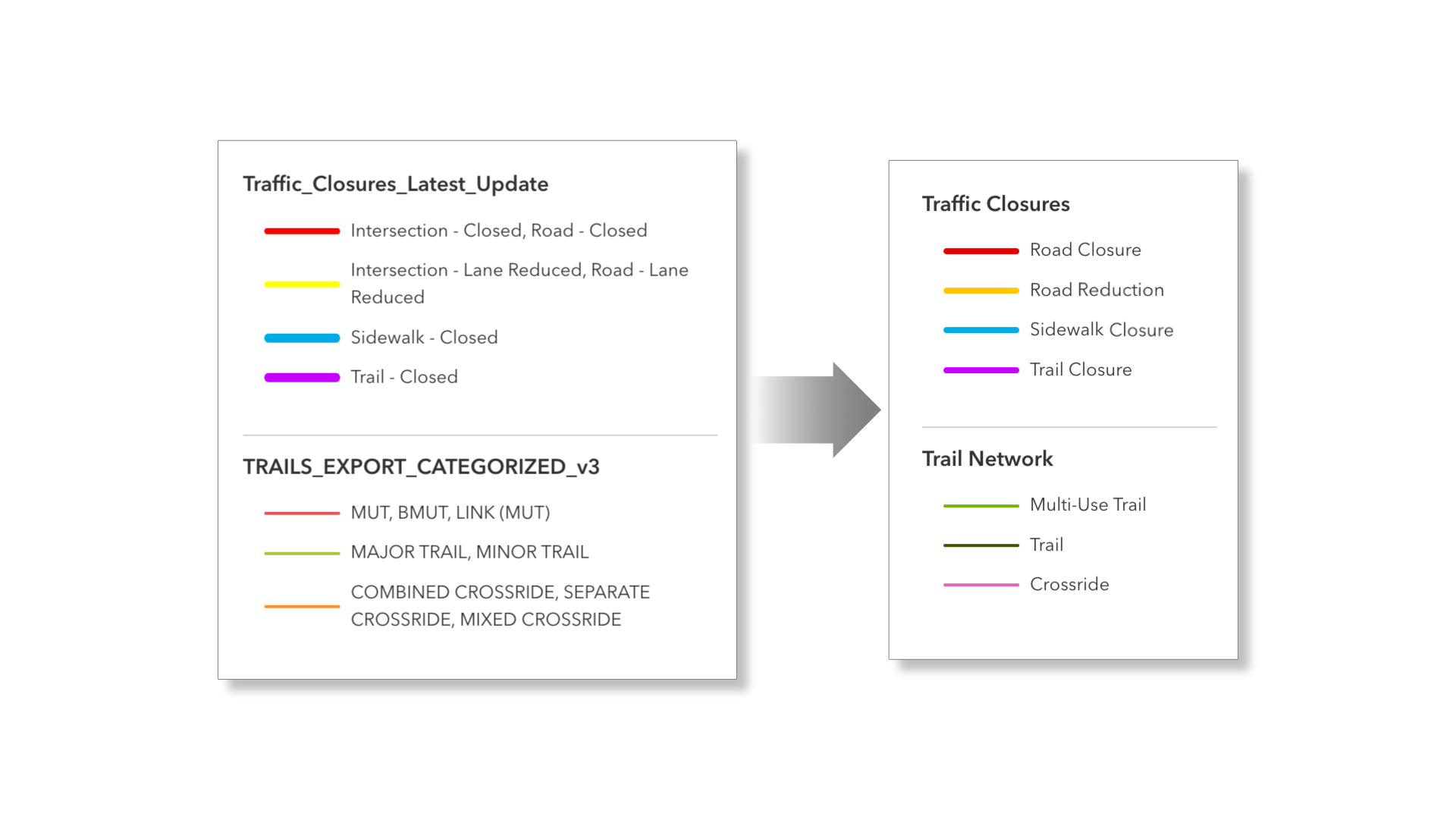
The legend doesn’t just list the symbols and colors used on a map; it also includes the text that describes those symbols and their categories. That means ‘all_roads_buffer_100m_v4` might be the less-than-flattering title that your audience sees. To improve this, layer names, categories, and classifications should be made human-readable and easy to understand.
Make it visible
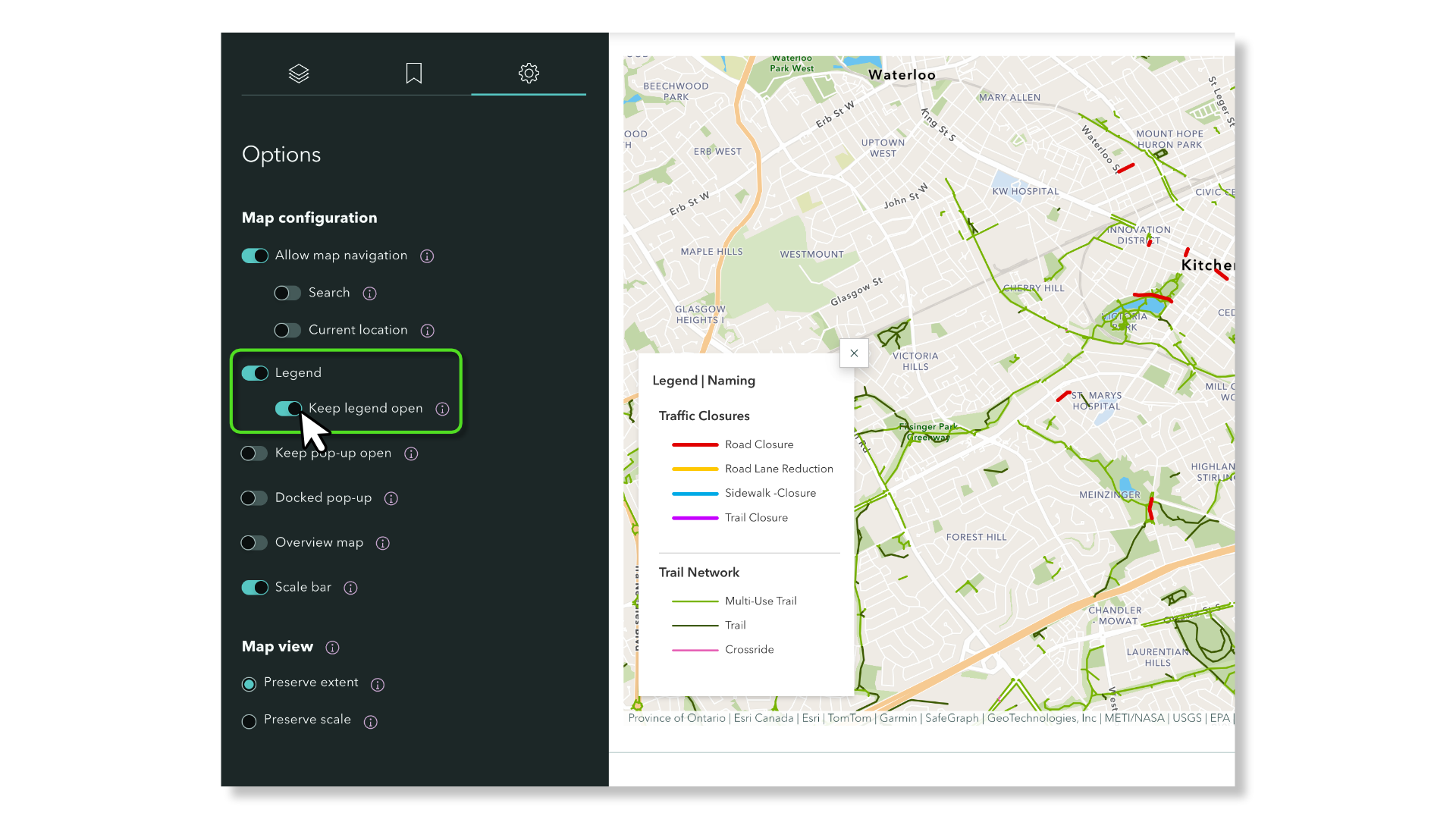
Of course, even a perfectly designed legend is useless if readers can’t see it. Having put in all the effort to prune and shape our legend, we need to ensure it’s visible when our readers need it. When working with maps in stories, whether as a standalone map or within a sidecar, ensure the legend is toggled on in the builder and if needed, have it expanded by default. That way, when a map is viewed in the story, readers will automatically have the legend alongside.
Final thoughts
A well-designed legend is essential to unlocking the meaning of the maps in your stories. By focusing on clarity, relevance, and simplicity, you can improve the effectiveness of both the legend and the map in telling your story.
In the next installment, we’ll explore some other techniques for incorporating legends into your stories.

Article Discussion: