Since the founding of the Group on Earth Observations (GEO) 20 years ago, Esri has been a proud collaborator, most recently as an associate member. GEO is a mini-United Nations of more than 100 governments and organizations working together to use Earth observation technology to tackle climate-related challenges and disasters while enhancing sustainable environmental management and public health.
Indeed, as we cope with the present and future dangers of increasing temperatures, rising sea levels, and more frequent and intense natural hazards, it is more critical than ever to have continuous, near real-time mapping and monitoring of the entire surface of the Earth. Esri sees GEO as one of the most thorough collaboratives doing just that—and at a time when such multilateral approaches seem to be waning or under attack.
For years, GEO has also had regional initiatives, including AmeriGEO in the Americas, EuroGEO in Europe, AOGEO in Asia-Oceana, and AfriGEO in Africa. Through these initiatives, there has been a significant rise in organizations harnessing Earth imagery and geospatial technologies to engage in sustainable development—particularly by several African countries. Recent collaborations among these nations is boosting data sharing and fostering better research and understanding. The tools they’re using provide crucial data for monitoring environmental changes and are playing a vital role in agricultural science, disaster management, and urban planning. They are shaping the continent’s future.
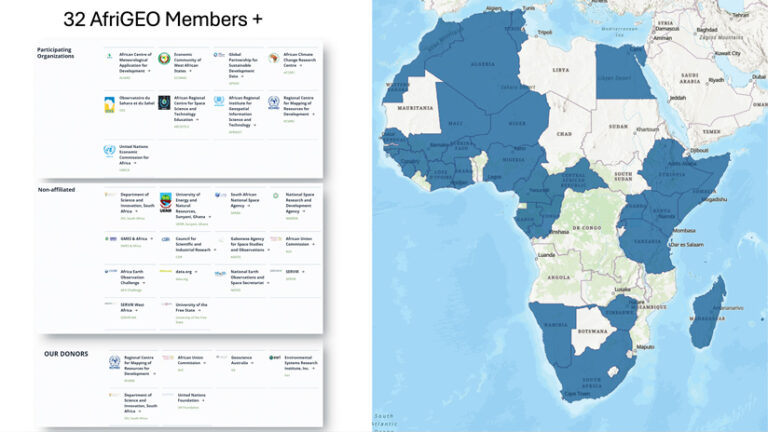
AfriGEO currently consists of 32 GEO member states, with a few more countries seeking to officially join. In addition, there are 15 participating regional institutions contributing to AfriGEO’s mission, including the African Center of Meteorological Applications for Development, the Intergovernmental Authority on Development’s Climate Prediction and Applications Centre, the African Regional Institute for Geospatial Information Science and Technology, and the Regional Centre for Mapping of Resources for Development. There are 14 nonaffiliated organizations—such as South Africa’s Department of Science, Technology and Innovation and the Council for Scientific and Industrial Research—that are not officially part of AfriGEO’s core structure but that still share data; collaborate on events such as symposia and workshops; and implement projects that have to do with agriculture, water management, and disaster risk reduction. Esri is one of six donor organizations that sponsor activities and contribute data, tools, and web portal infrastructure.
AfriGEO seeks to accomplish many things, and Esri supports its key objectives in four main ways:
- Providing a platform for countries to participate in GEO, especially by helping member states and other associated organizations in Africa set up websites to contribute and disseminate geospatial data
- Identifying challenges, gaps, and opportunities for African organizations to contribute to GEO, especially via technical enablement or capacity building
- Supporting knowledge sharing and global collaboration by, for example, hosting mapping challenges for geospatial communities in AfriGEO member states
- Bringing together relevant stakeholders, institutions, and agencies across Africa that are involved in GEO and other Earth observation activities
Each year, AfriGEO hosts the AfriGEO Symposium, a major event attended by hundreds of delegates from across the continent. The 2025 event focused on key topics such as advancing Africa’s geospatial ecosystem by improving data collection, accessibility, and sharing; integrating geospatial data into decision-making; strengthening geospatial infrastructure, policies, and capacity; how to embrace AI, big data analytics, and cloud computing; and investing in education and training, especially for youth and across genders. The thematic areas the event covered included agriculture, food security, and soil moisture; biodiversity, land degradation, and sustainable forest management; the blue economy and water resource management; and innovation, data, and infrastructure.
For the AfriGEO Symposium, Esri provided hands-on ArcGIS training to attendees. The sessions included an overview of the Africa GeoPortal; how to explore African reservoirs using ArcGIS Living Atlas of the World; how to conduct watershed planning in ArcGIS Online; and how to prepare for floods using the ArcGIS Instant Apps Streamflow Viewer template, according to the principles of GEO’s Global Water Sustainability initiative. Streamflow Viewer—which serves a range of users, from small landowners to businesses and governments of many sizes—is a regional-to-global streamflow service wrapped in an open-access web map featuring updated hydrologic modeling and cartography. Esri staff also presented in and moderated key sessions, including ones on marine and coastal management, compliance with the European Union’s Regulation on Deforestation-free Products, the Data Infrastructure Community of Practice, and the African Caucus meeting on GEO’s strategic plans.
Another exciting collaboration is Esri’s work with Geoscience Australia and others to integrate imagery from Digital Earth Africa into the Africa GeoPortal and to develop tailored apps and training materials specific to Africa. The Africa GeoPortal—a sister platform to Digital Earth Africa that’s built with ArcGIS Hub—is an open mapping community for data sharing, capacity building, and cooperation across Africa. It enables countries to work together on applied science projects, investment opportunities, and challenges. In the spirit of technical sustainability, Esri is committed to keeping the Africa GeoPortal running as long as needed, including as a portal of portals that references and hosts geospatial data, regardless of its source.
To that end, it is wonderful to see some AfriGEO member countries developing their own national GeoPortals under the umbrella of the Africa GeoPortal, integrating their own customized web mapping apps, imagery, and ArcGIS tutorials. In addition, participating regional institutions, such as the International Water Management Institute and the Consultative Group on International Agricultural Research (better known as CGIAR, the world’s largest global agricultural innovation network), are also moving forward with their own specialized open data portals—all of which are included on a growing list of GeoPortals under the Community tab of the Africa GeoPortal website. Participating regional institutions will also nominate some of their own authoritative datasets to be included in ArcGIS Living Atlas.
There are many other activities taking place in the applied Earth observations realm in Africa, though there is not enough space in this column to list them. That speaks to the excitement and momentum growing across the African continent over Earth observation science—including using web services and apps to transform raw data into actionable insights that drive policy, economic growth, disaster resilience, and sustainable development.
Esri is proud to assist AfriGEO in fulfilling its credo to provide regional, coordinated, comprehensive, and sustained Earth observation for better and faster decision-making that stimulates innovation and growth while tearing down digital divides.