
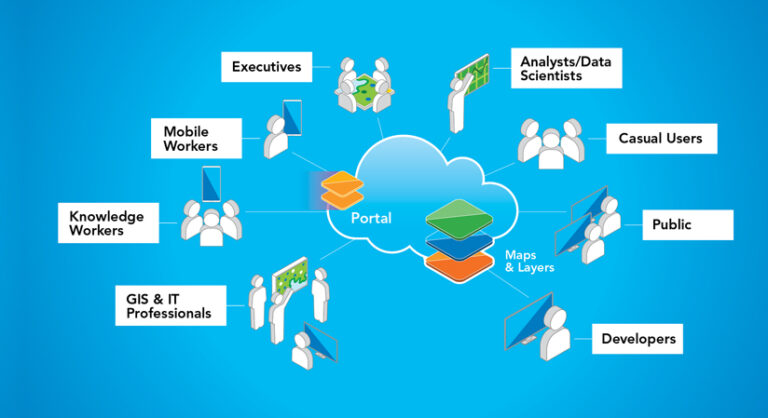
Technology has advanced significantly since the first release of ArcMap over 25 years ago. Whereas GIS professionals used to work only on desktop computers, now many types of users employ geospatial capabilities across desktop, web, and mobile environments.
For more than a decade, ArcGIS has been a comprehensive sharing and collaboration platform that forms the IT backbone of both large and small systems. ArcGIS users routinely build and define these foundational systems to meet their organizations’ needs.
The geospatial infrastructure powered by ArcGIS Online and ArcGIS Enterprise is open, interoperable, and secure. Just like any other enterprise IT platform, it also has observability tools built in so administrators can monitor system performance, usage, and health. All this ensures that teams can access the content and tools they need, when they need them most.
ArcGIS as Geospatial Infrastructure
ArcGIS is an enterprise-ready technology platform that thousands of organizations globally use to design, build, and sustain the geospatial systems they need to fulfill their missions. This means that implementation options for ArcGIS must be flexible—and they are.
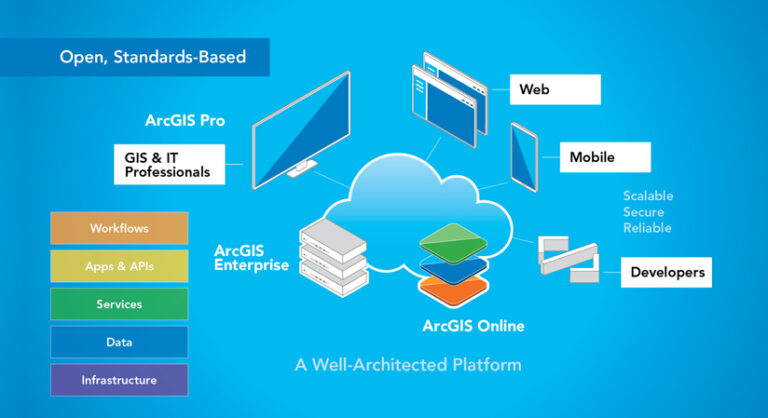
ArcGIS can be deployed as an Esri-hosted software as a service in the form of ArcGIS Online, or it can be deployed as self-hosted software in the form of ArcGIS Enterprise. Both deployment options come with advanced capabilities in mapping, visualization, data management, spatial analysis, app development, data sharing, collaboration, and engagement. These capabilities empower small teams, multinational organizations, and everyone in between, in both the private and public sectors, to infuse their work with the geospatial approach.
For organizations setting up a new system, ArcGIS Online is often a great entry point. As organizational needs increase, teams can take advantage of premium options available in both ArcGIS Online and ArcGIS Enterprise.
ArcGIS Enterprise provides flexibility in terms of form, functionality, and location. It comes in a fully cloud-native form—ArcGIS Enterprise on Kubernetes—that organizations with fewer requirements can configure simply or organizations with more demands can configure intricately. As self-hosted software, ArcGIS Enterprise lets organizations choose where to host servers to satisfy their unique data sovereignty and security conditions.
Beyond the foundations of ArcGIS Online and ArcGIS Enterprise, organizations can add advanced extensions to build systems that can tackle virtually any geospatial challenge—whether it involves real-time data feeds, large-volume image processing, orchestrating work orders across large groups of people, or map production.
When to Collaborate and When to Scale
Many organizations choose to build business systems that use ArcGIS Online and ArcGIS Enterprise together to serve different purposes while maintaining one system of record. This distributed collaboration enables users to share layers, maps, and other data from one system to the other.
For many customers, this makes data more accessible across the organization. It also allows for interoperable workflows, such as managing data in ArcGIS Enterprise and sharing it with partner organizations or the public via ArcGIS Online.
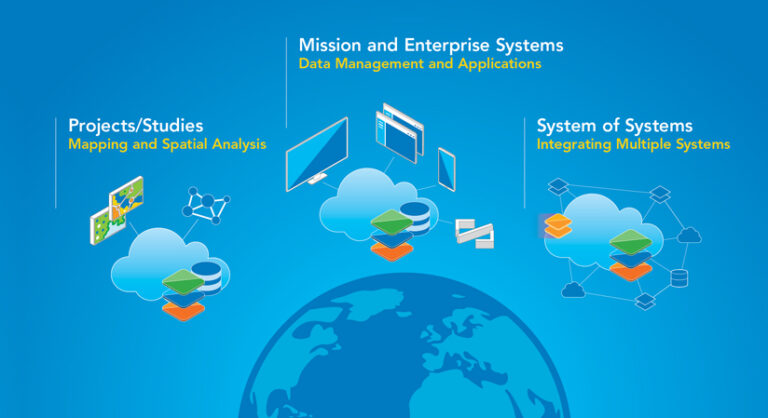
When organizations scale and integrate their geospatial infrastructure—connecting more people, processes, and data—a system of systems emerges that enables users to work across borders, jurisdictions, and sectors. This implementation pattern melds spatial data, geospatial technologies, and supporting systems and processes to enable informed decision-making across industries and various levels of government.
Multiorganizational communities of practice that share geospatial infrastructure can cooperatively manage geospatial data and create online destinations, such as ArcGIS Hub sites and open data portals, to share data and map products either openly or securely. Partners and other organizations can participate and benefit from shared knowledge and authoritative information, turning insight into measurable impact.
Shape the Future
To continue making IT departments and GIS professionals successful in managing their organizations’ geospatial infrastructure, Esri will persist in advancing ArcGIS technology, training, and resources for its community of users.
Ensuring that organizations have robust and secure ArcGIS deployments is a team effort. As your teams continue to innovate with ArcGIS, take advantage of the many world-class training courses Esri Academy has to offer, and explore reference resources such as the ArcGIS Architecture Center. You can also share your ideas with Esri product teams at ArcGIS Ideas on Esri Community.