
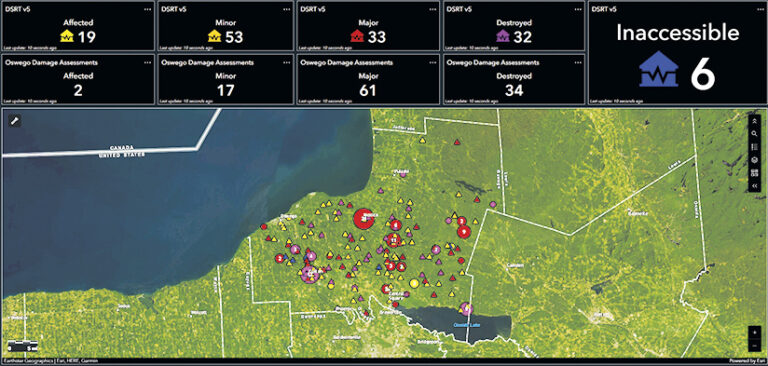
In February 2025, Oswego County, New York, was struck by a record-setting snowstorm that dropped more than 100 inches of snow in four days. The storm caused transportation challenges and widespread structural damage, including the partial or complete collapse of over 220 buildings.
The Oswego County Emergency Management Office activated its Emergency Operations Center for 21 days to coordinate response efforts with local, regional, and state partners. Central to the response was a real-time geospatial system powered by ArcGIS Survey123 and interactive dashboards built with ArcGIS Experience Builder. These tools allowed responders to gain clearer visibility of the situation, prioritize needs, and coordinate assets in a rapidly evolving and resource-constrained environment.
A Survey-Based Call Center
After hearing from home health agencies, meal delivery programs, and other service providers that heavy snow and ice accumulation was preventing them from reaching the vulnerable residents they serve, the Oswego County Emergency Management team brought in outside help. The county stood up a dedicated public call center staffed by Oswego County Health Department employees and operators from the local community assistance hotline, 211 CNY, to identify and track residents’ needs. The Health Department call center operated on weekdays from 8:00 a.m. to 4:00 p.m., and 211 CNY handled calls during off-hours to ensure 24-hour coverage.
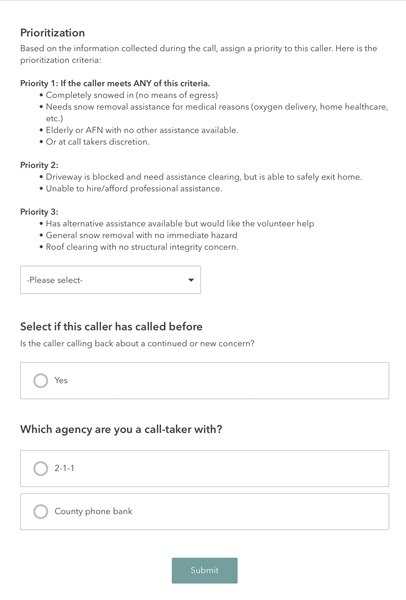
Call takers from both centers used a custom-built Survey123 form to collect key details about each assistance request, including whether callers had medical or mobility concerns, if snow was blocking their home’s only exit, whether they had safe access to heating, and other risk indicators. Using a set of clearly defined prioritization rules, call takers assigned each request a priority level in real time. This ensured that life safety concerns and medically vulnerable residents were flagged and taken care of first.
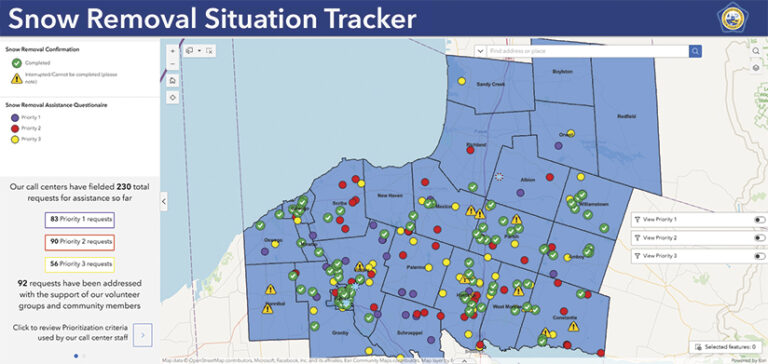
All this information flowed instantly into a dashboard, which became a central tool for staff from the Emergency Operations Center and external partners to monitor the volume, urgency, and location of public needs.
Doing “Far More with Fewer People”
To address the growing list of snow removal requests, Oswego County coordinated the deployment of several partners from the National Voluntary Organizations Active in Disaster (VOAD), including Team Rubicon, Mennonite Disaster Services, and members of the New York State Federation of Search and Rescue. Each morning, team leads received assignments during briefings at the Emergency Operations Center, and a designated point of contact distributed additional assignments throughout the day.
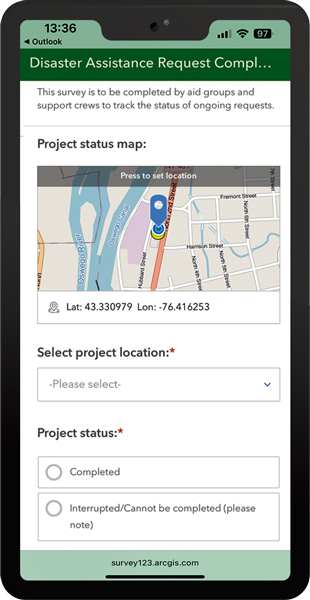
The county developed a second Survey123 form for VOAD teams to use to report when they completed a snow removal request—or when they couldn’t, and why. Teams could also include notes or photos in the form as needed.
What made this system especially powerful was that both surveys were linked through a shared data field: the address. This connection allowed VOAD teams to open a mobile map showing all pending assignments, click on their assigned address, and submit updates directly from the field. This real-time reporting fed back into the same dashboard that decision-makers were using, creating a closed-loop coordination system.
Because the dashboard updated in real time, VOAD teams could see new requests as they came in, including those flagged as the highest priority. In multiple instances, mobile teams were finishing one job when a new high-priority request appeared on the map just minutes earlier and only blocks away. This allowed team members to immediately assist another household without returning to staging to get updated assignments.
“This setup allowed us to do far more with fewer people,” said Tyler Peet, the emergency management coordinator for Oswego County’s Emergency Management Office. “Teams knew exactly where to go, what needed to be done, and when requests were updated—all in real time.”
A Clear, Unified View of Activity
The whole system was assembled using ArcGIS Experience Builder, which served as the primary visual interface for decision-makers, VOAD teams, and Emergency Operations Center staff.
Requests for assistance submitted through Survey123 automatically populated a feature layer, placing a color-coded point—to indicate priority level—on a web map. Similarly, data from the second Survey123 form, capturing snow removal requests’ completion status, created a separate feature layer with status indicators: green check marks for completed requests, and yellow warning symbols for issues needing attention.
These layers were displayed on a shared map embedded within Experience Builder. This configuration enabled users to filter requests by priority and completion status; access operational notes without revealing personal information; and interact with up-to-date, geospatially organized data. Experience Builder gave emergency responders a clear, unified view of field activity and unmet needs while eliminating the need to manually refresh data.
“By building both the intake and completion surveys in Survey123 and connecting them through a common address field, we created a dynamic feedback loop that updated in real time,” said Matt Goodsell, a communicable disease epidemiologist with the Oswego County Health Department who was tasked with deploying the solution. “Experience Builder allowed us to bring everything together visually so users at every level—call takers, VOAD teams, and decision-makers at the county and state levels—could interact with the same live data in a meaningful way.”
A Quickly Made, Tailored Tool
Oswego County created the Survey123 forms and Experience Builder dashboards within 48 hours of being requested to coordinate snow removal. While the county didn’t have an off-the-shelf tool prepared for this specific scenario, Goodsell was able to build out the framework quickly thanks to his prior experience working with Survey123, Experience Builder, and web maps.
Goodsell previously applied these tools to public health—building and maintaining routine respiratory disease tracking dashboards—and was able to translate that technical skill set along with his understanding of emergency operations into a purpose-built solution for the winter storm response. Goodsell’s familiarity with both the technology and operational needs of emergency coordination enabled him to quickly stand up tailored, effective tools that could be refined throughout the incident.
Oswego County is now revising and simplifying the framework for snow removal coordination so it can be deployed even faster in future incidents with only minor modifications. The county is also already exploring its use for evacuation support and disaster debris removal. The system is adaptable for any scenario where the public needs assistance, the county needs to track field work, and decision-makers need to visualize progress in real time.
Responding to and Anticipating Needs
For Oswego County, the need to quickly organize snow removal requests evolved into a real-time operational framework that supported tactical deployment, leadership visibility, and partner coordination. By linking Survey123 forms through a shared data field and visualizing the information in a live dashboard, Oswego County created a system that not only responded to community needs but also anticipated them.
“The strength of our response came from the shared commitment of every agency, volunteer, community member, and responder involved,” said Peet. “When we’re all working from the same information and toward the same goal, coordination becomes much more effective. For us, that goal was taking care of the people of Oswego County—[and] GIS tools helped us stay aligned and focused on what mattered most.”