
As geospatial AI grows more powerful, its future hinges on more than technological innovation. While AI tools can process vast amounts of data at remarkable speed, they cannot decide which questions matter most, which assumptions are sound, or which societal values should shape their use.
The Institute for Geospatial Understanding through an Integrative Discovery Environment (I-GUIDE)—a National Science Foundation-funded research institute led by the University of Illinois Urbana-Champaign—bases its AI work on a simple but critical vision: Responsible geospatial AI requires human judgment, expertise, and stewardship.
This vision fuels I-GUIDE AI, the institute’s AI and data discovery tools that help researchers connect geospatial datasets, workflows, and other digital knowledge elements. It should also steer how other geospatial technology practitioners make use of AI.
Use of Geospatial AI Demands Responsibility
Geospatial intelligence—the ability to analyze, understand, and reason about phenomena across space and time—is foundational to tackling many of society’s greatest problems. Disaster resilience, biodiversity conservation, public health, transportation, energy systems, agriculture, and urban planning all rely on geospatial intelligence to reveal how people, places, and processes interconnect. The emergence of geospatial AI, which integrates AI with geospatial data and geographic reasoning, offers transformative opportunities to enhance understanding of complex, real-world systems and accelerate scientific discovery.
Yet realizing geospatial AI’s potential comes with significant responsibilities. Geospatial data represents real communities and environments. Decisions informed by geospatial AI can affect how resources are allocated, risks are evaluated, and policies are developed.
Geospatial AI’s unprecedented ability to unearth patterns in large and complex datasets needs human guidance to ensure the results are accurate, transparent, ethical, and actionable. Humans must frame research questions, evaluate evidence, interpret results, identify bias, and determine whether the AI-generated insights are appropriate for a given context.
To Use AI Well, Abide by These Principles
I-GUIDE AI follows three core principles to support the conscientious use and development of AI.
- Emphasize transparency, accountability, reproducibility, and trust in data-driven decision-making. Users must be able to understand where knowledge originates, how conclusions are generated, and whether those conclusions can be independently validated.
- Encourage critical spatial thinking so AI aids scientific inquiry without replacing human decision-making. Understanding geographic processes demands more than identifying statistical relationships or detecting patterns in data. It requires grasping the underlying spatial context; asking informed questions; evaluating competing explanations; and interpreting evidence within broader environmental, social, and historical frameworks.
- Democratize access to geospatial data and AI. Historically, advanced computational resources, large datasets, and sophisticated analytical tools have only been available to well-resourced institutions and experts. I-GUIDE AI lowers these barriers by providing data resources and AI-enabled capabilities on an open, accessible platform. This empowers broad communities of researchers, educators, students, policymakers, and practitioners to discover, innovate, and solve problems.
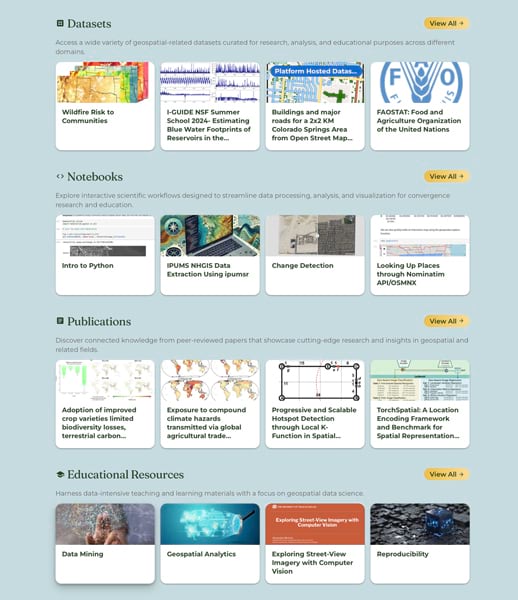
These principles are realized through the I-GUIDE Platform, an AI-powered cyberinfrastructure ecosystem that connects data, computational resources, analytical methods, educational content, and domain expertise from across disciplines. Rather than treating data, models, and publications as isolated resources, I-GUIDE fosters an integrative environment in which various communities can share, connect, validate, and extend their knowledge.
How to Connect People and Ideas to Advance Knowledge
At the heart of I-GUIDE is convergence research—the integration of knowledge, data, and expertise from diverse disciplines to tackle complex challenges that no single field can solve alone. Realizing the full potential of such collaboration requires innovative approaches for connecting people, data, models, and ideas.
To guide this effort, the I-GUIDE AI research and development agenda centers on three fundamental questions:
- What are the building blocks of a Convergence Knowledge Network (CKN)—the collaborative framework that links the people collectively working on a problem?
Traditional forms of scientific knowledge—including publications and reports—exist alongside new forms, such as datasets, computational notebooks, software code, workflows, machine learning models, and visualizations. Both types of knowledge are important. I-GUIDE AI recognizes that convergence research should leverage digital knowledge elements. - How can various research communities collaboratively construct and validate such a network?
Scientific knowledge production is inherently social. It advances through collaboration, peer review, evaluation, replication, and continual refinement. I-GUIDE relies on contributions from researchers, educators, and practitioners across many disciplines and institutions through streamlined workflows that support documentation, sharing, quality control, and validation. What results is an evolving and dynamic network of knowledge that encourages cross-pollination. Research papers reference datasets. Datasets are generated by computational workflows. Software tools analyze multiple datasets. Educational materials draw on published findings and analytical methods. These connections reveal not only individual pieces of knowledge but also the pathways through which knowledge is created, validated, and extended. - How can new knowledge be discovered by harnessing CKNs at scale?
As CKNs grow, AI systems can go beyond information retrieval. If an AI model recognizes relationships among datasets, methods, publications, and communities, it can help researchers identify relevant resources, uncover connections, recognize emerging trends, and generate new hypotheses.
The Bridge Between AI and Human Understanding
A distinctive aspect of I-GUIDE AI is its emphasis on spatial grounding: Whenever possible and appropriate, each digital knowledge element is associated with its geographic context. This grounding is essential because location often aids understanding of environmental processes, human activities, social dynamics, and infrastructure systems. Spatial grounding helps ensure that AI-generated insights remain connected to real-world places and conditions.
This commitment to spatial grounding enhances interpretability and trust. Researchers can more easily trace conclusions back to their underlying data, understand the geographic contexts in which observations were made, and evaluate whether findings are applicable to new locations or environments. Spatial grounding serves as a bridge between AI and human understanding.
I-GUIDE AI is a vision for the future of geospatial AI—one in which human expertise and AI work together. Rather than replacing human judgment, AI should augment human capabilities by expanding access to knowledge, accelerating analysis, and revealing patterns. Human guidance ensures that these capabilities are used responsibly, ethically, and effectively.
In this vision, responsible geospatial AI is not merely a technical achievement. It is a collaborative endeavor that places critical spatial thinking and human understanding, accountability, and stewardship at the center of innovation.