
There was a palpable buzz in the air during the 2025 Esri User Conference (Esri UC), held July 14–18 in San Diego, California.
“Vibes are high. Everyone’s kind of jazzed,” said Layne LeBleu, who was the GIS and asset management analyst for the City of Hillsboro, Oregon’s Public Works Department at the time. This was LeBleu’s fourth time attending the Esri UC. In addition to watching the Plenary Session—which always makes him feel like “I can change the world”—he said he appreciated seeing other GIS users “talking about the cool work they’ve been doing.”
Irene Egbulefu, a GIS analyst for Travis County, Texas, who has used the technology for more than 15 years, was enthusiastic about her third Esri UC.
“[I’m here] to learn innovations in GIS, see what’s going on, and what’s new,” she said. “My company uses a lot of GIS, so we need to be up-to-date.”
“It’s a great way to be exposed to all sorts of cool technologies, ideas, and techniques,” said Alyssa Gunning, a GIS analyst II for the City of Rocklin, California. “One of the best ways to learn is by talking with other people [and] seeing what they’re doing.”
LeBleu, Egbulefu, and Gunning joined more than 15,000 GIS professionals who attended the conference in person, along with over 14,000 virtual participants, to learn about how GIS is Integrating Everything, Everywhere—the theme of the conference. By attending the Plenary Session presentations, joining technical sessions, and networking, attendees from around the world discovered and shared ideas for applying emerging technologies, such as geospatial AI, new spatial analysis capabilities, the latest Esri integrations, and exciting advancements in 3D mapping and virtual reality.
“Our world is evolving rapidly,” Esri president Jack Dangermond said to a rapt Plenary Session audience. “These challenges suggest that we need a new approach that integrates our collective knowledge [and] creates a better future.”
GIS practitioners are leading this new approach, using geospatial technology every day to address big issues and effect meaningful change.
“[All of you are] applying the concepts of geographic knowledge to making the world a better place,” Dangermond said.
While the entire conference featured inspiring stories of applying and pushing the limits of GIS, the user presentations during the Plenary Session offered a microcosm of the innovative work Esri users are doing with GIS technology.
Making Airport Travel Safer in San Francisco
At San Francisco International Airport (SFO), GIS experts have integrated multiple systems into the airport’s GIS to build a 3D digital twin that allows them to map and manage more than half a million assets.

The airport is essentially “a small city that never sleeps”—according to Josephine Young, director of infrastructure information management at SFO—and has more than 700,000 features in its GIS. These features include natural gas and jet fuel lines, airfield lights, planes, parking garages, and more than 15,000 rooms.
The new Airport Integrated Operations Center is a centralized software system designed to enhance operational management and coordination. It integrates with the SFO Integrated Dynamic Twin, a virtual representation of the airport. Supported by this dynamic digital twin, SFO’s new operations center “will act as the nerve center of the airport…to make sure that there’s a seamless guest experience,” Young said.
For example, a map of airport lights within the Integrated Dynamic Twin allows electricians to easily identify light bulb types before making repairs, explained Guy Michael, GIS principal at SFO. This streamlines airport maintenance and allows technicians to make repairs more quickly.
“This saves time, increases safety, and minimizes impacts to our operations,” he said while demonstrating how building information modeling (BIM) is integrated into the new digital twin, which spans the entire airport and updates in real time.
Finding the Best Transmission Corridors
Aurecon, an international design, engineering, and advisory firm, is developing HumeLink—a massive energy infrastructure project to construct new transmission lines across New South Wales, Australia. While working on this project, which aims to bring renewable energy to consumers, the GIS team had to determine the best way to communicate hundreds of map layers and attributes to the design team to find the best corridor for each transmission line.
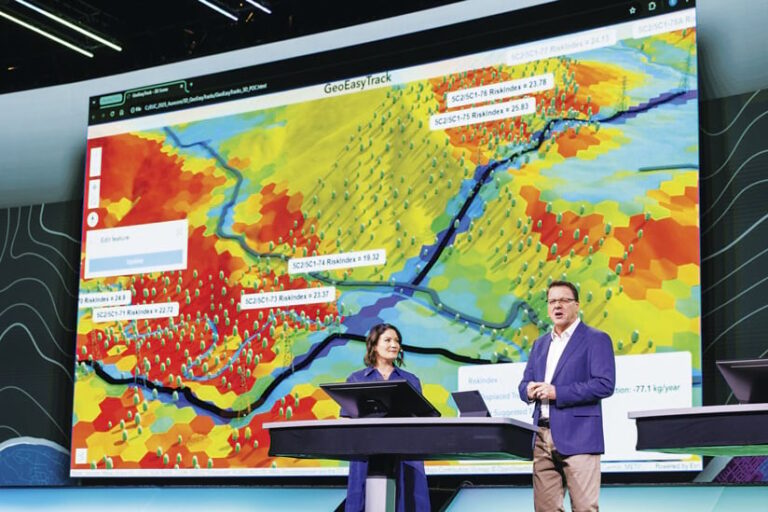
To address this, the firm built the Root Planning assessment tool, which enables the GIS team to map and quantify data layers, like soil and slope, into risk and opportunity scores. From there, the tool creates a corridor of least impact, according to Martin Russell, Aurecon’s director of GIS, environment, and planning. The data is displayed in hexbins—a grid used to aggregate spatial data—for simplified visualization.
“We believe it’s essential that these simplified maps can be interrogated in detail while telling a simple story,” said Russell.
Another tool the team developed is Aurecon Air. This collaborative platform for regulatory reporting and public approval is supported by ArcGIS Enterprise on Kubernetes. The platform uses interactive dashboards, charts, and 2D and 3D apps to communicate with stakeholders across the project team.
These tools have enhanced collaboration and improved project coordination and delivery.
“The key to this complex project is to make our delivery simple and well understood through a suite of digital design tools powered by GIS,” Russell said.
When Health Care Meets Location
Representatives from CVS Health, a provider of health care and pharmacy services, explained how the organization leverages a range of GIS-based tools to make the world of health care easier to understand and navigate.
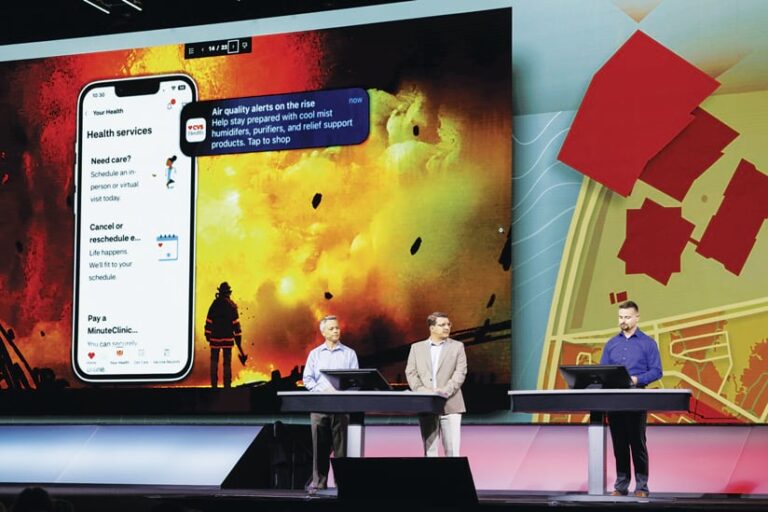
For example, when Texas suffered a major power crisis in 2021 due to winter storms, CVS quickly coordinated disaster response across dozens of teams working with siloed data. This led to the development of the Crisis Command Central app.
The app places assets in geographic context and provides real-time visibility into operations and potential hazards across the business. Now, when a severe storm occurs, the CVS team can check a dashboard, built with ArcGIS Dashboards, to see which stores are operational, which colleagues are affected, and which medication deliveries are vulnerable.
CVS Specialty, the specialty pharmacy branch of CVS, uses the same GIS technology to track, manage, and reroute medication during extreme weather events, explained Matt Anderson, the lead director of clinical social data intelligence at CVS Health. This is critical because delayed shipments can put consumers’ health at risk.
The CVS Health mobile app serves as a comprehensive tool for managing various aspects of health and wellness, including prescriptions and in-store shopping. This app also brings location-aware enterprise data into the everyday consumer experience. Geographic context helps inform daily transactions by integrating data and real-time weather information, so consumers have store and services information available at their fingertips.
According to Eric Hamilton, assistant vice president of clinical analytics at CVS Health, innovations like this empower operations leads, care managers, analysts, and anyone with an idea to explore, take action, and drive change.
Remote Sensing for Wildfire Management
In California, an integrated and automated remote sensing system—developed by the California Department of Forestry and Fire Protection (CAL FIRE) and powered by ArcGIS—helps airborne research data specialists protect people and resources from wildland fires before, during, and after fire events. This innovative application of GIS won CAL FIRE the Making a Difference Award, presented by Dangermond.
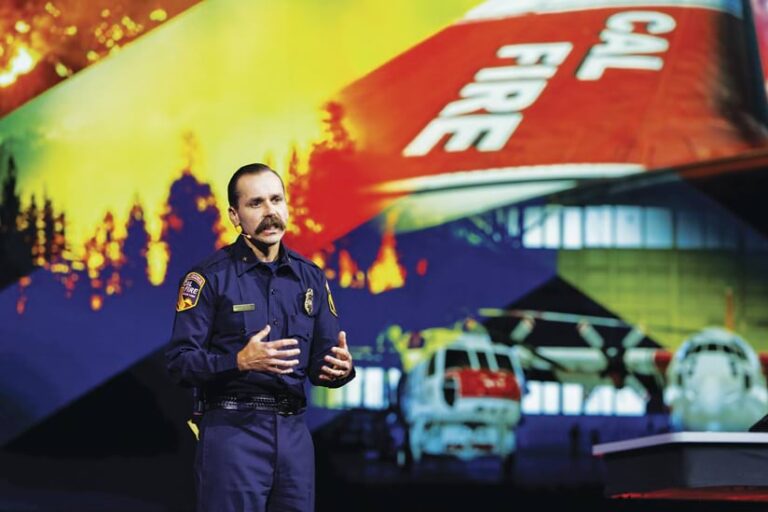
CAL FIRE uses remote sensing and GIS technology to map fire perimeters from aircraft flying 10,000 to 12,000 feet above active fires. This information goes to fire analysts and incident commanders to determine a fire’s location and where it may spread.
CAL FIRE research data specialist Logan Hansen described how a flight app—powered by ArcGIS Pro and part of the award-winning system—provides the CAL FIRE team with custom geoprocessing tools, features, and layouts.
“The flight app helps me take [ArcGIS] Pro anywhere—even into the skies,” he said, adding that a separate cloud-based app distributes fire perimeter information to operational specialists, public-facing web pages, and more. A dashboard displays fire incident progress, while a map shows spread predictions and risk forecasts.
“Whether it’s an operations chief making strategic decisions on an incident or a family who needs to know if it’s time to pack a go-bag, behind every perimeter we push from the air is the same goal: Help people act sooner, smarter, safer,” Hansen said.
Empowering Future Generations Through Science, Data, and Education
The Plenary Session concluded with a presentation from students at the Colegio Agustiniano in Chitré, Panama, and their director, Sister Esther María Rodríguez Aranda, who focused on educational transformation through GIS.
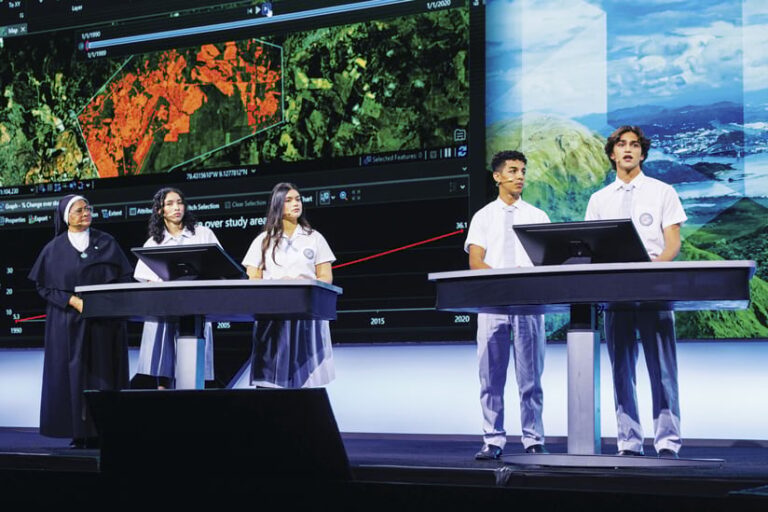
During the COVID-19 pandemic, Rodríguez Aranda began to wonder if the school was preparing the children for the uncertain future that lies ahead. After a student introduced her to GIS, Rodríguez Aranda began a quest to introduce geospatial analysis tools into the school’s curriculum.
Rodríguez Aranda worked with Esri to start a GIS program that would connect education, science, and technology. The program began with 17 students and 3 teachers and has since grown to more than 300 students, with 100 trained specifically in remote sensing.
“Now they map, analyze, create, and lead solutions for the community,” said Rodríguez Aranda.
Nieves Joel Pérez Moreno, Ricardo Enrique Sanchez Gonzalez, and María José Sepúlveda Calle—students at the Colegio Agustiniano in Chitré—led individual presentations on topics such as artificial lakes impacted by drought, urban expansion in Panama, and biodiversity research.
The final presentation was from student Franccesca Angelli Cravioto Salvatierra, who analyzed urban expansion in her hometown of Chitré. The results of her analysis show increased population growth in the central part of the city and a corresponding rise in land surface temperatures. Cravioto Salvatierra stressed that this is a call to action.
“We need digital, accessible tools like maps that anyone can use,” she said. “Chitré’s future shouldn’t be a guess. It should be a choice, one made with information, clarity, and vision.”
Rodríguez Aranda echoed this sentiment in her closing remarks, emphasizing that students in the GIS program are “learning to map based on real community problems, using the power of data with accessible tools, and committed to sustainable solutions and action that serve the community.”
It was a reminder that the call to use GIS to integrate everything, everywhere is not just an abstract idea. Organizing and visualizing data leads to informed decision-making, and this kind of action gives rise to communities that work better together, for everyone.
As Cravioto Salvatierra noted, the future shouldn’t be built on guesswork. It should be built on people’s shared knowledge, grounded in geography.