
Anthony Powell, IT manager for Houston Public Works in Texas, didn’t set out to become a strategic GIS leader, let alone the architect behind one of the most ambitious digital transformations in the United States. It was a happy accident.
While studying architectural drafting by day, he spent his nights digitizing telephone utility assets in a GIS database at a small mapping firm in San Antonio, Texas. That hands-on experience introduced him to spatial data and sparked a passion that would shape his career, beginning in 1988.
“I just fell in love with it,” he recalled. “Not just learning the assets but the logic, the GIS side of it—connecting the dots and understanding what goes into that.”

By 1992, Powell was helping lead the development of Houston’s first Web GIS platform, which made the city’s utility data accessible online to staff for the first time.
It was the first step in what would become a decade-long transformation. In a city that spans more than 600 square miles and faces constant pressure from flooding, growth, and aging systems, Powell has quietly helped digitize, modernize, and future-proof Houston’s infrastructure.
From Digitizing Utility Plans to GIS Leader
During Houston’s first Web GIS initiative in the 1990s, Powell—then a consultant at a private engineering firm hired to digitize the city’s utility records—helped manage the team tasked with the project. This work supported the development of a state-of-the-art water utility GIS management system for Houston that would later be called the Geographic Information Management System (GIMS).
The scope was staggering: More than 15,000 utility plan sets totaling over 1.5 million individual paper sheets, plus thousands of maps and countless engineering field books, needed to be digitized. The work extended over multiple shifts and required clear communication across a large and diverse team.
“That’s where I really built my project delivery and supervisory skills,” Powell said. “You had to keep the big picture in mind.”
The impact of the work was immediate. Mobile crews who once relied on paper drawings stored in file rooms could now access digital maps directly from their trucks—an early example of Powell’s people-first approach to GIS.
“We created something they could use anywhere, anytime,” he said. “And they loved it.”
In completing GIMS, Powell saw the full life cycle of GIS—from raw data to real-world application—and how spatial logic could drive smarter decision-making across Houston’s vast public works landscape. It was that end-to-end process, and the variety of challenges it presented, that sparked his deeper interest in GIS and inspired him to explore how technology could be used more effectively in the utility space.
“Afterwards, you look at the extraordinary amount of effort that went into not only learning but building one of the industry’s first geospatial web applications from digital data that didn’t exist. That was very exciting and definitely my ‘wow’ GIS moment,” Powell said.

That experience not only deepened his passion for GIS but also laid the foundation for a leadership style focused on setting clear goals, building trust, and empowering teams to solve problems creatively.
Leading Waves of Digital Transformation
Houston Public Works is one of the largest accredited public works agencies in the United States. It manages water, wastewater, stormwater, transportation, engineering, construction permitting, and customer water billing.
When Powell joined the department in 2005, GIS was still seen as a back-office tool—known only as the “GIMS system”—and was primarily used to print map books and locate water assets. While the city had made early strides with Web GIS, the technology wasn’t integrated much into daily operations.
Powell had a broader vision: “GIS anywhere, at any time,” he said.
With support from the department’s GIS manager and the GIS team at the time, they worked together to push GIS out into the field and across the department.
In 2006, Powell led the department’s migration from a custom-built GIMS environment to ArcFM, a commercial off-the-shelf solution from Esri partner Schneider Electric, which streamlined daily edits and utility data maintenance. By 2016, Powell was preparing for the department’s next digital leap: transitioning to Esri’s ArcGIS Utility Network model and building a more modern, robust enterprise GIS environment that could support mobile apps, dashboards, and real-time data across all business units.
To get ready for this, Powell wanted to hear directly from every business unit across the department to understand their operational goals and specific GIS needs. With help from Esri, Powell and his team held workshops with employees in each business unit—including the director’s office—capturing how GIS could support their initiatives and operations and where they could implement process improvements. A transition plan was designed around this feedback.
Changing to a new GIS environment was especially critical for emergency response. Now, emergency response personnel can use mobile tools for windshield assessments (rapid field surveys used to locate damage), predictive flood mapping, and automated reimbursement reporting for the federal government.
Embarking on this kind of transformation required more than technical knowledge and skill. “You have to build relationships and maintain trust, especially in a department this large,” Powell pointed out.
His strategy of centralizing data while empowering subject-matter experts to manage their own systems within a shared framework advanced collaboration. And through it all, Powell emphasized doing things with consistency, commitment, and discipline.
“It’s not just about building solutions,” he said. “It’s about knowing your customer, understanding their pain points, and building a solution around that information—not the other way around.”
The Right Tools for the Job
Powell has worn many hats during his tenure within the Public Works Department, including operations manager, GIS manager, interim chief technology officer, and now interim assistant director. Each role has shaped how he leads, listens, and builds systems that last.
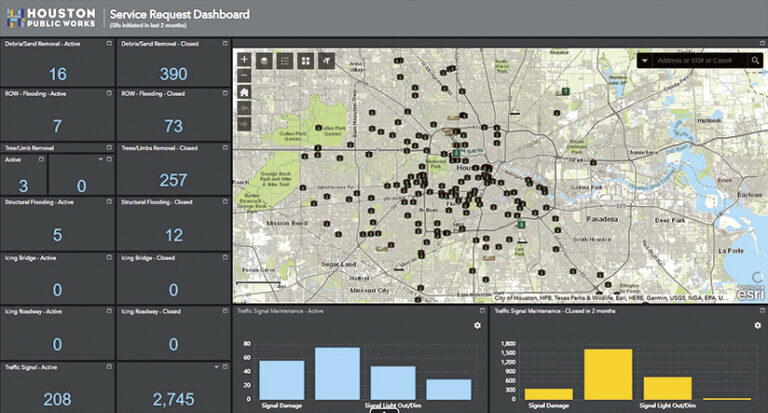
Under Powell’s leadership, Houston Public Works transitioned its enterprise GIS environment from on-premises infrastructure to the cloud. This has improved accessibility, resilience, and collaboration across departments.
“The transition has also created additional options in accessing critical GIS information during emergency events,” Powell said. “As long as you have power and internet access, you are able to leverage the environment and provide support.”
That move laid the groundwork for the department’s next step in extending GIS: using AI to collect and manage a massive inventory of transportation assets across the city.
“People suggested that we send crews out with mobile apps,” he said. “But since we have millions of signs and signals, that would take years.”
Powell partnered with a vendor to use AI-powered image recognition technology to scan 360-degree street-level imagery, extract asset locations, and assess their condition. In weeks, the city had a comprehensive, georeferenced inventory—a task that would have taken mobile crews a decade. That data now feeds directly into Houston’s work order system.
Still, Powell is quick to remind his team that technology is only as good as the problem it solves. He encourages his team to explore new technologies—but only after understanding the users and the added value that the solution will provide.
“You’ve got to know what you’re trying to achieve,” he said. “Then choose the right tool for the job.”
Throughout his career in Houston—navigating change, innovating, and building trust—Powell has come to believe that a successful GIS career is deeply personal and different for everyone.
“There are various levels to having a successful GIS career,” he said. “After you figure out the level that satisfies you, accept it, be committed, and be true to it.”
For Powell, whether building a system or mentoring a team member, he listens first, solves problems thoughtfully, and never cuts corners. That commitment has defined his four-decade career and continues to shape Houston’s GIS future.