
Managing 1,330 properties scattered across a sprawling transit network is complex, requiring financial analysis, tenant relations, maintenance, and strategic planning. When the number of properties is about to nearly double, effective management becomes critical.
Colombia’s second-largest mass transportation system, the Metro de Medellín, faced this challenge. The organization needed to ensure regulatory compliance, maximize commercial opportunities, and maintain public safety across a growing real estate portfolio. The solution was a specialized real estate asset system called Sistema de Activos Inmobiliarios, or SAI. Built on ArcGIS Enterprise, SAI has helped the Metro de Medellín optimize operations and improve efficiency.
A Complex, Interconnected Area
Located in the Andes Mountains at an altitude of about 5,000 feet, Medellín is part of the Aburrá Valley. The city is administered by the Aburrá Valley Metropolitan Area, which manages 10 municipalities, with Medellín as its core city.
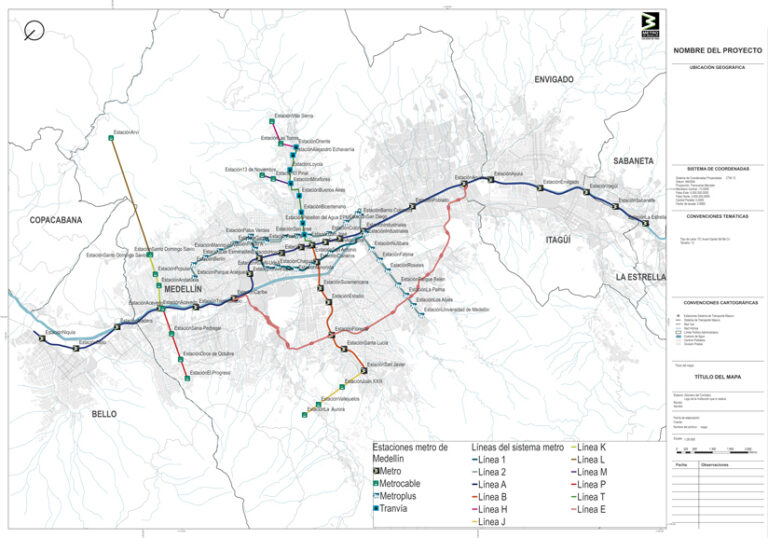
One of the challenges that residents of the valley face is mobility. To address this problem and promote integration between municipalities, the Aburrá Valley mass transportation company—known as the Metro de Medellín—was founded in 1979. It builds, operates, and manages a mass transportation system aimed at promoting development and improving quality of life for the region’s inhabitants.
As of 2025, the Metro de Medellín public transportation network included 27 train stations, 28 bus rapid transit stations, 20 cable car stations, and 9 tram stations. The network spans six municipalities and includes integrated routes to nearby areas, transporting more than 308 million passengers every year.
Planning for Growth
The Metro de Medellín implemented ArcGIS Enterprise in 2017, and it became the organization’s first real estate management system. Initial development included creating an enterprise geodatabase to centralize the location and management of geospatial data, as well as an open data platform to simplify data access and reduce data requests.
Benefits included enhanced route tracking, improved vehicle management, and faster emergency response. Staff also used ArcGIS Enterprise to develop a system expansion plan, with a goal of expanding the system network with additional or augmented public transit lines.
The software platform also helped the company develop a smart card app. The app enables contactless payments across Medellín’s public transportation system, including the metro, buses, and a bike-sharing system.
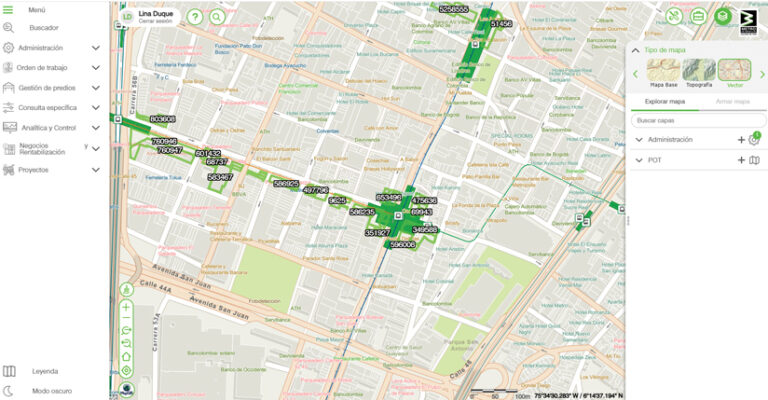
More recently, the company developed the SAI to provide the extensive spatial analysis capabilities the company needs to manage its real estate assets. Eventually, the system will incorporate AI to further optimize asset management and profitability.
Refining Real Estate Asset Management with Geospatial Analysis
“The SAI arose from the Metro de Medellín’s need for an innovative technological tool based on geospatial data,” said Lina María Duque González, a GIS professional at the Metro de Medellín. “It enables the agile and timely management of properties, commercial spaces, and other real estate assets.”
The SAI platform also helps ensure compliance with Colombia’s Land Administration Domain Model, a framework for land administration that improves data interoperability and resolves ownership issues.
As of February 2026, the Metro de Medellín manages approximately 1,330 properties. The new 80 Avenue line—scheduled to open in 2028—will add 1,239 more. This will bring the total to 2,569, Duque said, adding that geospatial analysis allows the Metro de Medellín to determine the best use of these properties for residents and the company.
The Metro de Medellín developed the SAI by integrating the company’s corporate systems—including ArcGIS Enterprise and other enterprise software—in a process that took more than a year. The SAI’s administrative modules include data visualization, work order management, tax and legal requirements, commercial and profitability information, management tracking, and historical documentation.
“Thanks to the inclusion of national standards in the SAI and the integration of recognized management systems, the platform can be easily adapted to enable other organizations in the region to manage their real estate assets,” Duque said. “We hope to expand this capability in the future.”
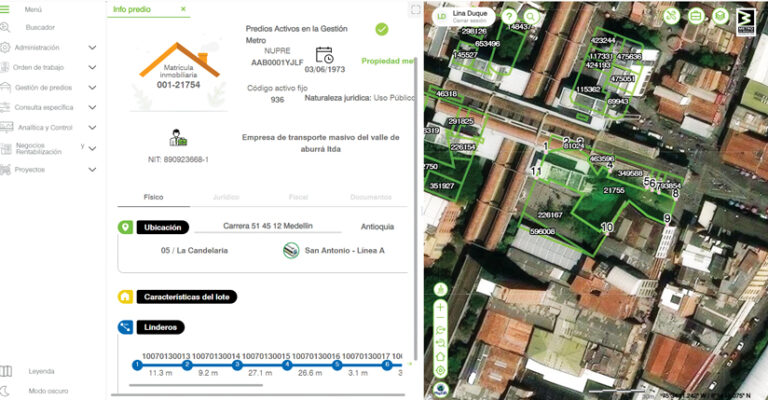
The ArcGIS technology used in the SAI system is integrated with the Metro de Medellín’s corporate geodatabase to process cartographic information. Staff use ArcGIS Maps SDK for JavaScript to create web apps. ArcGIS Server broadens data access by providing web access to SAI data. And ArcGIS Survey123 has transformed the Metro de Medellín’s asset inspections and maintenance workflows by enabling staff to collect data from around the transportation system and upload it to the SAI.
Data Centralization Results in Savings
All departments at the Metro de Medellín can use the SAI system to obtain information about the company’s properties. Data centralization increases productivity and helps minimize the duplication of efforts in real estate asset management. These GIS solutions have streamlined workflows and boosted efficiency across the organization.
“Proper management of real estate assets has allowed us to reduce the tax burden on the company’s properties,” Duque said. “We generated savings of $2.71 million between 2021 and 2024.”