
Home to nearly half a million residents, Atlanta, Georgia, is one of the most diverse cities in the Southeastern United States, according to US census data. A rich demographic mix of Black, white, Hispanic, Asian, and multiracial populations span urban and suburban neighborhoods. Residents have varying income and education levels, as well as employment opportunities in fields that range from government and education to film and small business. These varying lifestyles influence everything from housing and business development to transportation, food access, and neighborhood investment.
To foster prosperity and equity across its diverse communities, the city’s economic development authority, Invest Atlanta, is now leveraging interactive maps and visual storytelling to turn complex datasets into actionable insight. Invest Atlanta’s use of GIS technology, particularly ArcGIS Online, has enabled initiatives in affordable housing, small business growth, and neighborhood revitalization with precision and transparency.
Quickly Deploying Different Tools
When Invest Atlanta started using GIS to give clarity to economic and social data, it changed the authority’s approach to economic development, according to Nicole Torno, manager of data analysis at Invest Atlanta. Torno described this as a twofold transformation—of technology and communication—that addresses the technological challenges often faced by municipal teams and nonprofit organizations.
“One of the great things about ArcGIS is that I have one license for a platform that enables me to develop and deploy a lot of different tools a lot more quickly than if I were to write code to deploy a web app myself,” she said.
This functionality and flexibility enable Invest Atlanta to rapidly create and release web apps and interactive maps. Instead of stakeholders having to wait for data, which can delay critical projects, they get access to it quickly in easy-to-understand formats.
The second aspect of the organization’s transformation is communication. GIS technology provides a personal and relatable way to convey the importance of Invest Atlanta’s work, Torno explained.
“People relate to maps, and when you give community members something interactive to work with, it allows them to feel a personal connection to that data they’re looking at,” she said.
Promoting Equity and Prosperity
Invest Atlanta’s decision to use ArcGIS Online was inspired by the success of its partners. Torno’s predecessor noticed that many of the organizations Invest Atlanta worked with—including the City of Atlanta and local counties—had gained a lot from using ArcGIS. The platform’s ease of use and the availability of valuable data in ArcGIS Living Atlas of the World led Invest Atlanta to acquire its own ArcGIS license in 2021.
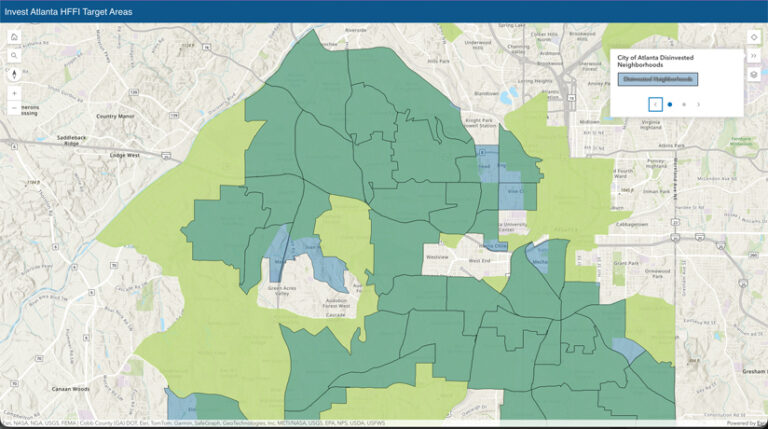
Today, GIS technology is essential to Invest Atlanta’s goal of advancing equity and prosperity for all in Atlanta. The organization has specific place-based key performance indicators (KPIs) that are part of its strategic plan, including investing in places that have historically lacked opportunities for economic advancement. For example, Invest Atlanta mapped the areas where residents face the highest risk of getting displaced from housing to discern who should benefit from an antidisplacement tax relief initiative. The initiative pays property tax increases for low-income seniors so that they can continue living in their homes.
Likewise, the GIS-powered City of Atlanta Affordable Housing Tracker is a critical tool for monitoring progress toward Atlanta’s goal of creating or preserving 20,000 affordable homes by 2026. Invest Atlanta collaborates with Atlanta Housing and the City of Atlanta to show progress toward city housing goals, while interactive maps help identify suitable locations for new affordable-housing developments. Tools such as the neighborhood planning units dashboard use census tract data to help organizations understand and address disparities in economic mobility and build support for neighborhood revitalization.
GIS has proved critical for Invest Atlanta to monitor its progress in intentionally investing in the areas of greatest need.
“If we weren’t using geospatial analysis to question where in the city our projects are and where our money is going, we would never be able to track that accurately,” Torno said.
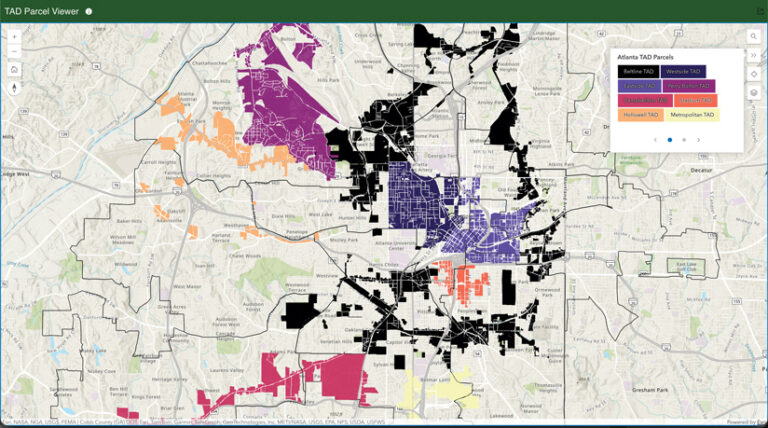
Local public mapping databases also help Invest Atlanta verify parcel information, zoning, and eligibility for incentive programs such as Tax Allocation Districts (TADs), which guide Atlanta’s reinvestment in underserved communities for infrastructure, blight remediation, and affordable housing. TAD-funded success stories that Invest Atlanta supported include the City of Refuge Transformation Center, which provides housing solutions, employment help, and basic medical care to residents of an underserved area; and Azalea Fresh Market, a first-of-its-kind municipally run grocery store in Atlanta’s downtown area.
Supporting Small Business Growth
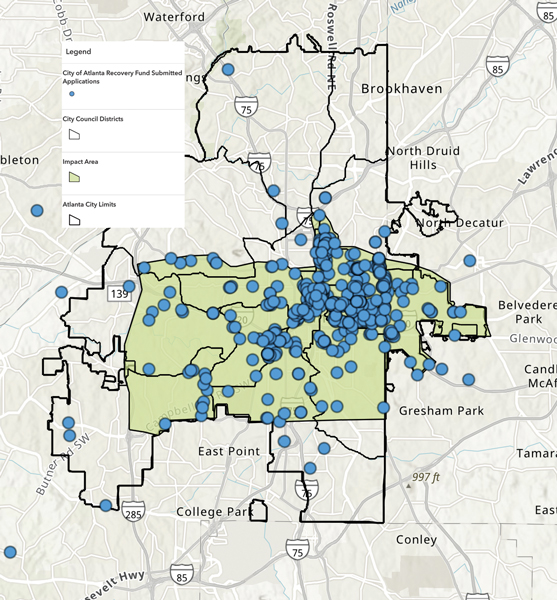
Invest Atlanta uses GIS-powered insights to foster small business development as well. One notable example is when unforeseen business disruptions occur and Invest Atlanta has relief funds to disburse. When a water main break impacted small businesses, for instance, eligibility for recovery grants was mainly determined by whether businesses were located in the impact area.
That program set the precedent for how other grants have been handled since then. When Atlanta’s Cascade Road experienced two years of delays on a construction project—reducing traffic and customer access to shops, restaurants, and service providers—precise mapping ensured that financial assistance reached the businesses most in need. It also provided clarity.
“By being able to show people exactly where [the area of eligibility] is, exactly how they’re eligible, and how we’re going to verify their eligibility, you have a really high level of data transparency,” Torno said.
To ensure that its GIS tools and data are accessible to small business owners, Invest Atlanta focuses on clear communication and user-friendly design with simple instructions and intuitive interfaces, Torno explained. This includes providing direct links to maps, splash screens with usage instructions, and accessible legends that avoid jargon. Features such as direct search capabilities and hiding less relevant layers make the tools useful for busy entrepreneurs.
Measuring Impact and Future Horizons
Invest Atlanta measures the success and impact of its GIS-driven initiatives through place-based KPIs, such as the percentage of investment in underserved neighborhoods and the proportion of small businesses served in those areas. The marketing team also tracks website visits; unique page views; and time spent on pages, including those featuring interactive maps and KPI dashboards. While specific performance metrics for individual GIS tools are not yet established, these tools are integral to the success of broader programs.
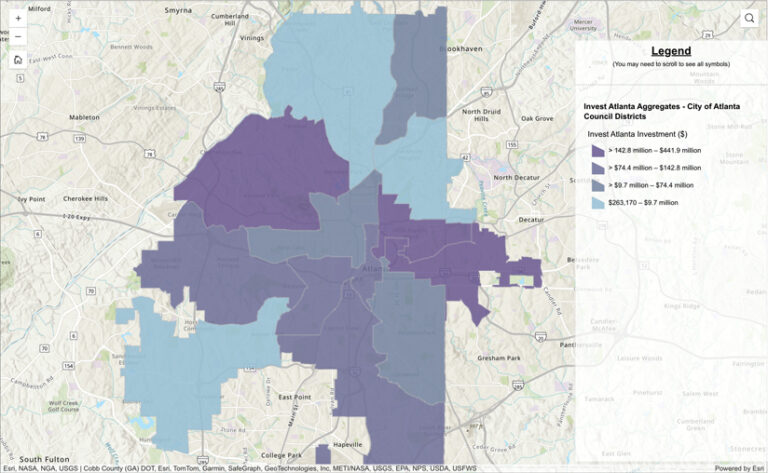
Reflecting its commitment to transparency in reporting, Invest Atlanta offers an ArcGIS Experience Builder web app that allows anyone to easily view Invest Atlanta projects sorted by neighborhood, project type, and amounts invested.
“All of our projects are uploaded every single month so that people can see exactly what kinds of projects are being funded, know where our resources are going, and understand the impact directly,” said Torno.
Plans for expanding its use of GIS include developing a more comprehensive way to track fresh food access initiatives. Invest Atlanta has created its own food desert dataset, and this custom data—combined with disinvested area maps—helps guide funding for projects that improve residents’ access to produce and other healthy foods. The goal is to track progress toward the mayor’s objective of ensuring that 100 percent of Atlantans have access to fresh food within a half mile of where they live. This will be similar to how the housing affordability tracker monitors Atlanta’s housing goals. Enhanced collaboration with its partners is also a key focus for future GIS expansion.
Invest Atlanta’s GIS approach stands out for its commitment to transparency and data integrity. Project data is uploaded monthly, allowing the public to see where resources are allocated and understand their impact. Invest Atlanta also often provides GIS services and data to city, county, and state entities that lack similar technical capabilities.