
When the newly formed Adams County Health Department (ACHD) in Colorado set out to modernize its operations in 2023, it sought to create a unified, data-informed foundation for public health. Emerging from the dissolution of the Tri-County Health Department, ACHD began with a rare opportunity: to design its systems from the ground up.
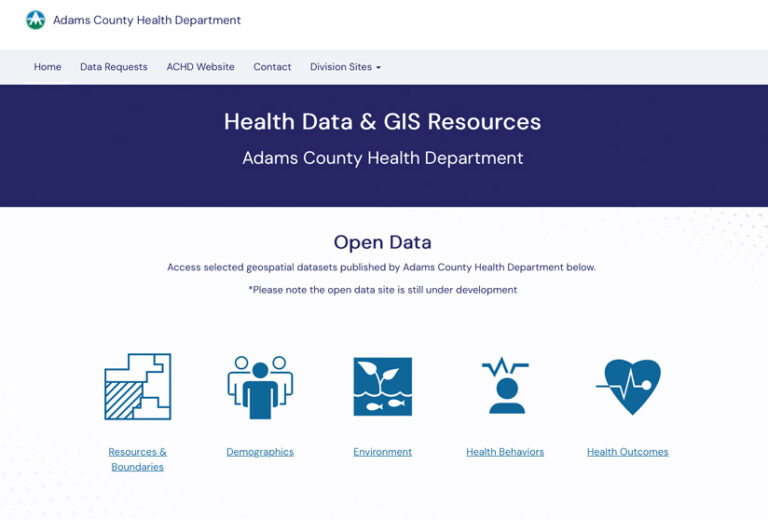
ACHD prioritized GIS technology and made it the backbone of its operations. The department built the Integrated Data System (IDS) that now connects every division, dataset, and workflow. The enterprise-wide platform enables Adams County to manage data, streamline public health processes, and respond rapidly to community-specific needs—all through the power of location intelligence.
From Fragmented Data to Integrated Systems
Before the IDS, Adams County staff relied on spreadsheets, manual data entry, and isolated databases. Data for programs such as communicable disease investigations and tracking, environmental inspections, and client referrals lived in different systems. This made it difficult to understand cross-program trends or identify at-risk populations in real time.
ACHD leadership recognized that traditional data systems would not meet modern expectations for transparency, interoperability, or spatial context. The department needed a comprehensive, well-governed, and secure approach that would unite health, environmental, and community data in one enterprise framework. Not only would this connect datasets, but it would also improve cross-program communication by enabling staff from different divisions to work from a unified view of public health information.
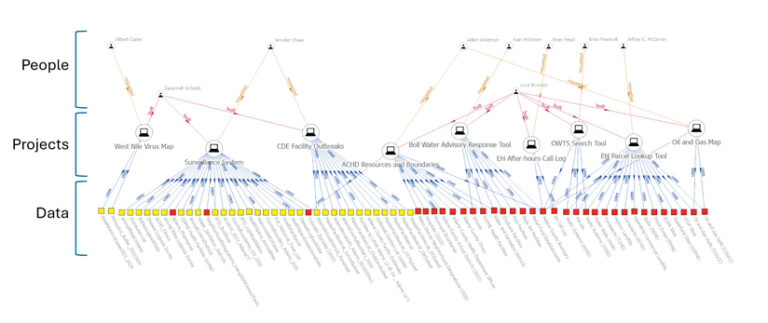
Now, the IDS is the foundation for ACHD’s internal data. It links datasets, workflows, and documentation across all divisions through a centrally governed geospatial framework. Built on ArcGIS Enterprise, SQL Server, and FME from Esri partner Safe Software, the IDS standardizes data collection and enables continual data exchange. Additionally, ACHD uses ArcGIS Knowledge for data cataloging, which ensures that staff can access current, authoritative information across programs.
“The IDS ties together every dataset, workflow, and program,” said Adam Anderson, director of epidemiology and data science at ACHD. “GIS is the thread that turns data into insight across the entire department.”
The Building Blocks of Modernization
From the outset, ACHD established a robust data governance framework—an essential aspect of long-term system sustainability and trust. Staff use ArcGIS Knowledge to catalog every dataset with its ownership, user access, update cycles, and defined connections to apps and projects. This ensures transparency and security, reduces duplication, and allows leadership to see how data is used across programs. It also ensures that as system access expands across diverse programs and roles, the data remains consistent, secure, and appropriately managed. Governance documentation—including data dictionaries and workflows—formalizes each project’s life cycle, creating a repeatable model for future systems.
To replace fragmented manual workflows, ACHD adopted ArcGIS Survey123 to standardize data collection across the department. Survey data automatically feeds into SQL databases and ArcGIS through FME-based automation pipelines, enabling near real-time updates. This unified approach simplifies how programs collect, share, and visualize data and supports initiatives ranging from food inspection and lead exposure monitoring to client referral tracking.
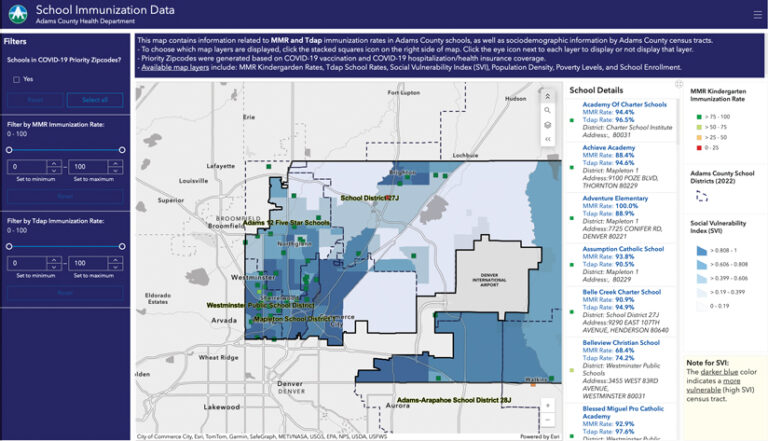
The IDS is also linked to multiple data systems, including HealthSpace, the state’s system for public health permitting and inspections; the Colorado Department of Public Health and Environment; demographic data; and county parcel data. This means that the ACHD created a single ecosystem for public health. Staff can now analyze the complex relationships between factors such as pollution exposure, housing density, and health outcomes, providing insight that was previously difficult to garner.
Everything on the Same Spatial Foundation
Adams County faces major environmental challenges from the impacts of air pollution, Superfund sites, Resource Conservation and Recovery Act (RCRA) sites, and ongoing oil and gas operations. GIS tools help identify, monitor, and communicate information about these risks.
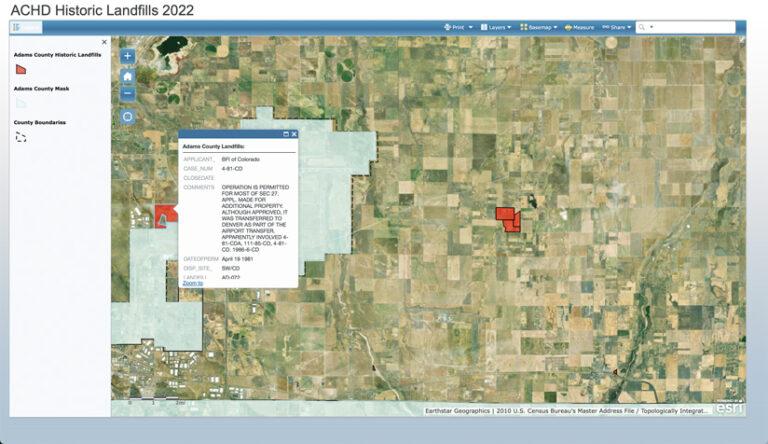
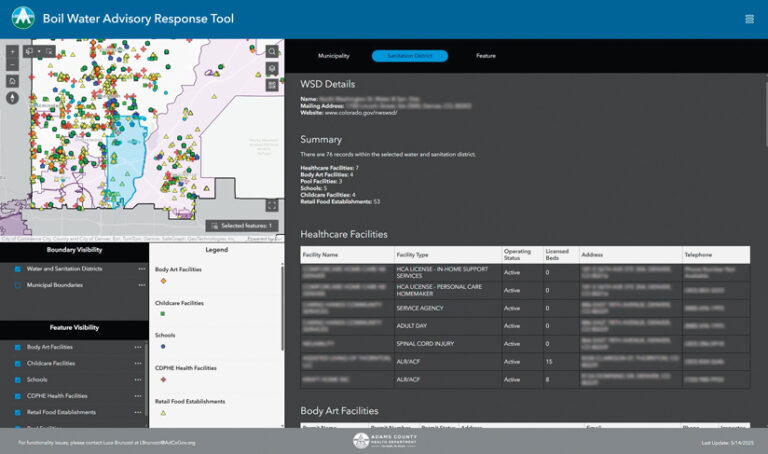
The Parcel-Based Search Tool allows staff to search for environmental records—such as on-site wastewater treatment system (OWTS) permits, RCRA sites, landfills, and spills—by parcel, integrating county, state, and federal datasets. The OWTS Search Tool, which pulls data from HealthSpace and links it to parcel boundaries, enables the public to find septic permit records. The Boil Water Advisory Response Tool uses GIS to identify every facility within a water district during advisories, improving communication and response times. And the Environmental Health Call Log tracks community complaints spatially for trend monitoring and program accountability.
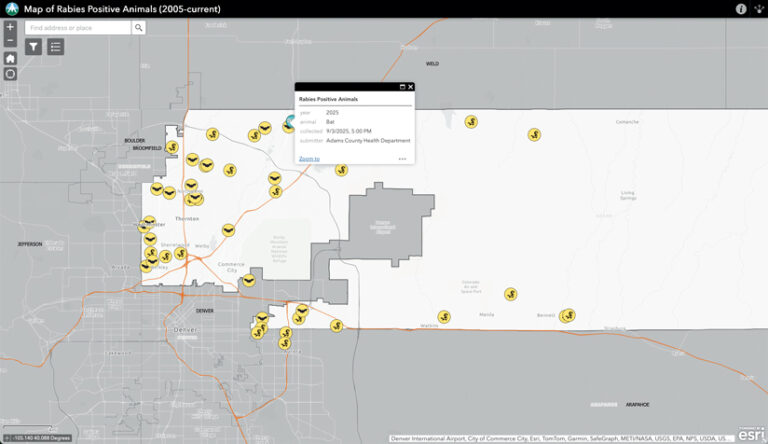
To provide better surveillance of communicable diseases, ACHD replaced spreadsheet-based tracking with its automated Communicable Disease Surveillance program, which integrates with the state’s reporting system, EpiTrax. Case data now flows automatically into dashboards, built with ArcGIS Dashboards, for visualization and analysis, allowing real-time monitoring of outbreaks.
GIS-based outbreak mapping also improves internal coordination among teams. For example, environmental health and communicable disease staff can view and act on the same exposure data simultaneously, enhancing situational awareness and collaborative response. A measles outbreak simulation demonstrated how automated dataflows help staff immediately map exposure sites and engage in rapid containment.
Other core systems built on the IDS include:
- The Central Referral System, which digitizes client intake forms and referral tracking to help with follow-ups.
- The Sexual Health and Harm Reduction application, which integrates with state systems to manage testing, outreach, and resource distribution.
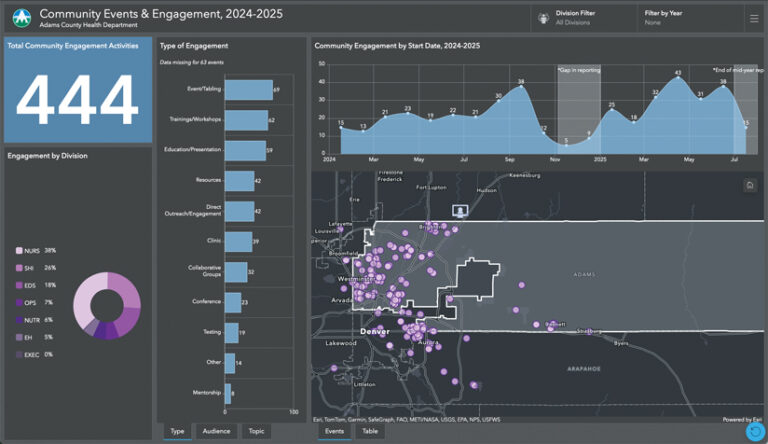
- ArcGIS Hub sites that provide the public with data, maps, and resources via dedicated portals for substance abuse, mental health, and healthy aging.
“Every public health program in Adams County runs on the same spatial foundation,” said Anderson. “GIS connects our daily work, from inspections to surveillance to community outreach.”
Better Opportunities for Good Health
As ACHD aimed to break down its data silos, unify workflow systems, manage data, and provide user access to that data, the team realized significant benefits that extend far beyond the staff’s own efficiency and effectiveness. Residents of Adams County are now served with better options and opportunities for good health.
Integrating data eliminated redundant spreadsheets and manual data entry across divisions. Automated data collection and near real-time reporting has improved operational efficiency. Staff can now track how data is being used across projects and programs, increasing transparency and accountability. And GIS dashboards now allow internal teams to work from a shared spatial understanding of public health issues while improving external communication—supporting faster, more aligned interventions.
All this helps ACHD respond more quickly to public health events and keep community members in the know. The public-facing hubs, in particular, make complex data accessible to ACHD’s partners and residents, enhancing equity and engagement and boosting people’s trust in the public health system.
A Blueprint for Modern Public Health
By centering GIS in its data modernization strategy, ACHD built more than an information system—it built a living, spatially intelligent infrastructure. The IDS connects people, data, and programs, supporting every public health function from disease surveillance to environmental response.
“GIS is the connective tissue of our health department—it links programs, reveals context, and drives smarter action for our community,” said Anderson.
Adams County’s experience demonstrates that GIS is not simply a mapping tool but a core component of modern public health operations. It allows departments to integrate disparate data, visualize community needs, and act decisively.
This data modernization strategy is repeatable by any health department looking to centralize its data resources and make them accessible to all relevant stakeholders. To learn more about how you can adopt this pattern for your organization, get in touch with Esri’s Health and Human Services team at healthinfo@esri.com.