
In humanitarian crises, having access to timely and accurate geospatial data is crucial for delivering aid to those who need it most. To achieve this, coordination and unity among response teams are essential.
This is why the United Nations (UN) Office for the Coordination of Humanitarian Affairs (OCHA)—guided by a geospatial data strategy drafted in 2022—secured an enterprise agreement with Esri in 2023. The partnership enables all OCHA staff, both at UN headquarters and in the field, to access the same ArcGIS technology and online resources. This creates a unified and efficient geospatial environment that enhances decision-making and response efforts.
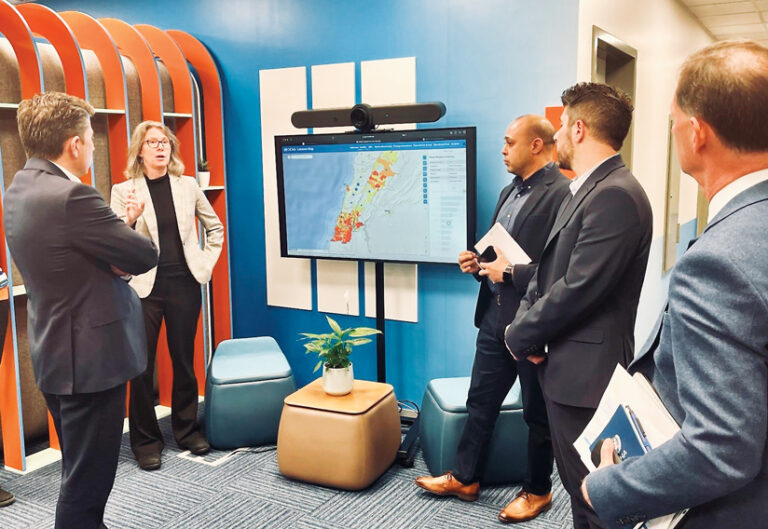
Now, OCHA’s humanitarian workers can use the same authoritative data—coming from the same geodatabase and held to the same metadata standards—to collaborate during critical, fast-moving events. And that can make all the difference.
A Geospatial Strategy
OCHA’s enterprise transformation began when its field information services (FIS) team drafted a geospatial data strategy in 2022. The strategy summarized the need for consistent tools, centralized data, and shared services across OCHA. It highlighted how efforts were frequently duplicated and costs rose when individual offices managed their own licenses, data storage, and mapping standards.
The strategy helped senior management recognize both the operational value and cost savings of a consolidated approach. The next year, OCHA signed an enterprise agreement with Esri, turning this strategy into action.
OCHA staff worked closely with Esri engineers to design the enterprise infrastructure and refine the approach, ensuring that its system could support staff at headquarters and those in field offices. In addition to being a sound financial decision for OCHA, the enterprise agreement reflected leadership’s commitment to building predictable, reliable geospatial capacity across the organization.
Centralized Data and Sound Metadata
At the heart of OCHA’s mandate is maintaining Common Operational Datasets for Administrative Boundaries (COD-AB). Historically, these datasets were scattered across different country offices and managed in various formats. Through the enterprise rollout, OCHA consolidated COD-AB into a centralized SQL geodatabase connected to ArcGIS Enterprise. This provides a single authoritative source for administrative boundaries that underpins all field mapping activities and ensures consistency across humanitarian relief operations.
Equally important is an emphasis on metadata governance. Each COD-AB record is tagged with standard metadata fields, including review dates, validity periods, and lineage information. Taking a systematic approach to metadata ensures transparency and trust in the boundaries, which humanitarian relief providers use to develop population statistics, create needs assessments, and coordinate efforts.
OCHA also automated COD-AB data sharing with the Humanitarian Data Exchange (HDX), a website managed by OCHA that makes it easy for humanitarian workers around the world to find and use relevant data. OCHA’s FIS team worked with the HDX team to integrate the site with ArcGIS Enterprise. Whereas field offices used to send their COD-AB data (which typically wasn’t standardized) to HDX, now a Python coding pipeline automatically checks for new data and updates the HDX website when needed. The old manual and time-consuming process is streamlined, with boundary updates flowing seamlessly to the wider humanitarian community, keeping partners aligned during rapidly evolving crises.

Streamlined License Management
In addition to improving workflows and data sharing, OCHA centralized license management under the enterprise agreement. Now, all staff members have access to the level of software and user types they need, rather than having individual field offices and sections negotiate separately with Esri. This unified approach reduces administrative overhead and guarantees that technical capacity matches operational needs across the organization.
With consistent access to ArcGIS Pro and ArcGIS Enterprise, OCHA staff have standardized online mapping templates for situation and reference maps, as well as interactive dashboards. These templates allow field offices to build products that are visually coherent, technically robust, and easy to update. The result is faster turnaround times and greater comparability across crises.
Collaboration Gets Transformed
Enterprise technology, shared structures, and elevated trust have transformed collaboration during humanitarian responses.
Instead of exchanging shapefiles or PDFs via email, OCHA staff, clusters (groups of humanitarian responders organized by sector), and UN agencies coauthor web maps, apps, and analyses in real time. Permissions are managed through enterprise groups to protect sensitive data while enabling authorized partners to contribute directly. This approach saves time, reduces duplication, and ensures that all actors are working from the same authoritative information.
To extend participation beyond OCHA, the organization has established distributed collaboration with several trusted partners, including the Logistics Cluster, which coordinates and provides shared logistics services to keep humanitarian aid moving efficiently during emergencies. Datasets and apps flow seamlessly between systems, giving logisticians and coordinators access to the same operational picture.
One public-facing example of this coordination is the Humanitarian Access and Conflict Dashboard for Lebanon. The app, built with ArcGIS Experience Builder, shows—in a single GIS-based interface—up-to-date data on resources and infrastructure in Lebanon. These include entry and exit points, airports, and ports; where damage has been reported; population movements; and critical facilities. The maps, charts, satellite imagery, and time slider support coordination and decision-making in this sensitive and fast-changing context.
Building for the Future
OCHA spent more than two years testing and piloting everything from data standardization, schemas, and metadata to web map styles, templates, and apps. In 2026, the organization plans to roll out operational web maps like the Lebanon example across all its country and regional offices. These apps will give field teams a consistent way to track essential issues and needs in areas where humanitarian crises are bubbling up and in full force.
In parallel, OCHA is expanding automation and analytics using ArcGIS API for Python to support content-audit dashboards and strengthen metadata governance. Vector tile basemaps, versioned COD-AB workflows, and offline-ready mobile solutions are also in development to ensure that OCHA’s geospatial backbone remains predictable and reliable even in the most demanding field environments.
Systemwide Approaches Work
By centralizing data, standardizing workflows, and consolidating licensing, OCHA has turned a fragmented system into an organization-wide geospatial service. The enterprise agreement with Esri has improved internal efficiency while strengthening OCHA’s ability to deliver timely, trusted geospatial information to the humanitarian community.
In just two years, OCHA moved from developing a strategy to implementing systemwide approaches. Although there is much more work to do, the foundation has been laid with clear guidance, a focus on metadata, standardized templates, and training—ensuring sustainable growth.