
In a community with a population of just over 6,000, the City of Starke, Florida, operates one of the smallest municipal utilities in the state. But that doesn’t mean its technology needs are slight.
For decades, the utility relied on institutional knowledge, veteran line workers who knew the power grid by memory, and 35-year-old paper maps to manage its infrastructure. Without a modern GIS implementation or digital records, the city faced growing operational risks and limited visibility into critical assets, including poles, attachments, and lighting infrastructure.
That changed when the city’s newly appointed director of utilities, David Sparks, deployed ArcGIS Online to manage and maintain the city’s grid. Collaborating with two Esri partners—1898 & Co., a leading technology consulting firm, and Noteworthy AI, a provider of AI-powered utility asset inspection solutions—Starke quickly transitioned from analog processes to a digital-first approach without exceeding the city’s budget.
Building a GIS from Scratch
At the outset, Starke had no formal inventory of its utility poles, only estimates that ranged from 2,500 to 3,000 total. With limited internal resources and no prior digital records, the city faced a fundamental problem: how to cost-effectively collect field data and populate the city’s new ArcGIS instance with accurate, up-to-date information.
Initial estimates to manually collect geolocated images for each pole, even without attribute or defect data, were drastically over budget. The cost exceeded the city’s available funds and would not have provided the necessary asset intelligence to justify the investment.
To keep costs low, the city tried to train its line workers to collect pole data manually in their spare time. After several months, progress was minimal, as line workers necessarily placed higher priority on active grid maintenance. It became clear that a new approach was needed—one that was fast, accurate, scalable, and within budget.
A Strategic Partnership
Recognizing the need for a technology-forward solution, 1898 & Co. introduced the City of Starke to Noteworthy AI. Known for its vehicle-mounted camera system and AI-powered collection and analysis of utility asset data, Noteworthy AI—a recent graduate of the Esri Startup program—offered a turnkey solution that addressed Starke’s needs far beyond simple pole counts.
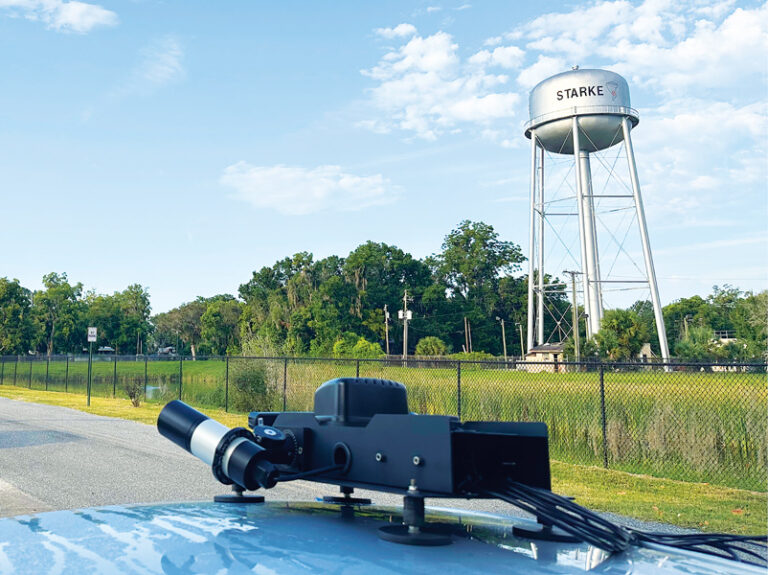
Instead of just capturing photos and locations, Noteworthy AI proposed a collection-as-a-service model that would provide comprehensive field data using the company’s vehicle-mounted camera systems. Noteworthy AI’s solution automatically captured geolocation and high-resolution imagery for every pole; modeled asset inventories using AI; and detected defects, including structural issues and stubbed poles (remnants of old utility poles often left next to new ones). Noteworthy AI also provided vegetation growth analytics, lighting audits, and counts of joint-use poles as well as poles with third-party attachments.
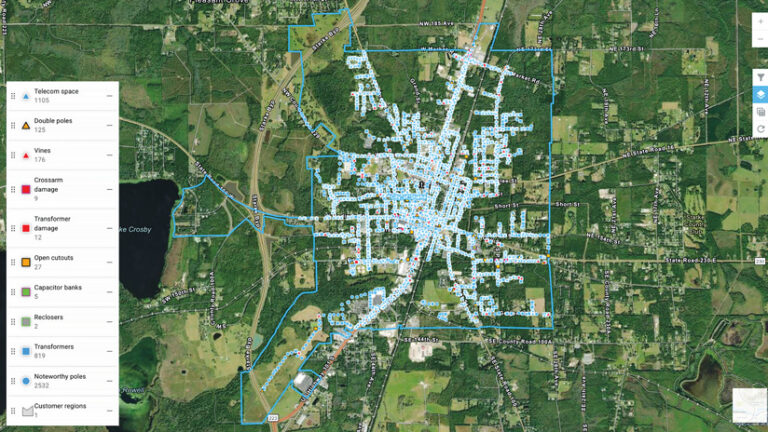
All data was delivered directly into the city’s new ArcGIS Online system, furnishing an integrated and immediately actionable digital record of the grid.
“Noteworthy AI was a transformative partner on this project,” said Darris Friend, senior GIS specialist at 1898 & Co. “Their AI-powered approach allowed the City of Starke to collect the mission-critical data needed to populate ArcGIS quickly and cost-effectively.”
All the Poles in the City, Captured in Seven Hours
Over just two days, Noteworthy AI completed field collection across the entire service territory, capturing more than 2,300 utility poles in under seven hours of drive time. Using its vehicle-mounted camera system and AI-powered analysis, Noteworthy AI delivered a complete pole inventory that included imagery, GPS coordinates, and attribute data. All of this was delivered directly to ArcGIS Online.
In total, the project cost up to 80 percent less than traditional manual inspection methods. What would have likely taken several months or longer was instead completed in a single day with a fast, accurate, and scalable solution.
Better Data and Smarter Operations
With its ArcGIS Online data fully populated, City of Starke staff began making more informed decisions across grid planning, maintenance, and storm response.
Instead of relying on outdated maps or institutional knowledge, utility employees could access a centralized, searchable GIS with real-time visibility into pole material, locations, and ownership; streetlight status and condition; vegetation encroachment; asset defects; and anomalies such as leaking transformers. In addition, the new system provided data on joint use and third-party attachments, open fuses, and arrester material.
Noteworthy AI’s automated defect models flagged structural issues such as damaged, leaning, or stubbed poles, helping Starke prioritize repairs and reduce safety risks. These early insights give a baseline for predictive maintenance strategies, which can prevent outages and extend asset life.
The joint-use audit delivered a full accounting of third-party attachments across the system. For a smaller utility like Starke’s, this was especially valuable. Many of these attachments were previously unbilled, representing missed recurring revenue. With verified counts now in ArcGIS Online, the city can reconcile billing records and potentially recover tens of thousands of dollars annually.
Industry averages suggest that unbilled attachments could equal $10–$30 or more per attachment in lost revenue per year, making this audit a meaningful financial win that helps offset project costs and fund future improvements.
“This project was a big leap forward for our utility,” said Sparks. “Moving from institutional knowledge and paper maps to a fully digital view of our grid in ArcGIS gives us the tools to better serve our community. Noteworthy AI’s data collection made this transition possible in a way that was affordable and fast.”
Scalable for Utilities of Any Size
While many technology deployments begin with large investor-owned utilities or well-funded cooperatives, the City of Starke proved that GIS- and AI-powered asset data collection is accessible to utilities of any size. The city’s successful execution also shows that a utility can conduct a full territory scan in a single day, at a fraction of the cost previously thought possible.
“Timely and actionable grid insights are critical to utilities of all sizes. A project like [the one at] the City of Starke shows what’s possible when you combine scalable data collection with smart GIS integration,” said Noteworthy AI CEO Chris Riccuiti. “If we can deliver this level of value for even a small municipal utility, the potential impact for larger organizations could be exponentially greater.”
A New Standard for Cost-Effective Grid Visibility
The City of Starke’s GIS journey underscores the power of collaboration among Esri, its partner network, and forward-thinking startups like Noteworthy AI. With 1898 & Co. leading implementation and ArcGIS serving as the central platform, Starke successfully transitioned from legacy mapping to a real-time, data-driven grid without exceeding its budgetary constraints.
By combining AI-driven data collection with the analysis capabilities of ArcGIS, small municipal utilities can unlock new efficiencies, reduce operational risk, and improve service to their communities. In the case of Starke, a few hours of data collection delivered decades’ worth of progress.