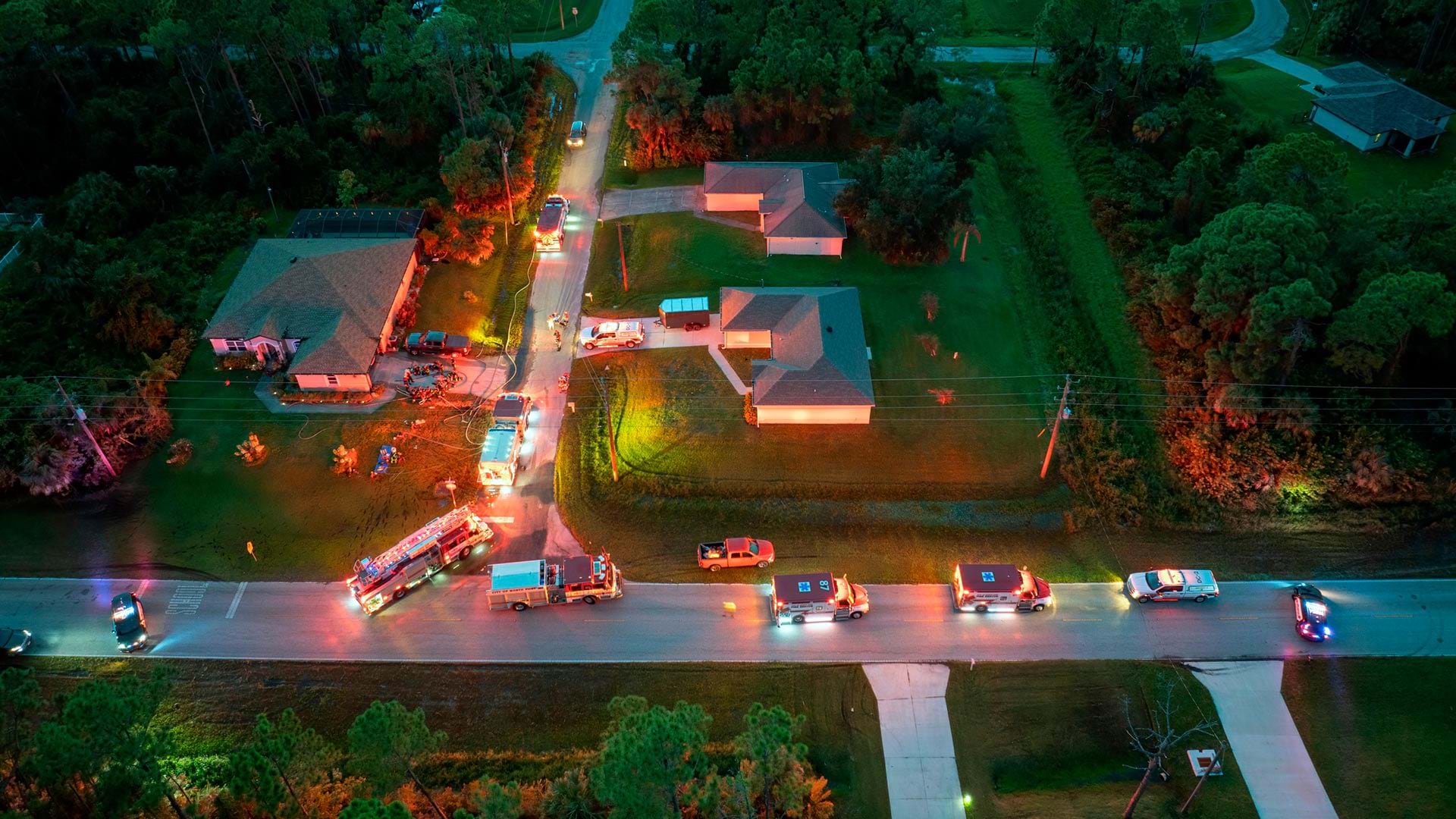
An elderly man called 911 several times on behalf of his wife, whose medical condition could turn life-threatening quickly. Each time, the call took over a minute to connect.
The problem, eventually traced by 911 staff, was that the couple’s address didn’t exist in the system—no address point, not even a road centerline range encompassing their location. Just a gap in the map where their home should have been.
“That story has always stayed with me,” said Brooks Shannon, Esri’s director of emergency communications solutions. “He wasn’t calling about something minor. Every one of those calls mattered. And every one of them was delayed by a data problem that nobody knew existed until someone went looking.”
This is the highest-value problem that an accurate address solves. When 911 dispatchers receive a call, everything that follows depends on whether the location of the caller is real, current, and spatially correct. The dispatcher, the route, and the first responder who drives fast down unfamiliar streets are all downstream of a single data point. Get the address wrong, and the system fails.
And while getting to the right building is one problem, getting to the right door and room is another. The correct address must exist on the map to make all this possible. Yet only now are the adequate tools, standards, and national frameworks converging to tackle this issue.
What makes accurate addressing a stubborn problem to solve is that the United States maintains not one addressing system but many. Each city and county has its own standards, update cycles, and tolerances for error. Actively-used data gets scrutinized, corrected, and kept alive. But data that is consulted by no one outside a single department can harbor gaps for years without anyone knowing.
The address of the man who was trying to get help for his wife had almost certainly been missing from the system for a long time. It took a life-threatening pattern of failed calls to reveal the problem.
Mapping the Path to an Answer
Across the country, local GIS professionals close those gaps. In the United States, addresses are assigned and maintained at the local level—by counties, municipalities, and 911 authorities—then shared with public safety answering points (PSAPs) that dispatch first responders.
When that chain works, a call becomes a coordinate, a coordinate becomes a route, and a route expedites help. When it breaks anywhere, the consequences are immediate and human.
Next Generation 911 (NG911) is the nationwide transition from analog, landline-era systems that have routed emergency calls for decades to fully digital, Internet Protocol (IP) networks. These networks can handle calls from mobile devices, accept texts and video, and use live GIS data to route calls geospatially rather than by address ranges in a table.
The transition to NG911 has forced many states to confront how fragile that chain can be. Moving from a decades-old tabular address guide to fully geospatial call routing means that every county’s road centerlines, address points, and jurisdictional boundaries must be accurate and synchronized with neighboring counties’ data. In fast-growing areas, the challenge compounds as new structures go up faster than the map can keep pace, leaving a window where a call from a new home can fail in the same way a call from a missing address does.
The work is painstaking. Rural addressing schemes can be decades out of date, there may be dual-address legacies from past county consolidations, and neighboring jurisdictions can have boundary conflicts. All this must be negotiated one line at a time.
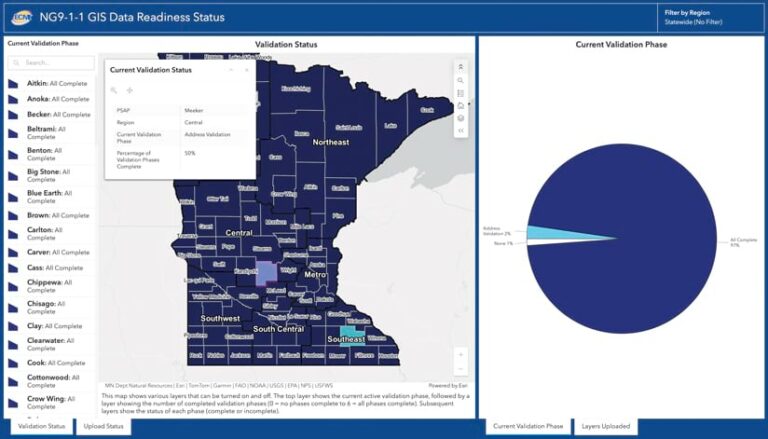
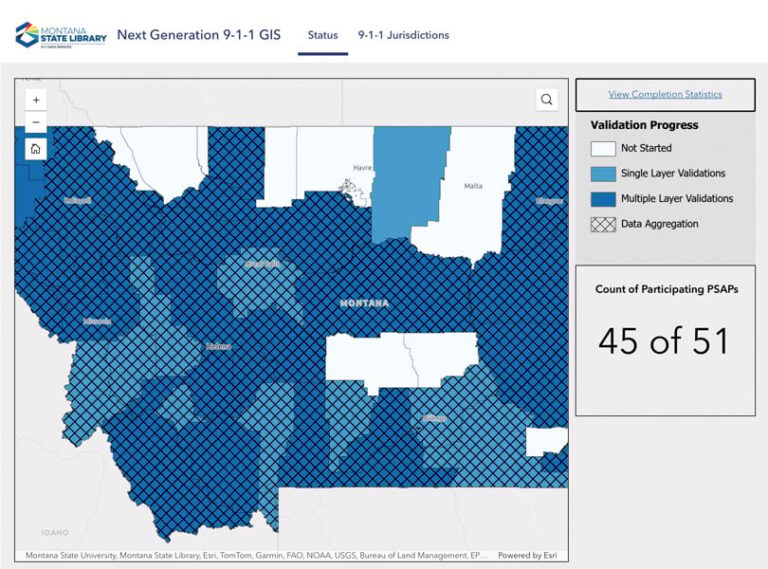
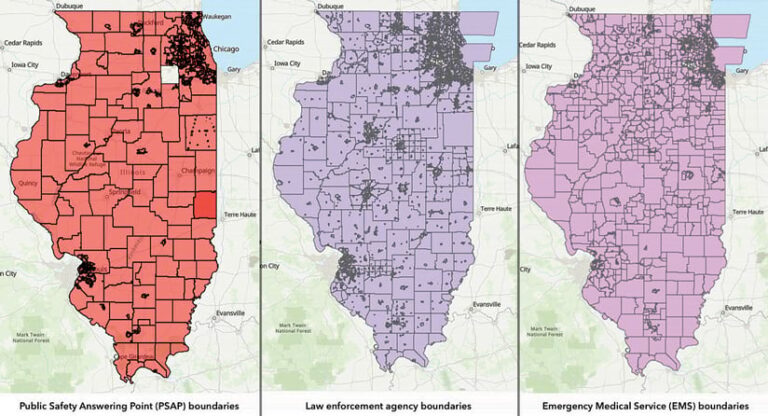
Illinois’s statewide effort, led by the Illinois State Police across 102 counties, is among the most documented examples of what that work looks like at scale. Minnesota and Montana have taken a parallel path: investing years in address data cleanup and GIS preparation before NG911 procurement was even underway. Minnesota’s NG911 GIS Hub and Montana’s corresponding hub reflect that investment. They are collaborative platforms where county contributors, state coordinators, and public safety partners can track readiness, validate data, and resolve gaps together.
States like these have learned that modern GIS tools can streamline the hardest parts of the process. Shared data hubs walk contributors through each step of the address update process. Dashboards make it easier to surface gaps across the state. Collaborative workflows let neighboring jurisdictions see and resolve conflicts without waiting for a scheduled meeting.
The technology is ready. In most states, the limiting factor is sustained investment in modernization.
From the Street to the Room
The work of getting responders to the right address has always been hard. Getting them to the right room is the next frontier. Once inside a large structure, responders receive no guidance from the address given on the call about which hallway to take, which floor to go to, or which room to enter.
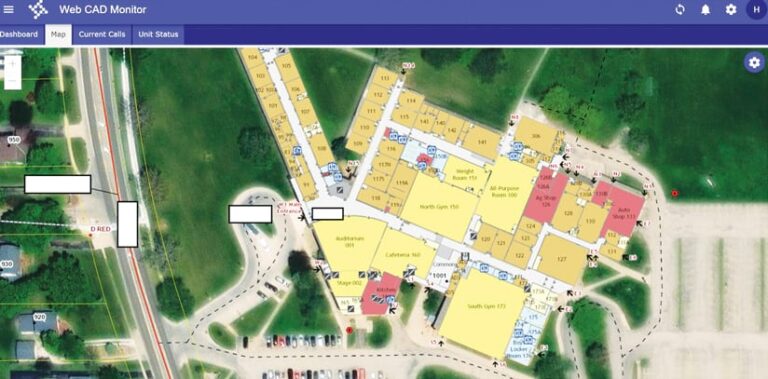
Some jurisdictions are going further, asserting the authority to issue official subaddresses for large buildings—unit numbers assigned by the jurisdiction rather than the building owner, sequenced so any responder entering knows intuitively which way to go. The goal is to make navigating inside a building as reliable as navigating to it.
Illinois is piloting this at the school level with a statewide indoor mapping initiative. The maps connect to computer-aided dispatch, giving telecommunicators a live floor plan that guides responders directly to the room where help is needed.
When a student began choking at an elementary school, the caller gave a room number, and the map showed it on the far side of the building near a driveway. The responding ambulance and fire truck drove there, entered a back door, walked a few feet, and reached the child. Later, they estimated that the indoor map saved them five minutes.
In Frisco, Texas—one of the fastest-growing cities in America—that same logic has extended citywide. Police, fire, and transportation departments share a single live map—indoor floor plans, personnel locations, traffic cameras, and school camera feeds—so any agency responding to an incident arrives with the same picture. The integration of this information gives dispatchers and first responders seamless access to building features, contact information, and additional details such as chemical inventories directly within the city’s Situational Awareness For Emergency Response (SAFER) platform, which provides a unified operational view for public safety.
“With access to floor plans, SAFER allows Frisco agencies to coordinate resource support for emergencies in real time,” said Jon Bodie, director of emergency management for the Frisco Independent School District.
The address is the key that unlocks all of it.
The Case for Sharing What’s Already Been Built
The address data built and maintained for 911 is precisely what transportation planners, public health agencies, broadband administrators, and federal programs also need. Data kept current through the discipline of emergency response is good data for everyone.
The NG9-1-1 GIS Data Model standard from the National Emergency Number Association gives that work a common structure, making address data built for emergency response consistent and interoperable across agencies and state lines. The National Address Database (NAD), stewarded by the US Department of Transportation, is designed to carry it to the national scale. As of mid-2025, 36 states were contributing roughly 90 million records—about two-thirds of all US addresses. Completing that coverage, grounded in 911-validated data, is what makes it useful for every program that depends on knowing the location of every address.
That completion is the explicit goal of NAD 2.0, an initiative convened through the National Geospatial Collaborative (NGC) by a coalition of GIS leaders, 911 stakeholders, federal agencies, and national associations. Their plan calls for 100 percent of the nation to be covered, all records to be 911-validated, and a data model that’s flexible enough to make it sustainable for jurisdictions to continue contributing.
Jill Saligoe-Simmel, Esri’s spatial data infrastructure lead and a newly appointed board member of the NGC, sees the convergence of NG911 modernization and NAD 2.0 as a seminal moment.
“A 911-validated address is the highest-quality address there is. It has to be right because lives depend on it,” she said. “Filling in the national map with that standard of data is how we make sure it’s fit for every purpose that follows.”
The framework is there, the standards exist, and the communities of practice are more closely aligned than they have ever been.