
When organizations need to bring together stakeholders and data, ensuring that everyone working on a project has a unified view of the issues and potential solutions, Esri partners can help. Their expertise in applying the geographic approach and implementing ArcGIS technology to achieve digital transformation is unmatched.
See how four Esri partners spanning the hemispheres helped their clients develop GIS solutions that galvanize data-driven decision-making in fields ranging from bird conservation to broadband expansion.
Dashboards for Diverse Stakeholders
Conserva Aves is a hemispheric initiative that advances bird and biodiversity conservation across Latin America and the Caribbean. Led by the National Audubon Society, BirdLife International, the American Bird Conservancy, and the Latin American and Caribbean Network of Environmental Funds, the program supports the creation and effective management of protected areas while empowering local and Indigenous communities to be active partners in conservation. The initiative’s long-term vision aligns with globally adopted goals to protect 30 percent of critical ecosystems by 2030 and promote sustainable livelihoods.
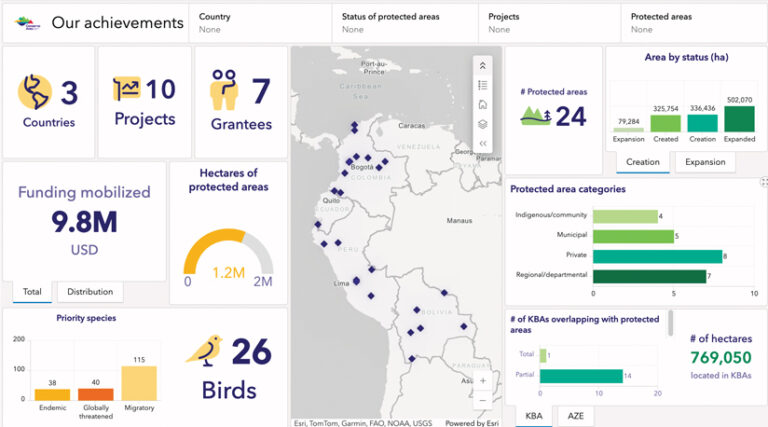
With activities spanning multiple countries and organizations, Conserva Aves needed a unified and transparent system to consolidate data, monitor biodiversity indicators, and clearly communicate results to funders, partners, and communities. So the National Audubon Society partnered with DreamGIS to design and implement a series of interactive dashboards that allow near real-time visualization and management of all Conserva Aves indicators. The company, based in Colombia, specializes in satellite data integration and geospatial analytics.
The team from DreamGIS custom built each data relationship, function, and analytical process using ArcGIS Online and ArcGIS Notebooks to mirror the planning and decision-making workflows of the program’s multiple stakeholders. This tailored design ensures that the dashboards go beyond visual display and represent the initiative’s operational and strategic dynamics. The system supports on-the-fly data updates, advanced querying, and the integration of field information from local organizations—guaranteeing that conservation actions and outcomes across participating regions are fully traceable.
The dashboards have transformed how the consortium monitors and communicates impact. Project managers can now visualize key indicators across more than 7,000 square miles of biodiversity hot spots, link ecological results with social benefits, and generate reports instantly. This digital transformation enhances transparency, accountability, and data-driven decision-making, paving the way for Conserva Aves to expand into new regions throughout Latin America.
From Data Silos to Digital Twins
After three water agencies in Southern California’s Santa Clarita Valley merged to form Santa Clarita Valley Water, the new unified agency needed to consolidate and digitally transform asset management across its 195-square-mile service area. Initially, distribution networks and facilities were managed separately through disconnected databases and legacy applications. This limited visibility, slowed maintenance, and prevented employees from having a real-time, systemwide view of infrastructure.
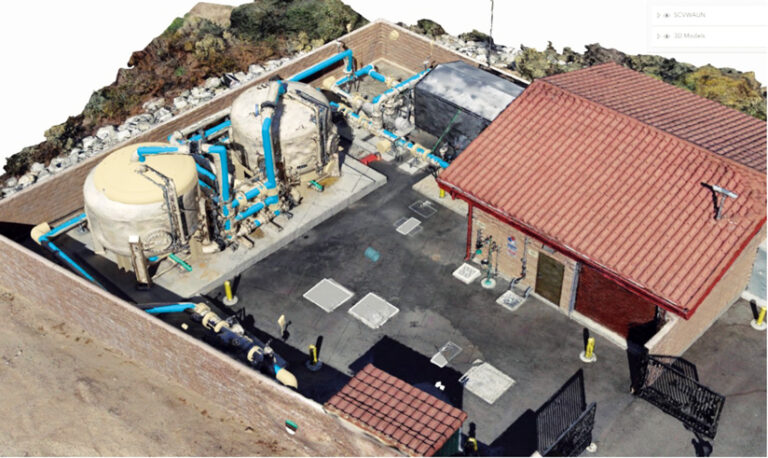
To overcome these challenges, Santa Clarita Valley Water partnered with DCSE, Inc. to build a GIS-centric asset management framework powered by ArcGIS Utility Network. The goal was to create a single, authoritative GIS asset registry that connected office and mobile staff through a unified spatial view of all network and facility assets.
While having one asset registry provided clear operational advantages, leadership at Santa Clarita Valley Water recognized that facility managers and operators need different things compared to GIS professionals. To bridge this gap, DCSE introduced the award-winning GIS-Enabled Asset Registry (GEAR), an intuitive digital twin that’s compatible with ArcGIS Utility Network and gives non-GIS staff direct, browser-based access to asset data.
GEAR helps employees manage treatment plants, pump stations, tanks, and wells using immersive 2D and 3D visualizations. Within GEAR, asset managers can move seamlessly from viewing assets in the digital twin to creating and tracking work orders, which are automatically routed to Trimble Unity Maintain and reflected across ArcGIS Utility Network via the single asset registry.
This feature service-based architecture eliminates data silos, fixes issues with synchronization, speeds up field response, and supports coming to sound resolutions quickly. Today, Santa Clarita Valley Water operates within one unified geospatial environment where 3D visualization, web access, and digital twin technology have streamlined workflows, improved data accuracy, and laid the foundation for doing predictive maintenance. Santa Clarita Valley Water is a connected utility today that’s preparing for tomorrow.
Expanding Broadband Collaboratively
In rural, mountainous Vermont, many residents still lack affordable and reliable high-speed internet. This absence has caused economic, public health, and educational challenges for the state and stifled connections between people and their communities.
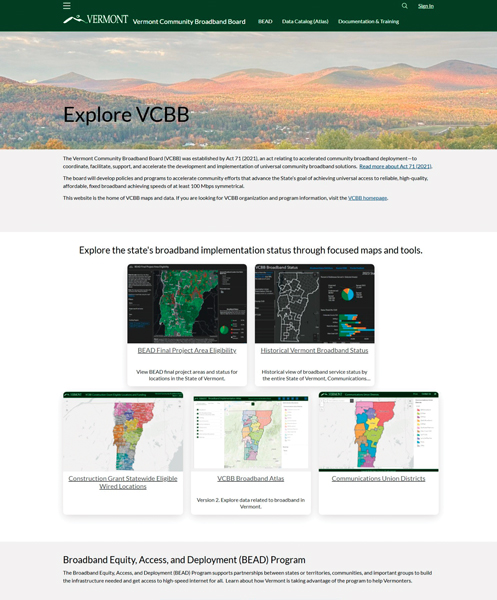
Since 2021, the Vermont Community Broadband Board (VCBB) has supported and overseen the significant expansion of broadband internet access across the state. Knowing that GIS is key to understanding spatial distribution and identifying infrastructure gaps, the VCBB enlisted Stone Environmental—an employee-owned science and engineering firm located in Montpelier, Vermont—to deploy ArcGIS Online and create a wide range of data, maps, and apps.
The VCBB allocates funding to Communications Union Districts around the state that manage broadband infrastructure deployment regionally. To help districts report their progress to the VCBB, Stone’s geospatial and data solutions team established workflows in ArcGIS Online to efficiently aggregate data from the districts and other sources in standardized, statewide datasets. The team also developed dashboards using ArcGIS Dashboards and web-based apps using ArcGIS Experience Builder. Additionally, the VCBB maintains transparency by sharing content via a public-facing ArcGIS Hub site built by Stone.
Stone’s geospatial and data solutions team also conducts data analysis for the VCBB to support federal, state, and legislative reporting and performance monitoring. Recently, Stone helped with Vermont’s Broadband Equity, Access, and Deployment program, which enabled the state to secure an additional $228.9 million in federal funding for broadband expansion and $5.3 million to improve accessibility and technology education.
Over the past five years—with help from the geographic approach and GIS technology—high-speed internet access has expanded to 97 percent of serviceable addresses in Vermont, connecting neighbors and communities with each other and the world.
Data-Driven Land-Use Planning
To comply with national regulations and address issues including urban expansion, mobility, and pressure on rural areas, the city of Medellín, Colombia, is updating its zoning and land-use plans—called Planes de Ordenamiento Territorial, or POT. The update incorporates a national standard—the LADM_COL-POT Extended Model—that facilitates the unified and effective management of spatial and regulatory data within the area and promotes institutional interoperability.

Through its Department of Planning, the District of Medellín hired technical teams and H&G Consultores S.A.S. to provide methodological and technological support throughout the project. Together, the teams harmonized the spatial layers of Medellín’s zoning and land-use plans and updated nearly 78 percent of the city’s regulatory framework, covering essential areas such as public infrastructure, housing, land use, project financing, resident participation, and climate adaptation.
H&G Consultores developed a technological solution called MapGIS-POT, which integrates with ArcGIS Enterprise, ArcGIS Pro, ArcGIS Online, and ArcGIS Dashboards. The platform allows users to manage multiple versions of the POT, streamline data editing and review, assign roles, and validate both topological and logical data. Additionally, it ensures compliance with the LADM_COL-POT standard.
The integration of MapGIS-POT with Esri technology has enabled the City of Medellín to unify the regulatory and technical management of the POT within a robust and collaborative geospatial environment. As a result, Medellín has established itself as a national leader in modernizing territorial planning. The platform strengthens traceability, interoperability, and efficiency and represents a critical step forward in Medellín becoming a digital-first, collaborative, and data-driven city.