
Johns Creek, Georgia, has long embraced innovation in its municipal services. Home to more than 80,000 people in the northern Atlanta metro area, the city has promoted many projects to improve the quality of life for residents, including large-scale redevelopments to create walkable neighborhoods and upgrading utility infrastructure. Recently, city officials applied that forward-thinking approach to communicating with residents about long-term planning.
With a quickly growing portfolio of active plans affecting everything from transportation and parks to zoning and comprehensive planning, city leaders needed a better way to centralize information, simplify public access, and provide context on policy in both documents and maps. Esri startup partner Konveio had the solution.
Founded in 2020, Konveio helps community leaders communicate project details with stakeholders from start to finish. Konveio is an ArcGIS technology-connected engagement platform for planners with two flagship offerings: Engagement Hub and Plan Hub. These hubs help cities facilitate public participation, making plans and policy documents easier to access and understand.
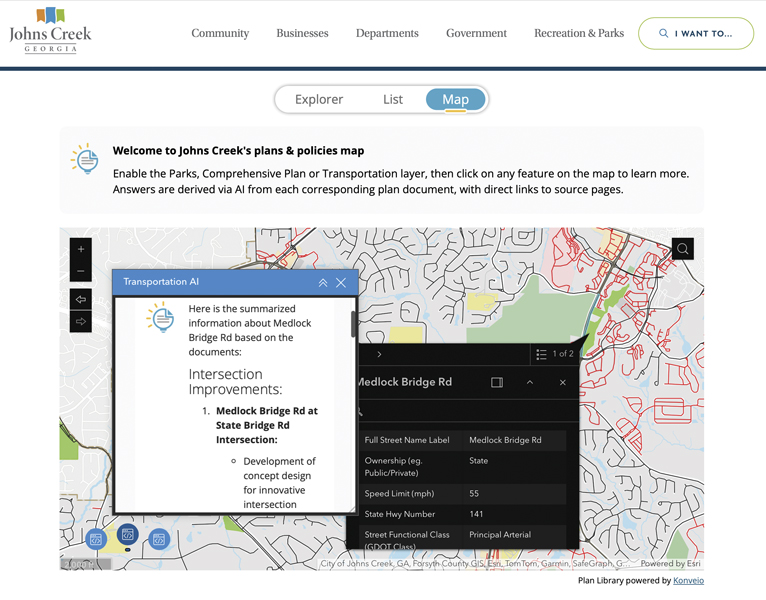
Konveio’s solutions are built to support existing workflows, requiring no special software or training—ideal for staff who typically work with PDFs and ArcGIS Online. The company’s products seamlessly integrate with ArcGIS Experience Builder, enabling geospatial data to interact with policy documents in new and more accessible ways.
Addressing Communication Challenges
Before partnering with Konveio, Johns Creek faced the same challenges common to many other municipalities. Planning documents were hosted as static PDFs across various department webpages, fragmented by topic in a way that was difficult for staff and residents to explore and cross-reference. The content was also dense, jargon-filled, and difficult to navigate.
For city staff, answering residents’ routine questions—such as “What new road projects are being planned in my neighborhood?”—required manually searching through multiple documents, which cost time and increased the risk of misinformation. Meanwhile, the city’s GIS data, which was hosted in ArcGIS Online, was not connected with these documents, so spatial insight was rarely meaningfully linked to policy information.
To address these challenges, Johns Creek deployed Konveio’s Plan Hub as a new feature of the city’s website. The hub is fully integrated with Experience Builder, creating an AI-powered, geospatially enabled framework for city plans that is directly embedded into the website.
Accessible Information for Staff and Residents
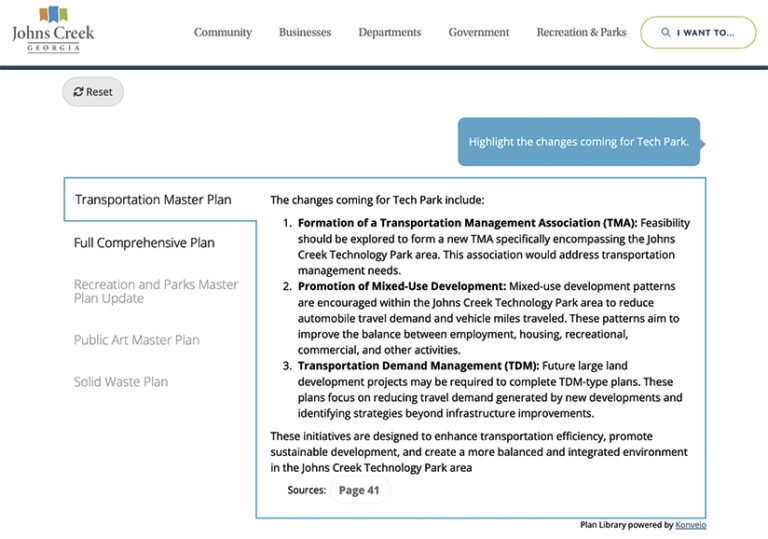
The Johns Creek website now features a visually engaging, tile-based layout of adopted plans, each with its own detailed page, glossary, and AI-powered assistant that allows users to ask questions in everyday, nontechnical language, such as “What are the long-term goals for parks in the city?”
“Konveio has made our city plans more accessible,” said Jennifer Chapman, senior communications manager at the City of Johns Creek.
Konveio’s Explorer view allows users to search across all plans at once or filter by status, like “adopted” or “draft,” and provides results with clickable page references. For example, when searching for parking policies, the platform identifies which plans contain relevant policies—such as the Transportation Master Plan and the Recreation and Parks Master Plan—while clearly showing which documents are not relevant to prevent user confusion. The AI assistant pinpoints where each policy is mentioned and generates concise summaries to help users quickly grasp key takeaways. In a pop-up window, users can then click on links to open the source pages in the document, streamlining navigation and reducing the time it takes to find precise information.
It is Konveio’s integration with Experience Builder, however, that represents the biggest transformation for Johns Creek. This is how Konveio redesigns planning communication so that, instead of being a document-based process, it is a spatially informed decision-making support tool.
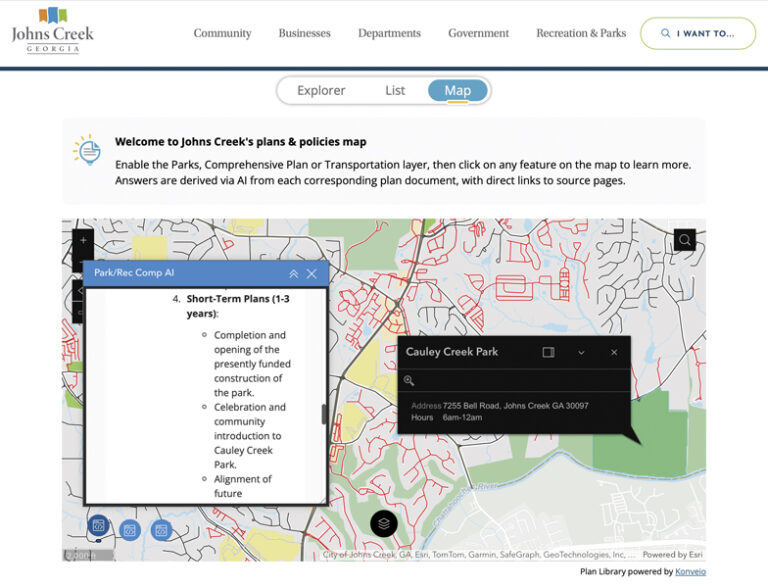
By embedding Konveio into an Experience Builder app, Johns Creek allows users to interact with a citywide map layered with GIS data, including information such as park locations, zoning districts, or bike lanes, and instantly retrieve related planning policies. When a user clicks on a location like Cauley Creek Park, that triggers Konveio’s AI-powered map function. The system automatically surfaces excerpts from the Recreation and Parks Master Plan that relate to that specific park, including details about its development phases, short- and long-term goals, and direct links to supporting documentation.
Because Konveio’s AI search is connected to both document content and GIS layers, it acts as a real-time bridge between spatial data and narrative policy. It doesn’t just show a location; it also explains the “why” behind the planning decisions made for that location.
“Integrating with ArcGIS lets us explain planning decisions in a spatial context, which shows residents exactly what’s planned for their community—and why it matters—without them having to dig through dense documents,” said Chapman. “Our communication is clearer, faster, and a lot more helpful.”
Furthermore, the system is adaptive. As staff update GIS layers or upload new versions of planning documents to Konveio, the integrations update automatically. This ensures that the map always reflects the latest data and insight without requiring manual syncing—a major time-saver for the city’s IT and planning departments.
Enhancing Communication and Trust
Johns Creek’s new Plan Library has significantly enhanced public access to complex planning materials. Residents can now quickly find relevant information without scrolling through entire PDFs or calling city staff. The AI assistant reduces information barriers, and glossary features help decode jargon for everyday users. Translated versions of documents support inclusivity, ensuring that more residents can engage meaningfully with the content.
From the administrative side, the city gains visibility into what questions residents are asking, helping staff tailor future documents, FAQs, and community engagement efforts. Staff also spend less time fielding repetitive questions and cross-referencing plans, freeing them up to focus on higher-value work.
Perhaps most critically, the Experience Builder integration has turned spatial exploration into an educational tool. By tying policy content to locations, Johns Creek helps residents understand not only what is planned but also why and where—boosting transparency and building public trust in the city’s plans for the future.