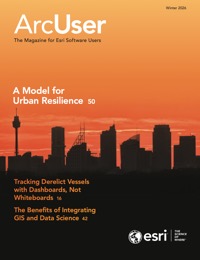
The world of GIS has always been one of shifting ground, cutting-edge technological advancements, and constant change. But owing to factors as varied as generative AI tools and changing climate patterns, things are now moving faster than ever and show no signs of slowing. Some changes require vigilance; others mandate staying ahead of the curve by familiarizing yourself with new technologies and workflows. What they all demand is adaptation.
In the winter 2026 issue of ArcUser, adapting to change takes center stage. Like many cities around the world, Sydney, Australia, is enduring a pattern of ever-increasing urban heat and using GIS to better understand and react to changing temperature patterns. In New York City, rat mitigation efforts require new, geospatial ways of thinking in response to evolving information about the efficacy and safety of traditional rodenticides. The Renewable Water Resources district in South Carolina has developed an in-depth geospatial system of record to keep track of its expanding property holdings. Saudi Aramco, faced with increased desertification across the Kingdom of Saudi Arabia, is leveraging GIS capabilities to retain the last drops of water from the country’s 5,000-year-old river basin.
Technology itself is also evolving rapidly. Articles in this issue cover new ways to organize data within ArcGIS Hub and ArcGIS Pro, as well as workflows to ensure that ArcGIS Field Maps apps function offline—an essential capability when working in environments of shifting connectivity. And within the ArcGIS ecosystem, developer tools are transitioning to the use of map components, a vital step in enabling you to future-proof your custom apps.
Change is constant. We can map it or try to stop it, but often what is most useful is making an effort to understand efficient and productive ways you can adapt to change. When the ground moves underfoot, you have to move with it. That nearly always means making substantial changes of your own, as in St. Johns County, Florida, where the county’s GIS division has transitioned from analog solutions to a system of dashboards to track derelict vessels. Adaptation is a tough, ongoing process, but in an industry that moves as quickly as this one does, few things are more important than learning how the world is evolving, and how to evolve with it.