New ArcGIS Integrations for Microsoft Fabric
In response to growing demand among data scientists, data engineers, business analysts, and executive stakeholders for spatial analytics and mapping, ArcGIS for Microsoft Fabric brings together three ArcGIS integrations: ArcGIS for Power BI, ArcGIS Maps for Microsoft Fabric, and ArcGIS GeoAnalytics for Microsoft Fabric. These integrations enable users to transform, enrich, and analyze geospatial data of any size, as well as visualize, explore, and share insights through interactive maps and BI reports.
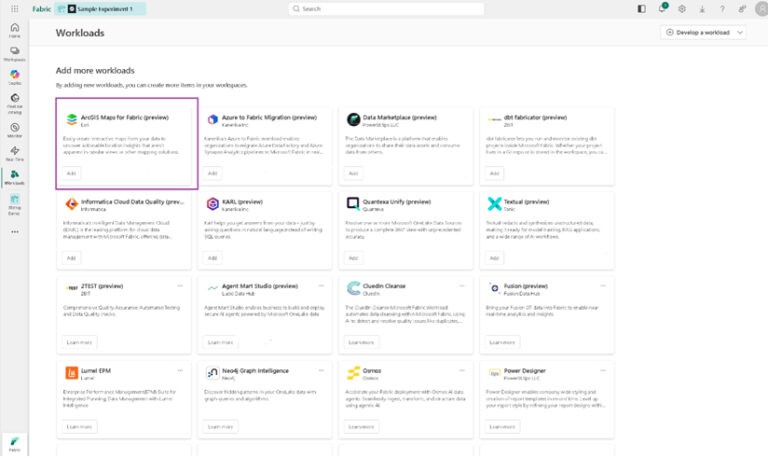
With ArcGIS GeoAnalytics for Microsoft Fabric, users can now directly access sophisticated spatial analytics tools and functions, as well as an extensive library of authoritative and curated spatial data, to discover where things are, how they relate to each other, what they mean, and which actions to pursue. ArcGIS Maps for Microsoft Fabric, currently in public preview and available via the Fabric Workload Hub, empowers organizations to create interactive and insightful maps that reveal patterns, relationships, and trends that are invisible in tables or charts.
GeoAnalytics for Fabric is now generally available for Microsoft users, alongside ArcGIS for Power BI. The integrations continue to expand, with Maps for Fabric having entered public preview and being prepared for general availability in the near future.
Learn more about the latest updates to ArcGIS for Microsoft Fabric.
New Session Usage Pricing for Basemaps
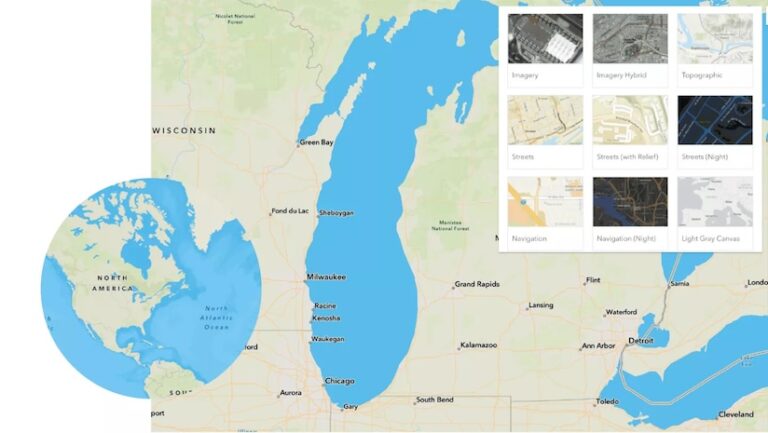
A new session usage pricing model for basemaps, available through ArcGIS Location Platform, gives developers and organizations a more predictable and cost-effective way to integrate Esri basemaps into apps and business systems by aligning pricing with user interactions like panning, zooming, and searching. This session usage model is especially valuable for high-traffic apps or those with extended user sessions, such as real estate search portals, rideshare apps, or delivery tracking systems. It complements the existing tile usage pricing, which customers can still choose based on their needs.
The new pricing model is available to both new and established users of ArcGIS Location Platform. It is designed to meet the needs of developers, CTOs, and product leads across a wide range of industries, including real estate, financial services, health care, e-commerce and retail, media, and logistics. It enables organizations to easily integrate data-powered maps into the systems they use.
Learn more about the ArcGIS Basemap Style service and explore pricing options.
NbE GeoPortal for Students, Teachers, and Conservationists
In a joint venture with the International Union for Conservation of Nature (IUCN), Esri is making a $10 million in-kind donation to expand access to data, maps, and GIS technology in support of Nature-based Education (NbE). The donation will help IUCN stand up the new NbE GeoPortal, which will allow students, teachers, and conservationists worldwide to explore maps, collaborate on conservation, and develop technical skills.
NbE places nature at the core of learning. By blending environmental education, Indigenous knowledge, and outdoor and experiential learning, it fosters a deep connection between humans and nature. This approach treats nature as a learning environment, cultivating systems thinking; empathy; responsibility; and the skills needed to address changing climate conditions, biodiversity loss, and planetary health across formal and informal settings. Combining GIS and NbE allows students, teachers, and conservationists to visualize the world around them using the critical context of location. This provides a holistic, geographic framework to better understand what is occurring, how it is changing, and—most importantly—where action is needed to protect and conserve nature.