All told, the city of Los Angeles takes up about 470 square miles, including thousands of miles of streets and sidewalks, and is home to a population of almost four million people. With that much land and that many people comes a lot of trash. Los Angeles residents and businesses produce about 96,500 tons of waste daily, requiring roughly 900 heavy-duty trash trucks to keep the city clean. Despite these efforts, discarded items pile up, posing health and safety risks to residents and visitors alike.
If this sounds like a problem ripe for a GIS-based solution, Los Angeles Sanitation & Environment (LASAN) would agree. Previously known as the Los Angeles Bureau of Sanitation, LASAN started using Esri technology in the early 1980s to create printed map books for trash collection routes. Supervisors also used it to map requests for special-collection drivers to pick up bulky items like old appliances and furniture.
But LASAN’s GIS has come a long way since the ’80s, and has recently taken a leap into the future. CleanStat, a 2016 initiative designed to map the cleanliness of LA streets, allowed LASAN to target its resources more effectively within the city. With AI tools that integrate with LASAN’s ArcGIS Enterprise environment, CleanStat has undergone an upgrade, enabling LASAN to be even more precise and efficient in the way it keeps LA’s streets clean.
Clean, Cleaner, Cleanest
“CleanStat was started almost 10 years ago as a directive from the mayor to evaluate the cleanliness of Los Angeles streets and alleys,” said Oscar Figueroa, chief of GIS at LASAN. “It established the city’s first measurable standards for the cleanliness of Los Angeles streets.”
The assessment was done every three months by five teams that drove through the city to evaluate each street segment based on four criteria. There are about 42,500 designated segments throughout the city that are evaluated based on loose litter, household items, illegal dumping, and weeds. Homeless encampment data is captured but does not factor into the cleanliness score.
The locations of blight are shown on ArcGIS Online web maps where each street segment is rated on a scale of 1 to 3, excluding homeless encampments. These scores are then tabulated to create a citywide cleanliness score. Over the years, LASAN has increased the number of field crews for cleanliness assessments, but the process still takes from six to eight weeks to complete.
Patrick Soriano, senior systems analyst at the Los Angeles Department of City Planning, noted that the Los Angeles mayor’s office and the city council directed city departments to explore the use of AI tools to enhance services for residents, given the rapid growth of these technologies. This led to LASAN’s development of CleanStat 3.0.
LA’s Future Is Clean—and Automated
The idea is simple: The CleanStat 3.0 program automates data collection by using cameras on the city’s trash collection vehicles. These cameras capture images that are then processed with a model that identifies items that need to be collected. The model, called You Only Look Once (YOLO), is based on deep learning and computer vision and used for real-time object detection and image segmentation.

A mesh Wi-Fi system in each vehicle yard automatically downloads each trach collection truck’s camera footage to a dedicated computer when the truck is within network range. This process enables weekly street cleanliness assessments and frees up field crews for other tasks.
“After the YOLO models analyze the images, the data is sent to a REST endpoint on [ArcGIS] GeoEvent Server,” said Soriano. “The data is stored in our spatiotemporal big data store, then published as a feature service in our ArcGIS Enterprise portal environment. This allows us to create operational dashboards to provide updates on where we need to deploy resources.”
The dashboards enable staff to show the locations of detected refuse and other items, such as black trash bins, construction cones, and discarded furniture. They also display the confidence level of the model’s correct identification of the object. A Google Street View link verifies the location of the object.
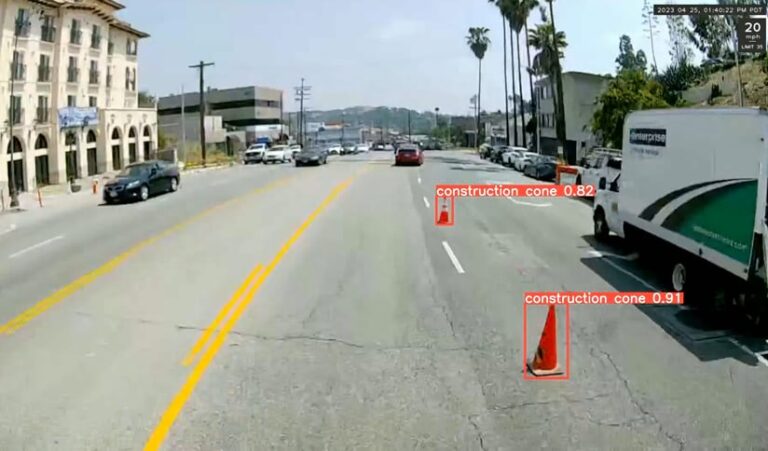
Allowing operational staff to view data on a dashboard also helps them identify refuse hot spots in the city. This includes areas that often experience illegal dumping or need regular graffiti removal. Staff can predict the type of waste services required for specific locations in the city and plan for their cleanup.
LASAN aims to use its data to help other city departments develop their own computer vision models. The data can be used to identify other things within the public right-of-way such as unpermitted construction, missing or vandalized street signs, or damaged city assets. This will help those departments provide greater efficiency for their own city services.
If LA’s future looks cleaner, it might be because of the GIS and AI tools LASAN has developed to help it along.
About the author