First published in GoGeomatics
Before the software platforms, before the glossy atlases, there’s a photo. A little boy in pajamas sits between his grandmother and brother. Behind them, pinned to the wall: a world map. Allen Carroll remembers staring at it from his bunk bed, nudging continents together in his mind. He was four or five.

The picture opens Carroll’s book Telling Stories with Maps: Lessons from a Lifetime of Creating Place-Based Narratives, and it tells you everything you need to know. This is a book that begins with wonder, not code.
Carroll would go on to become chief cartographer at National Geographic and later, the creator of ArcGIS StoryMaps. He’s spent a lifetime shaping how people see places.
And while the maps have evolved—from airbrush to interactive layers—the instinct behind them hasn’t. Clarity. Connection. A sense of where we stand.
The way Carroll organizes his book feels deliberate, almost architectural. He starts with questions about how humans respond to stories, how memory and location are tied together in the brain, and why maps command attention.
“Maps pack huge amounts of information into a form that most people find easy to interpret. The human mind has a remarkable ability to mentally project patterns on a page or screen onto the real world,” Carroll told me. “As long as maps are carefully designed and not overloaded with detail (and that’s a pretty important qualifier!), they speak a visual language that’s almost universal.”
The early chapters are personal. He recalls going on childhood road trips, sketching floor plans, drawing his own neighborhood maps by hand, and later designing infographics for The Washington Post Magazine.
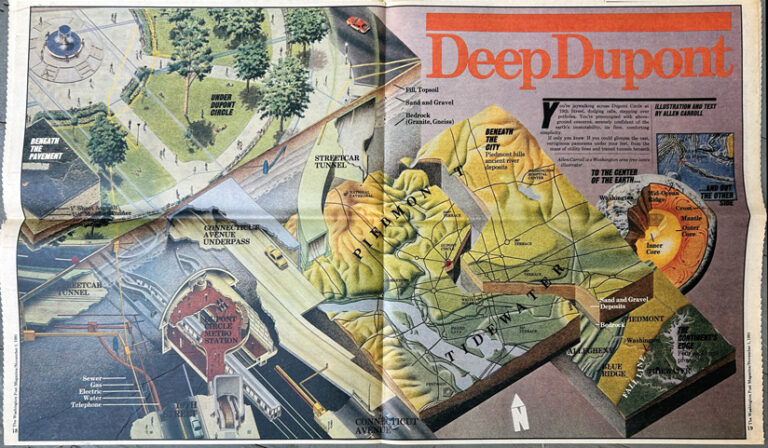
Once he pitched an idea to them: What lies beneath Dupont Circle, that tangled roundabout in Washington, DC? The result was a six-panel vertical excavation, moving from the asphalt to the streetcar tunnels to the Metro system to the geologic provinces under the city—and, finally, to the exact point on the Earth’s surface opposite DC, somewhere in the Indian Ocean.
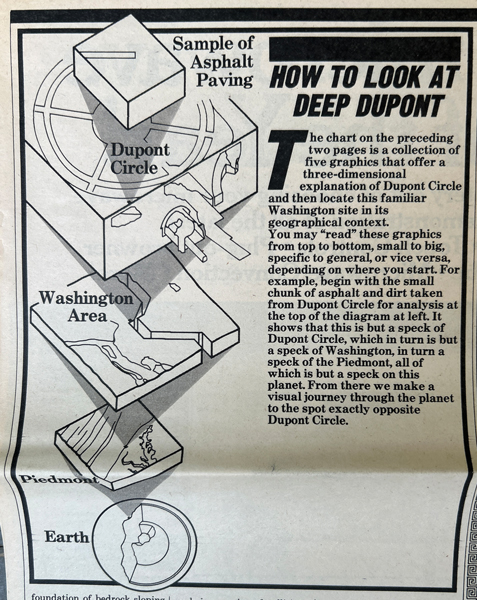
He used airbrush and colored pencil to draw the entire thing, manually researching and sketching out spatial layers. The story caught the attention of National Geographic staff, who called him in. According to Carroll, he spent too long on that piece for what it paid. But it bought him something else: a job that would change his life.
This anecdote is one of the first moments where we see how design, research, and storytelling can sit inside a single visual. From there, the book expands into science, education, and technology. Carroll traces the emergence of digital storytelling tools, the development of ArcGIS StoryMaps as a platform, and the editorial choices that shaped its direction. You see someone carefully considering each layer—how a map is built, and how it connects with the person reading it.
A Platform That Almost Didn’t Happen
When Carroll left print and moved to Esri, he was stepping into the digital unknown.
He describes the winding road to building ArcGIS StoryMaps. Early trials were clunky web experiments, mock-ups, weekend hacks, custom scripts. One of his team’s first successful stories involved mapping tornadoes across four decades. Not a flashy subject, but the way the data moved and updated with every zoom level gave readers a sense of both scale and detail.
These early prototypes—be it a story on bird migration or the Titanic’s passenger map—weren’t meant to become a global story-telling tool.
But slowly, the pieces came together. A platform emerged that was designed to let people create place-based stories using maps, media, and narrative structure. Teachers used it in classrooms. Scientists used it to explain ecosystems. Communities used it to document histories that wouldn’t make it into official archives. Even governments started using it to publish public dashboards.
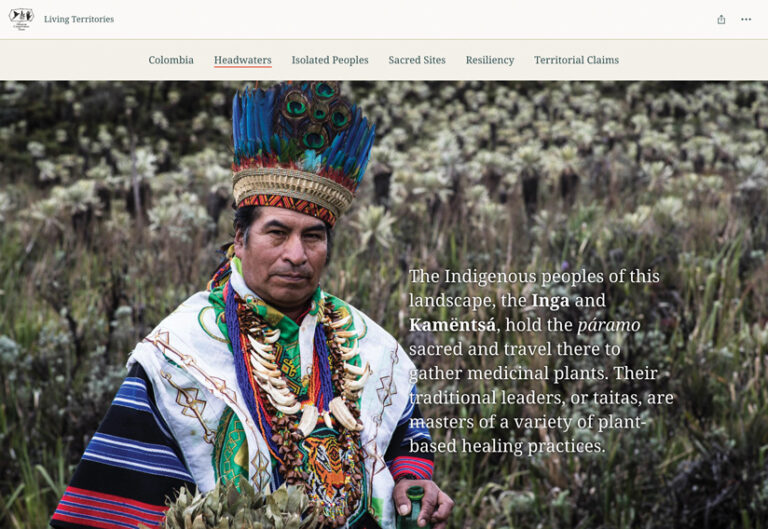
Today, there are more than 3.5 million stories created using Esri’s tool. Carroll doesn’t hype this. He presents it the way he presents everything else: through examples that explain themselves.
Carroll walks the reader through different kinds of mapping narratives: Some begin with small details and expand outward, others frame a problem and lead the viewer toward resolution. In one especially effective structure, he shows how maps can serve as narrators—anchoring the story while shaping its emotional rhythm.
Take the story The Two Koreas. Carroll first worked on this project in 2003 as a print map for National Geographic. It was a typical foldout—carefully designed but limited by the static nature of the print medium. Years later, he retold the story digitally with his Esri team. This time, readers could scroll through a changing map that showed territorial control during the Korean War, frame by frame. Each scroll step unlocked a new phase of the war—no arrow diagrams, just visual motion through time and geography.
The effect was different. No overload, no wall of data. Just a spatial story told in rhythm. That’s the kind of map Carroll argues for: not flashy, not drowning in interactivity, but constructed with a sense of timing.
Where the Story Lives
The book’s most compelling sections focus on how spatial stories are built. Carroll explains how a map can act like a narrator or a setting or a protagonist. The role changes depending on the story.
One of Carroll’s personal favorites is World’s Longest Mule Deer Migration, created by the University of Oregon Geography Department and the Wyoming Migration Initiative. It tracks Deer 55 as she navigates a 150-mile journey across Wyoming’s fragmented landscapes. The story reveals how roads and fences have fragmented migration routes, cutting herds off from one another.
“It combines tracking data, which I always find spellbinding,” Carroll notes in the book, “with land-use and land management data to show that, even in the nation’s least populous state, wildlife must navigate a series of subdivisions, fence lines, roads, and other hazards.” By focusing on a single animal, the story personalizes a broader environmental challenge—turning movement data into something compelling and urgent.
Carroll emphasizes that many of the best stories are built around people. One memorable example in the book follows a couple—Dorothy and Nathan—who drive to the beach in an electric vehicle and try to find a place to charge. What sounds like a product demo becomes documentary: failed chargers, broken maps, delays. The reader sees a real-time gap between infrastructure and expectation. It’s the kind of storytelling that makes policy feel lived-in.

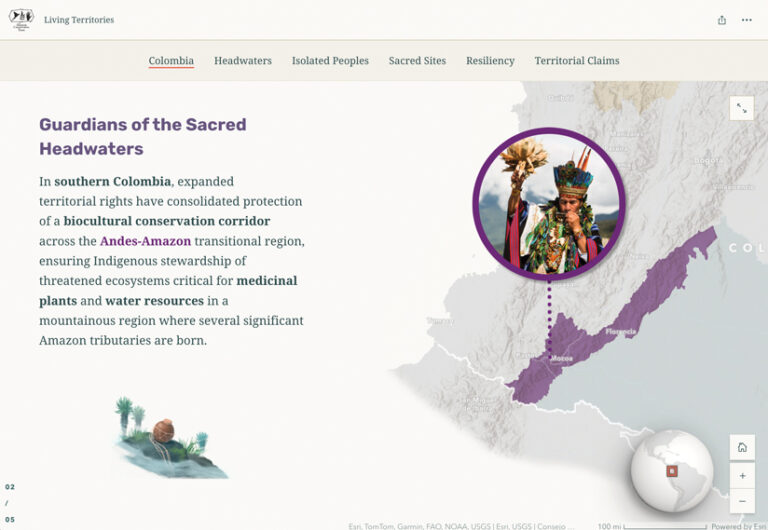
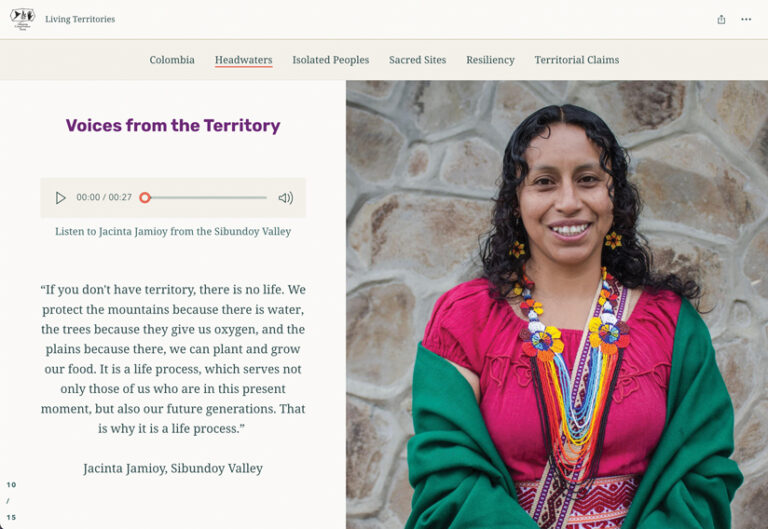
The book quietly insists on cartographic responsibility. Carroll returns often to questions of representation: Who is included? Whose perspective does the map reflect? What choices shape what we see? He describes how Indigenous communities in the Amazon cocreated stories with ArcGIS StoryMaps that blended oral history with geography, drawing territorial lines shaped by memory, ecology, and cultural meaning rather than legal boundaries.
In one of the book’s most revealing chapters, Carroll explores the neuroscience of storytelling. He explains how place, memory, and emotion are physically linked in the brain—how grid cells and place cells activate when we remember where something happened. This connection explains why stories rooted in geography resonate.
This is where his argument takes shape: Maps are not just explanatory tools. They are memory engines. They help us remember where stories took place and how we felt when we heard them.
A Book Meant to Be Moved Through, Not Rushed
The pace of Telling Stories with Maps is unhurried. Carroll lays out examples the way a curator might lay out a gallery—step by step, layer by layer. Some sections outline narrative structures or story types, but they don’t read like instruction manuals. They read like field notes from someone who’s been refining his approach for decades.
Carroll isn’t trying to dazzle. He is trying to equip. And he does it by showing what thoughtful storytelling can look like when it’s grounded in place.
“I’d love to think that the book might inspire GIS professionals to tell more stories about their work—the data they use, the insights they gain—to broad audiences,” he told me. “I hope the book makes people appreciate the peculiar power of maps: how dense they are with information, how they provide an additional dimension to storytelling, how they add richness and context to narratives. And I hope they’ll use this potent mix of maps and multimedia to positive ends—to inform and inspire people about the interconnectedness of our planet, nature, and human culture.”
In the end, Telling Stories with Maps isn’t about promoting maps. It’s about telling stories with care—stories that embrace detail, hold complexity, and reveal the patterns that shape the way we live and understand place.
It’s a quiet book, full of carefully chosen examples and hard-won lessons. Like the best maps, it lingers, less for what it shows than for how it changes the way you see.
If you think maps are merely tools for directions or spatial data, Carroll wants you to pause. He invites us to consider the map as something else altogether—narrator, interpreter, witness, advocate. What unfolds is more than a professional retrospective. It’s a generous offering from someone who has spent decades observing how storytelling evolves through technology, visuals, and the ways we make meaning from place.
About the author