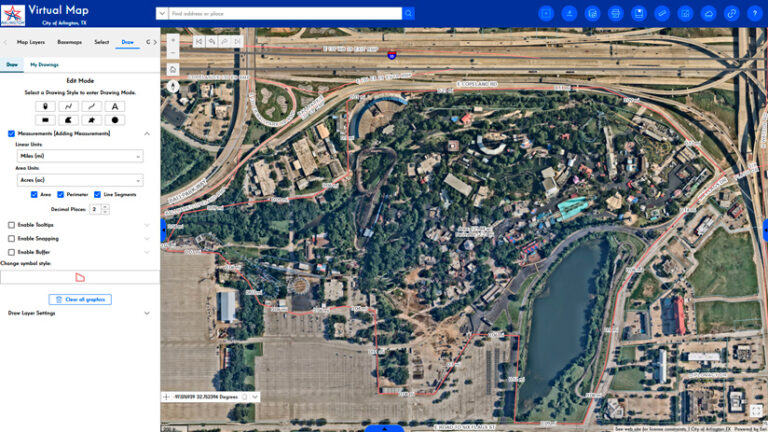
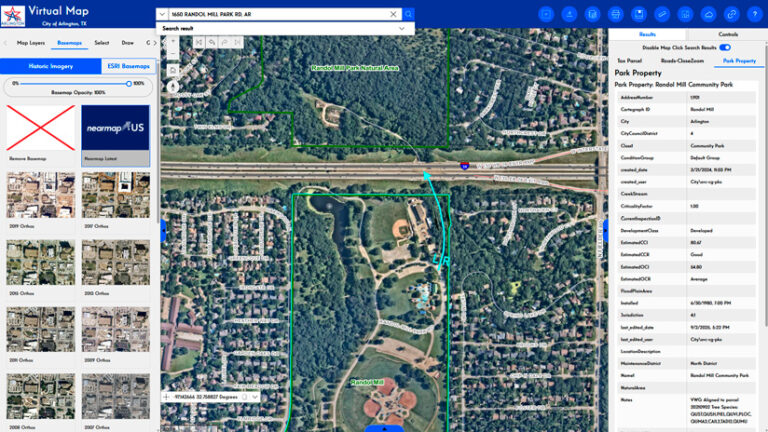
The City of Arlington’s Virtual Map is an internal application designed to be a central data repository for the city’s GIS database. The app is available to all of the Texas city’s roughly 3,000 employees, and about 200 of them use it every day.
According to Jeffrey Thompson, GIS applications developer for the City of Arlington, the availability of Virtual Map saves Arlington residents roughly $2 million a year while improving the customer service experience.
An application like Virtual Map relieves pressure on the city by reducing the need for additional resources, including more staff and added training costs. Virtual Map supports many different city functions, with its heaviest users relying on it for providing answers to questions from the public. And because most users of the application have no formal GIS training, simplicity of use is a must.
At the heart of this app is code Thompson developed that registers data from a REST endpoint as an ArcGIS Experience Builder data source.
“That’s something that I think I might have been the first person to figure out how to do,” said Thompson. “It’s opened up a lot of doors for us in Experience Builder.”
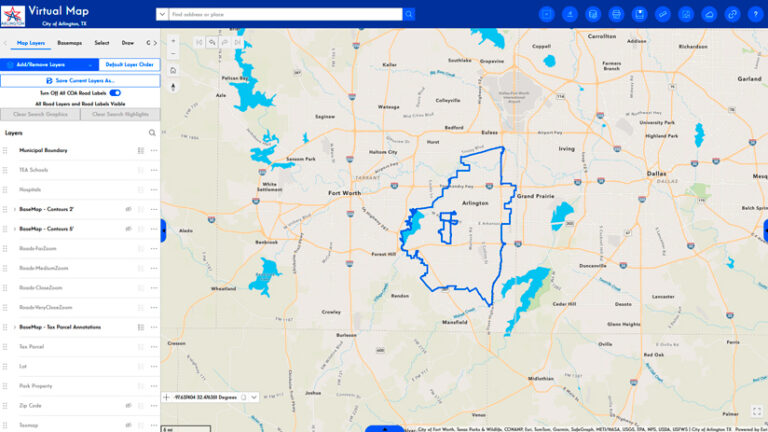
Thompson was able to overcome limitations he’d run up against when using the typical method of adding data to maps in Experience Builder via ArcGIS Maps SDK for JavaScript. Data added through his alternate method is fully compatible with all the features in ArcGIS Experience Builder.
But getting to the bottom of this wasn’t a solo effort. Thompson is a regular participant in Esri Community—Esri’s free online platform for connecting users from around the world—and routinely relies on shared resources to help develop apps like Virtual Map.
“Esri Community was vital to figuring out how to do this,” Thompson said. “I knew it must be technically possible because the Add Data widget can do it, but the functions were buried deep in the Experience Builder code, and I could not find them on my own. I asked this as a question on the boards and got a vital piece of code from the developers. I know at least three members of the build team personally looked at and contributed to the answer.”
A Community Contributor
Within the first hour of every workday, Thompson signs in to Esri Community to hunt down questions that need answers.
“I use Esri Community partly as a warm-up to my day by answering a few questions,” he said. “That gets my brain started and helps me get on to my real work.”
By “real work,” Thompson means tasks like developing custom widgets, scripting for geoprocessing applications, and migrating data that the City of Arlington had in ArcGIS Web AppBuilder over to ArcGIS Experience Builder.
Even after he’s turned to the day-to-day needs of his role, Thompson keeps tabs on Esri Community by periodically returning to check on conversations or by reviewing email notifications for new activity on posts he’s following. Since he began using Esri Community in 2023, he’s answered hundreds of other users’ questions.
Thompson’s employer is supportive of the time he spends in Esri Community. His involvement is an investment that has translated into efficiency gains and saved resources for the city.
“There have been a number of times where I’ve solved problems before they came up because I’d been out reading things that other people had posted,” said Thompson. “Seeing the answers to those questions and knowing what problems could arise has been hugely beneficial in getting me past issues before they even show up.”
Despite his growing presence in Esri Community, Thompson doesn’t think of himself as a typical GIS person, having manifested this relatively new career trajectory out of a geology background. It was only after a manager pointed him toward Esri Community as a helpful resource for his then-new role that he began using the platform and contributing at a pace rarely seen among new members.
That involvement and the benefits to the City of Arlington have garnered appreciation from Thompson’s higher-ups, some of whom have commended the relationships he’s developed within the broader GIS community and how it reflects on the city.
Expanding Peer Support Through User Groups
Of Thompson’s many touchpoints in the Esri Community, his coleadership in the Experience Builder Tips and Tricks user group and the Experience Builder Custom Widgets group are among his most prominent. In both open user groups, visitors can find helpful guidance, workarounds, and custom widgets specific to ArcGIS Experience Builder, a product in which Thompson has carved out a special niche for himself over the course of his migration duties.
After contributing to the Experience Builder Custom Widgets group, Thompson saw the need to expand the scope of knowledge to include more than user-made widgets. Finding that he was regularly repeating answers to the same questions from different Esri Community members, he created the Experience Builder Tips and Tricks group as a dedicated location for information from the customer side of product use. This could help other users find already-existing answers to their questions more easily. He also viewed it as an opportunity to constructively draw Esri staff attention to feature requests and improvements he wished to champion.
In 2025, Experience Builder Tips and Tricks became the second-most frequented user group in Esri Community, with over 22,000 visits and more than 13,000 unique visitors. Messages of thanks from other users are common, which lets Thompson and other contributors know that their efforts are making a meaningful difference.
Thompson has always wanted the group to be a collaborative space and is constantly looking for more contributions from other contributors, especially when it comes to adding new content to the blog. For Esri Community as a whole, Thompson recommends new members start by subscribing to Question Boards.
“You’ll get so much information just by reading those questions and the answers,” Thompson said. “You’ll solve problems before you even come across them yourself.”

About the author