Sea turtles and beach mice might not look like frontline defenders of Florida’s coast, but for Kindall Butler, an environmental specialist for Escambia County, they are precisely that. To protect these species and the delicate ecosystems they support, the team she coleads monitors over 12 miles of beaches. The team uses high-accuracy GNSS technologies such as Reach RS2+ and Reach RX receivers from Esri partner Emlid alongside GIS tools like ArcGIS Survey123, ArcGIS Field Maps, and ArcGIS Pro.
Before adopting modern GIS and GNSS solutions, monitoring sea turtle nests for Escambia County was a labor-intensive process involving manual tape measurements and phone GPS, often accurate only within 15 feet. In the storm-prone Gulf Coast, that margin for error made post-storm nest recovery nearly impossible.
“If we lose a nest because of a hurricane or overwash and we lose our stakes, we still need to be able to find where it was,” Butler said. “Having that accurate point is crucial.”
Now, Butler’s team can get one-foot-accuracy data. This solution enables the reliable pinpointing of nests and streamlines the team’s workflow. Along with improving data precision and efficiency, Escambia County’s new setup ensures that staff can respond faster and with greater confidence, even after storms disrupt physical markers.
Smart Conservation and Time Savings
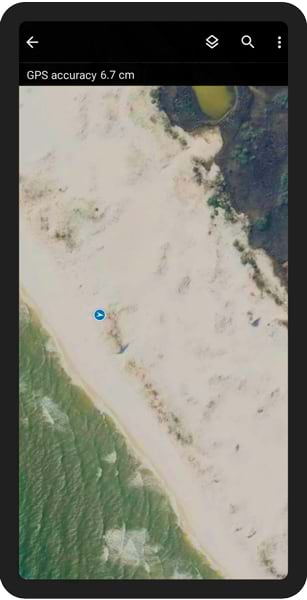
When volunteers see turtle activity on the beach, they log the information in an ArcGIS Survey123 form. This alerts Butler’s team to the rough location of the nest. With this, the team can validate the presence of nesting activity and capture the coordinates with the Emlid Reach RS2+ or Reach RX receiver and ArcGIS Field Maps.
To achieve high-accuracy data, the Reach receivers are connected to a Networked Transport of RTCM via Internet Protocol (NTRIP) service to get real-time kinematic (RTK) GNSS corrections. The receivers can then be connected to ArcGIS on an iPhone, which is used as a data collector. The Reach RX is connected with ArcGIS Field Maps via Bluetooth, while the Reach RS2+ connects over the TCP server.
This high-accuracy workflow saves a significant amount of time for the nest-recording and -locating portions of the work. For nest recording, the team previously needed two people to use tape measures, taking about 20 minutes for each nest. With the GNSS workflow, only one person needs to walk to the site and, within seconds, save the measurements digitally.
The one-foot data accuracy for nest locating also means a much shorter period of digging to find each nest. Before, members of Butler’s team might hand-dig large holes for hours, only to come up empty-handed. “No one wants to be digging in a 15-foot radius when you could be in a 1-foot radius,” Butler said.
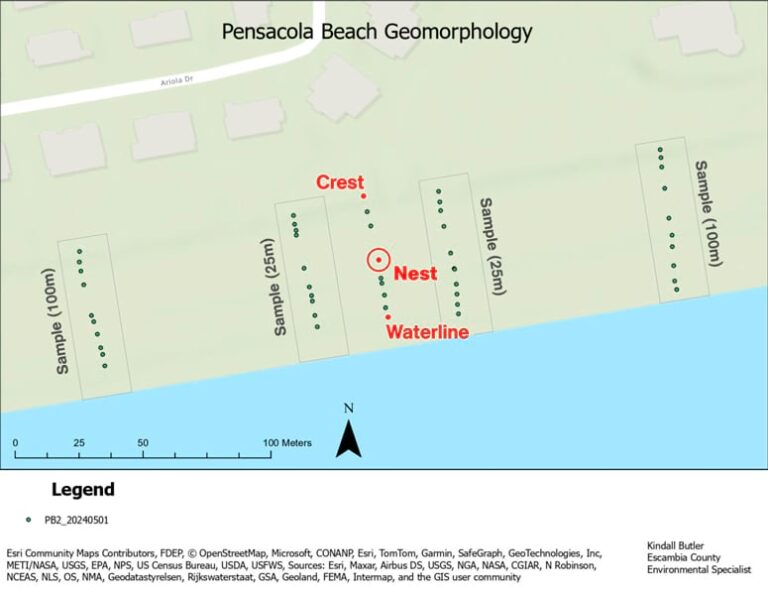
The precise location data feeds directly into the team’s nesting site suitability analysis using ArcGIS Pro. Starting at the nest location, staff measure elevation points along a line from the dune crest to the waterline. Team members then compare these elevation profiles to adjacent beach sample profiles without nests, first 25 meters away and then 100 meters away.
“If we find that turtles only nest at certain elevations, we can advocate for policies to maintain those elevations and create protected zones,” Butler explained.
This early-stage research is part of a broader effort in Escambia County to influence land-use policy and coastal development in ways that benefit both wildlife and residents.
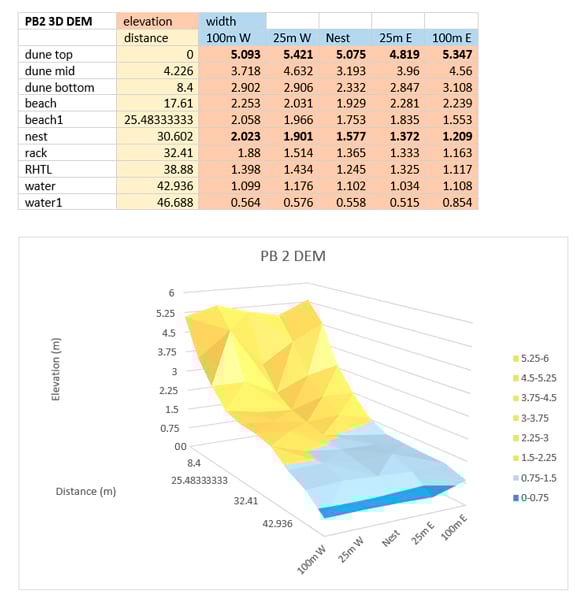
As a result, the conservation work doesn’t stop with turtles. The Escambia County team also uses Reach RS2+ and ArcGIS Survey123 to monitor the endangered beach mouse population. Elevation data helps pinpoint potential high-ground refuge areas, which are critical for survival during hurricanes.
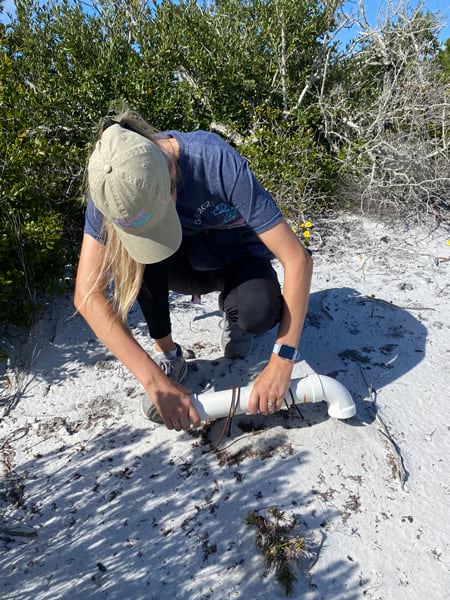
Beach mouse presence is monitored at different elevations using track tubes. These track tubes are PVC pipes with card stock and an ink pad inside. The tubes are placed 300 meters apart and baited at the end of the tube. If beach mice are present, they will leave inked paw prints on the cardstock.
Escambia County staff check the tubes every other month and complete an ArcGIS Survey123 form that tracks the presence or absence of beach mouse activity. If there is a deviation from the normal activity at a track tube site, an ArcGIS Pro map will alert the team to that location.
The same GNSS and GIS workflow supports shoreline erosion monitoring and artificial reef mapping. While reef mapping presents unique challenges, like maintaining a GNSS lock from a moving boat, Butler’s team is continuing to expand its capabilities as time goes on.
A More Accurate and Efficient Process
Through its conservation efforts for both the beach mouse and the sea turtle, Escambia County is seeing a slew of benefits from its modernized GNSS and GIS workflow.
For one thing, significantly increased data accuracy helps Butler’s team precisely record and locate the turtles’ nests and the mice’s activities. The data collection and location process is also now faster and easier, and stakeholders have more access to visualize and disseminate data.
On top of this, Escambia County is growing a historical database to help answer questions about dune elevation preferences. These answers could result in greater efficacy of conservation programs aimed at helping endangered species.
From habitat mapping to policy advocacy, integrating ArcGIS software and Emlid hardware is transforming coastal conservation. For Escambia County, it’s not just about collecting data—it’s about protecting ecosystems that shield inland communities from storm damage and preserve biodiversity for future generations.
“This work helps us balance public access with environmental responsibility,” Butler said. “We’re doing everything we can to protect these species—and the coastlines we all depend on.”
About the author