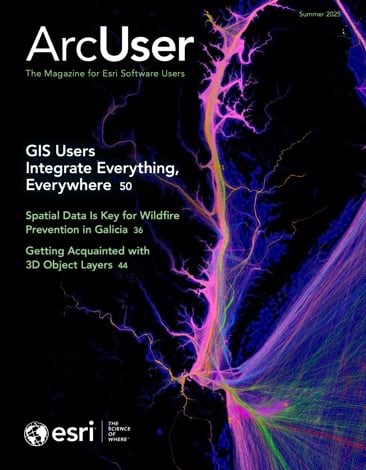
“Integrate” is a powerful word in the world of GIS. It’s typically used in reference to data, as in pulling spatial data from various sources, in various formats, for use in a comprehensive dataset. And in ArcGIS Pro, the Integrate tool analyzes the coordinate locations of feature vertices and helps ensure that vertices are connected.
At this year’s Esri User Conference (Esri UC), the theme was GIS—Integrating Everything, Everywhere. Like the Integrate tool, this theme was all about cohesion and connection. Plenty of the presentations at the Plenary Session and during the rest of the week were about data management. But the conference itself is predicated on the idea that people are more organized and effective when we come together and collaborate, when we can network and share ideas that make our communities better. That’s exactly what attendees were there to do.
Many of the articles in the summer 2025 issue of ArcUser follow this thread. Understanding how to migrate your data from ArcGIS Online into an enterprise geodatabase, learning tips to make your dashboards more effective and aesthetically pleasing, better understanding the ins and outs of 3D object layers—these are all ways to make your data work better for you.
Stories featured in this issue also highlight the ways GIS professionals are making their work more collaborative, data driven, and integrated. The Massachusetts Housing Partnership, a public nonprofit, is using housing data to help tamp down out-of-control housing prices and zoning laws across the state. In Oman, network management is a critical element for Oman Broadband’s mission to deliver high-speed, affordable internet to the whole country. Communities in Indiana that are required to replace lead service lines are pooling their GIS resources to make their drinking water safer. The US National Park Service is developing new ways to integrate fossil data from regional parks into its national databases. And in the Spanish region of Galicia, spatial data is an essential part of wildfire mitigation as these disastrous events become more frequent near developed areas.
The common denominator is collaboration. When organizations work together to solve problems, when their data is organized, easily communicable, and freely shared, issues that at first glance might seem insurmountable become more manageable. Those who came together at Esri UC 2025 saw just that—that GIS makes the world easier to understand, more collaborative, and more integrated.