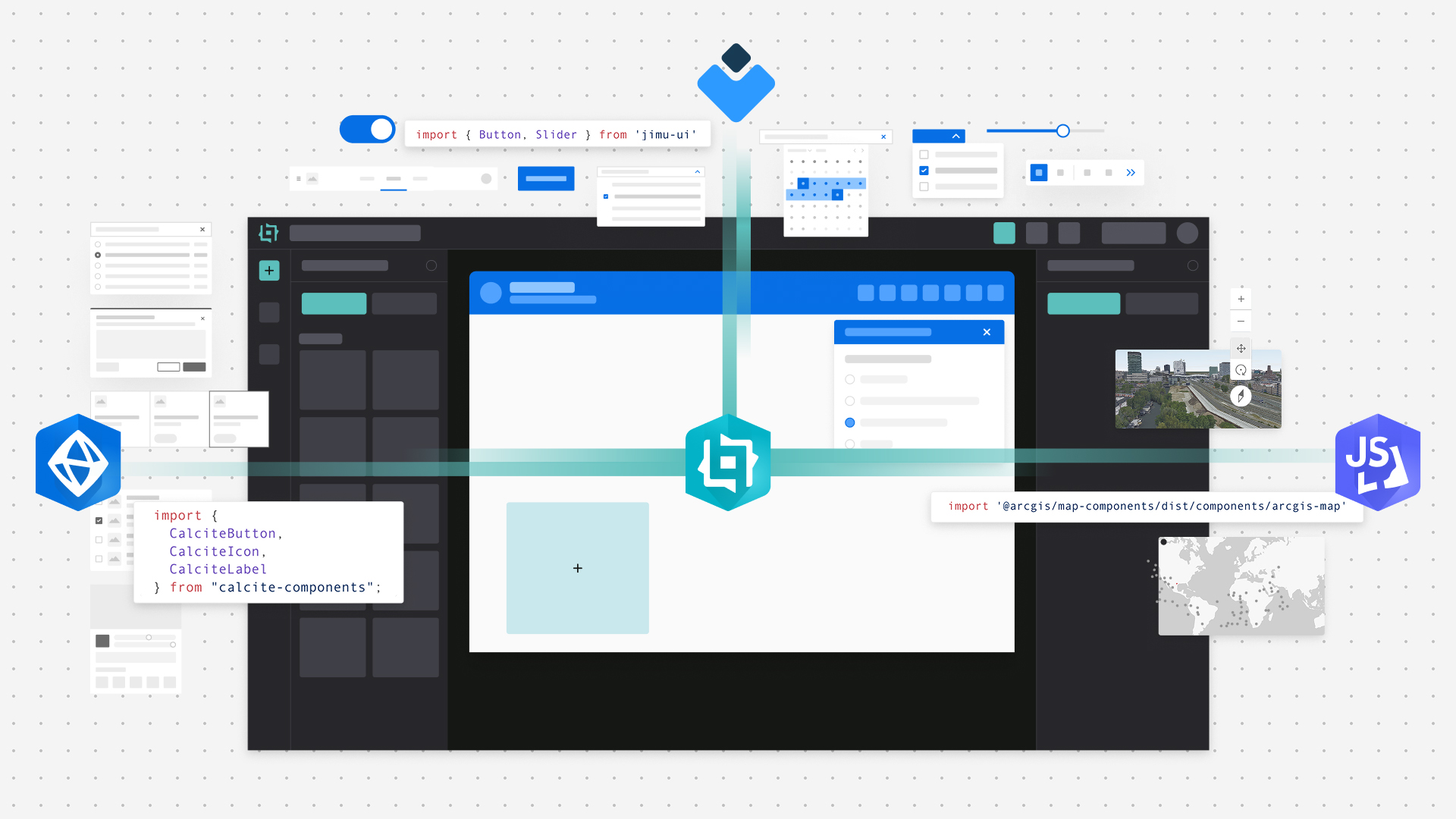
The world of web development is constantly evolving. Browsers are advancing both capabilities and standards, while developer tooling progresses. In this changing landscape, keeping your solutions future-proof requires adopting the latest standards and best practices.
ArcGIS Experience Builder allows you to create custom widgets for specific workflows—configurable and sharable functional units within Experience Builder. Creating your own widgets can be done with any integrated development environment that you’re comfortable with.
However, if you are building solutions that integrate ArcGIS experiences into your apps, the new recommended approach is to use ArcGIS Maps SDK for JavaScript web components. That approach applies to solutions that are fully custom as well as those involving custom widgets in Experience Builder.
Web Components Are the Future
Esri is fully committed to building standards-based web components that extend the core API of JavaScript Maps SDK into reusable custom HTML elements (e.g., <arcgis-map>). All legacy JavaScript Maps SDK widget functionality is being deprecated and removed, making this transition essential for long-term stability.
While the 2026 road map for ArcGIS Experience Builder includes a transition for the underlying Jimu framework to use JavaScript Maps SDK components, the current implementation is based on the SDK’s legacy widgets, MapView, and SceneView, rather than components.
Crucially, that doesn’t prevent developers from building custom widgets using the SDK’s components so that custom code embraces forward-looking techniques.
JavaScript Maps SDK widgets are legacy UI elements that enable maps, scenes, and other common web mapping workflows. These widgets are being deprecated and removed from the SDK. Equivalent functionality is available as web components.
Experience Builder widgets, however, are configurable UI elements that encapsulate functionality often built with the JavaScript Maps SDK. These widgets will transition to use JavaScript Maps SDK components rather than legacy widgets.
The Power of React
ArcGIS Experience Builder is now based on React 19. This version of React introduces major improvements for working with web components, essentially treating them as native HTML elements. Therefore, using SDK components within custom widgets has been greatly simplified.
React 19 fully supports the web components specification, allowing developers to use custom HTML elements within React without needing work-arounds or wrappers. Additionally, the most current version of React makes event handling for custom elements more consistent, behaving similarly to native HTML elements. It also allows for better management of properties, ensuring a consistent and reliable data flow between React applications and the custom elements.
Esri development teams are working to adapt to the changing technological landscape, enabling more powerful applications and optimum productivity for building web applications. As Esri product teams evolve the underlying architecture of Esri’s web applications (like Experience Builder), there are pathways that developers can take today that will future-proof the hard work they put into custom solutions.
About the author