While greater demand requires greater capacity, the opposite is also true—greater capacity creates greater demand. This is particularly true for the information services department of Cobb County, Georgia, where the use of GIS has grown exponentially for the past 26 years. It is now an essential part of the county’s operations, supporting a wide range of departments and services.
“The use of ArcGIS technology is applied in virtually all of the services provided by Cobb County,” said Chunguang Zhang, information business analyst in the county’s GIS Core Group, which is part of the information services department. “We utilize GIS in many ways—from desktop-based editing of parcels, roads, highways, and water utility networks to managing real-time public safety and emergency event data. Today, Cobb County makes extensive use of both enterprise GIS and ArcGIS Online in the daily operations of county government.”
Applications range from parcel and land records management to public safety and emergency response to elections and voter services. If you can name it, Cobb County uses GIS to make sure it’s done well.
“There are five members in our group and we support countywide GIS operations,” said Zhang. “We oversee more than 30 GIS databases, maintain three production ArcGIS Enterprise portals, and run numerous internal and external GIS applications. In addition, we ensure the smooth integration of our ArcGIS platform with critical county systems like the UMAX water billing system and Accela business process. We also handle daily GIS-related requests from residents, such as GIS data sales inquiries, emails, and phone calls.”
The sheer volume of these tasks caused Zhang to wonder if he could develop a GIS chatbot specifically for Cobb County to handle both public and internal inquiries in real time.
What Makes This Chatbot Different
While large language models (LLMs) like OpenAI’s ChatGPT and Google Gemini retain extensive information, they are generalized models. They lack deep domain expertise, which is critical in government applications.
For example, LLMs sometimes provide incorrect or misleading information (hallucinations). In government, misinformation can have significant consequences. LLMs also lack domain-specific knowledge because they are trained using publicly available data that does not include proprietary or recently updated information. In GIS, domain knowledge is vital for accurate responses. Additionally, LLMs often do not reliably remember past interactions, leading to inconsistent user experiences. The probabilistic nature of current LLMs means that asking the same question multiple times can yield different responses, which is undesirable in a government setting where consistency is crucial.
“To overcome these challenges, we implemented a solution using Retrieval-Augmented Generation [RAG],” said Zhang. “This powerful framework enhances LLMs by integrating them with private data stored in a vector database. Instead of relying solely on the model’s pretrained knowledge, RAG retrieves relevant, up-to-date information from our proprietary GIS dataset and provides it as context for the model. This approach significantly improves response quality and reliability.”
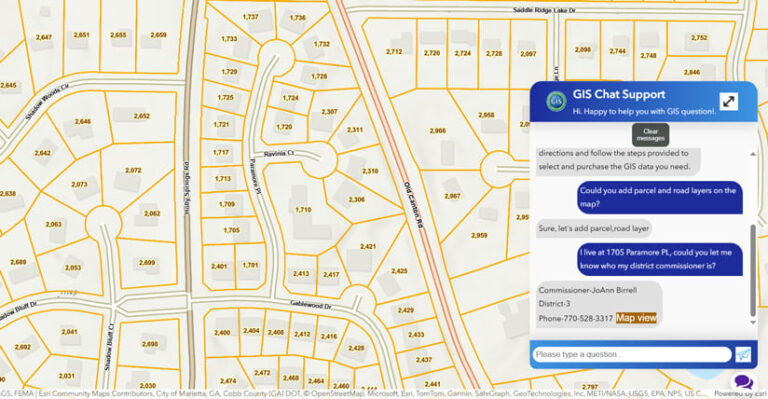
In developing the GIS chatbot, Zhang compiled years of resident inquiries and staff responses from GIS-related emails for training purposes. To ensure the consistency of the chatbot’s response, he leveraged ChatGPT to generate three similar variations of each question while keeping exactly the same answer. This ensured uniform and accurate responses every time.
Software used for the GIS chatbot’s development and operation included ArcGIS Enterprise, ArcGIS basemaps, ArcGIS Maps SDK for JavaScript, and ArcGIS API for Python. Other technologies used are LangChain open-source libraries and the ChatGPT API.
The Future of AI in Cobb County
By integrating RAG for relevant and up-to-date knowledge retrieval and function calling for real-time GIS operations, Cobb County has built a GIS chatbot that overcomes the limitations of generic LLMs. The project leverages AI to improve public services and optimize GIS workflows.
“The GIS chatbot answers frequent GIS-related questions and queries, which reduces the need for human interaction and support,” said Zhang. “This improves response times and ensures consistency in the response. It also allows staff to quickly retrieve zoning information, parcel verification, address validation, and GIS application data.”
Moreover, the chatbot supports government transparency and operational efficiency, helping agencies within the county better serve their communities.
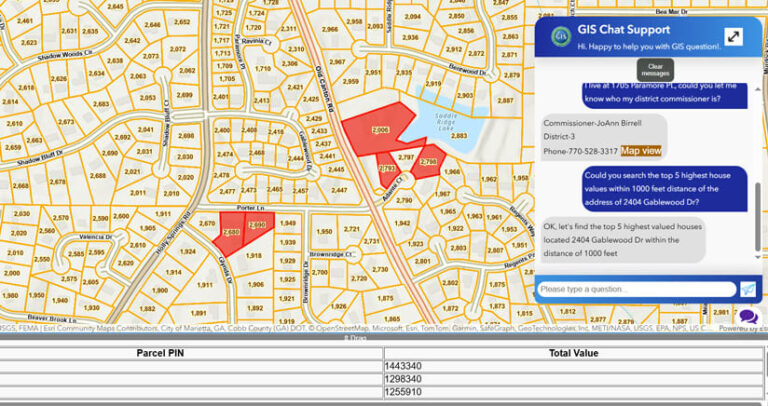
“I envision increased use of AI to improve services and optimize GIS workflows at Cobb County in the future,” said Zhang. “This includes automated feature extraction, change detection over time, and predictive modeling for infrastructure.”
In its expanded use of AI, the county aims to use ArcGIS pretrained image models to extract features such as houses, streams, and roads from the county’s annual Pictometry aerial imagery flights. The use of change detection would analyze temporal imagery to identify changes, such as new construction, deforestation, and post-disaster damage. Predictive modeling for infrastructure would use machine learning models to predict when infrastructure (like roads or water pipes) might fail based on historical patterns, current sensor data, accidents, and other road incidents.
In the meantime, Cobb County staff and residents with GIS-related questions now know where to turn to get geospatial information efficiently and effectively.
About the author


