Roughly 5,000 years ago, a river system called Wadi Al-Batin flowed through the Arabian Desert. Today, this area is devoid of any permanent rivers, though groundwater reaches the surface at some locations to form oases. Ninety-five percent of the Kingdom of Saudi Arabia lies within this desert region.
But according to Eyad Hammad, remote sensing specialist and project manager at Saudi Arabian Oil Company (Saudi Aramco), the country’s fertile land is at risk of becoming as arid as the desert.
“Desertification is a variable phenomenon,” said Hammad. “While much of Saudi Arabia is desert, some regions support an abundance of plant and animal life. In addition, farming is conducted near dry wadis by pumping water from underground aquifers to pivot irrigation systems.”
The urgency of maintaining these resources and preventing the spread of desertification is one of the factors that led to the Kingdom of Saudi Arabia’s National Water Strategy 2030. This plan is designed to provide a framework for the sustainable development of the country’s water sector, and was developed by Saudi Arabia’s Ministry of Environment, Water and Agriculture (MEWA) to help achieve Saudi Vision 2030, a strategy to diversify the country’s economy.
As part of this plan, Saudi Aramco, the world’s largest oil exporting company, is using ArcGIS tools to model desertification risk throughout the country, gathering data and developing the means to hold onto Saudi Arabia’s fertile ground.
Developing the Model
Founded nearly 100 years ago, Saudi Aramco began implementing ArcGIS technology in 1982 for oil exploration and production. Since then, the system has grown into an enterprise-wide platform.
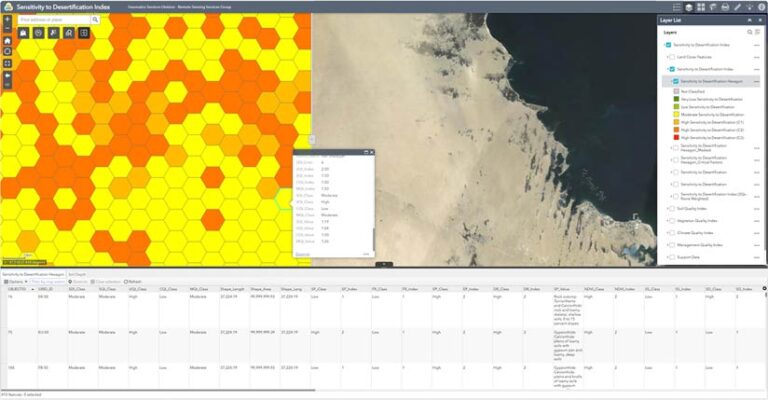
The company has relied on ArcGIS Pro to combat desertification with geospatial data processing, manipulations, and analysis. Portal for ArcGIS, a component of ArcGIS Enterprise, is used to share web GIS solutions, including dashboards and stories created with ArcGIS StoryMaps. ArcGIS Server hosts and publishes the project’s online services. ModelBuilder was used to automate the processes.
“The goal of our project is to identify areas throughout the country that are at high risk for severe desertification,” said Hammad. “We want to determine the reasons for this condition by analyzing the impact of various factors that can potentially contribute to desertification.”
Imagery for the Saudi Arabian desertification risk model was acquired by Hammad’s team from the European Space Agency’s Copernicus Sentinel-2 satellite constellation.
Copernicus is the Earth observation component of the EU Space Programme. Sentinel-2 collects continual, high-resolution optical imagery of Earth with multispectral sensors, providing detailed views of vegetation, soil, and water cover under daylight and clear atmospheric conditions. The ArcGIS Image Analyst extension in ArcGIS Pro is then applied to the multispectral imagery to create false-color composites and perform analysis.
The team used historic satellite imagery with a very high resolution of 30 and 50 centimeters to analyze and classify changes in desertification throughout the country and validate the model.
Other data used in the model includes meteorological data from WorldClim, climate data from the Food and Agriculture Organization, demographics data from the United Nations, and land-cover and soil data from the MEWA.
In the development of the dynamic Saudi Arabian desertification model, the project team also implemented modified versions of the Mediterranean Desertification and Land Use (MEDALUS) model and the Environmentally Sensitive Areas Index (ESAI). MEDALUS is a framework created by the European Union to identify areas vulnerable to desertification and land degradation.
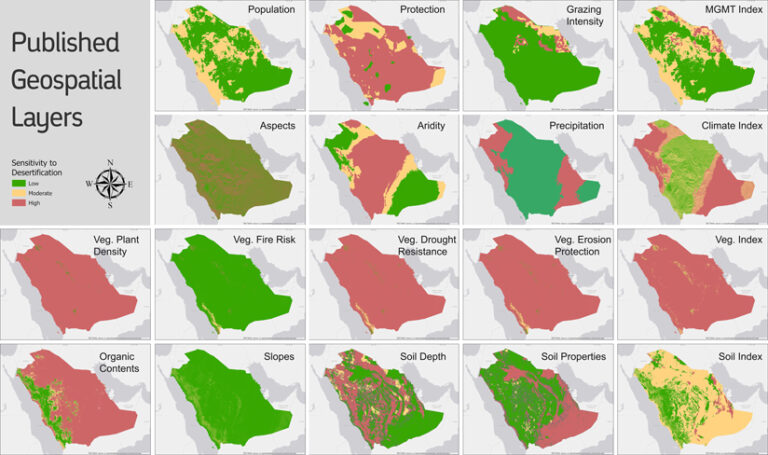
“The team started the desertification model development by evaluating the original MEDALUS model, which contained three primary indices including soil, vegetation, and climate,” said Hammad. “After the first assessment on a pilot area, we decided to implement an enhanced version of the model by adding a fourth index to represent the human factor related to land degradation or preservation.”
The indexes required processing 14 different geospatial datasets that collectively represented various aspects of the desertification process. They were acquired from both public and private sources. To ensure consistency and comparability, all input data was normalized and converted to a unified unit scale. This involved assigning sensitivity scores of 1, 1.5, and 2 to each criterion, reflecting its relative impact on desertification and land degradation. The normalized datasets were then applied to the MEDALUS equations to calculate the ESAI index and include it in the desertification model.
First Steps
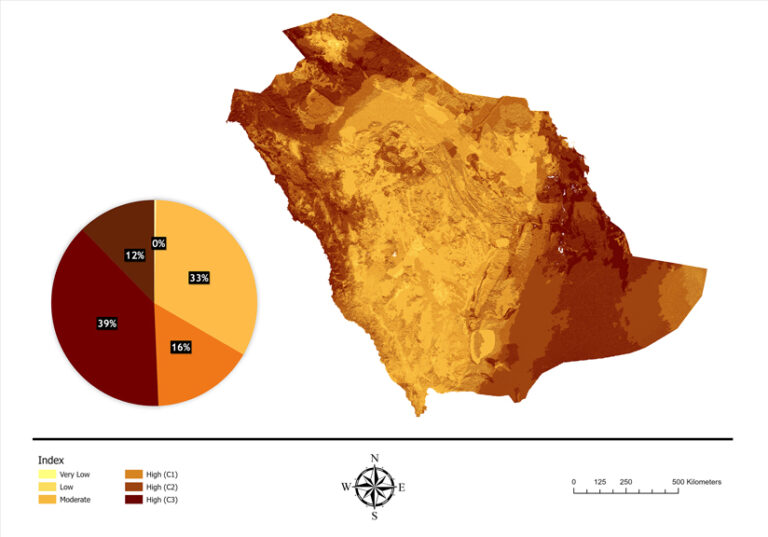
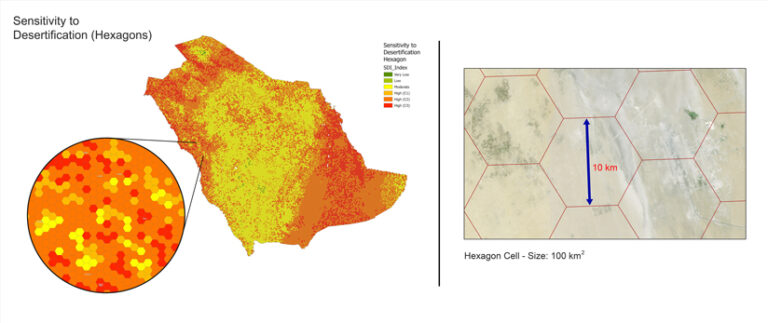
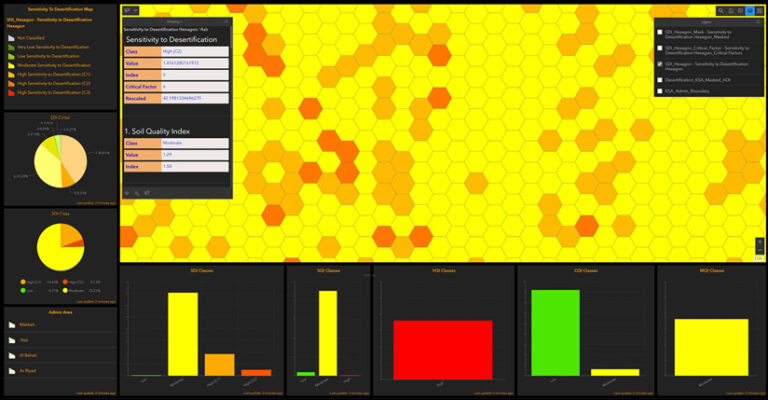
The completed model is the result of a one-year study and represents the first step in protecting those areas under threat of severe desertification by incorporating them into the Saudi Aramco Biodiversity Protection Program. Desertification risk maps, such as the Sensitivity to Desertification Index map, are crucial for highlighting areas at high risk of desertification using advanced interactivity, analysis, and geovisualization.
The results of the Saudi Aramco team’s model were clear. Analysis revealed that climate factors play a major role in the ongoing desertification of Saudi Arabia. Perhaps unsurprisingly, rainfall is the most significant of these factors. The amount of annual precipitation has a direct impact on desertification sensitivity scores.
“Another crucial factor is human pressure, which encompasses human activities that interact with land, such as population pressure, grazing intensity, and conservation practices,” said Hammad. “These factors have a noticeable impact on resource sustainability and land degradation.”
Hammad noted that this project is only one building block in a larger plan to develop a climate change stress index in support of biodiversity protection. In addition to the original four indexes, desertification factors in future studies could include ecosystem diversity, elevation, storm surge flooding, sea level rise, dust storms, landslides, habitat impact, and
desertification risks.
“Our analyses provide decision-makers with the necessary knowledge and insights to better understand the impact of desertification on biodiversity,” said Hammad. “This allows them to prioritize areas for conservation and restoration efforts.”
About the author