At Johns Hopkins University in Baltimore, Maryland, GIS education gets about as hands-on as you could imagine.
Take the students who investigated Chesapeake Bay shoreline erosion. They initially suspected that sea level rise was the primary cause. Careful analysis revealed a more complex story.
“The students found that shoreline erosion is happening because underground saltwater intrusion is reaching plant roots that help hold soil together,” said Jim Blanchard, a lecturer at Johns Hopkins University. “When this kills the vegetation, you get erosion. This is useful to know, because although you can’t hold back the rising water, you can plant salt-tolerant vegetation.”
He offered another example: “One student, a law enforcement officer in a major city, implemented drone mapping using thermal sensors to detect human activity on rooftops.” By establishing baseline activity patterns adjusted for weather conditions, the officer could identify anomalies warranting investigation during public gatherings or in areas with criminal activity.
These students are part of Drones in Geospatial Decision Making, an eight-week course Blanchard has taught since 2019. He brings more than 40 years of aviation and remote sensing expertise to the curriculum. After becoming a commercial pilot at age 20, he worked at Embry-Riddle Aeronautical University, then advised military leaders on aviation systems for a decade following the September 11 attacks.
In this class, students in the university’s environmental science and GIS programs go beyond basic flight training to master a skill that sets them apart in the job market—the ability to transform drone-collected data into actionable geospatial knowledge. The students use drone technology alongside Site Scan for ArcGIS, ArcGIS Drone2Map, and ArcGIS Pro to move beyond surface observations and identify underlying mechanisms. These are the kinds of hands-on analytical skills designed to set students up for success.
Beyond Basic Certification
Many universities across the United States offer Federal Aviation Administration (FAA) Part 107 drone pilot certification as part of their geospatial education. At Johns Hopkins, earning that certificate is just the beginning. Through the repeated data collection missions of Blanchard’s course, students learn to detect environmental changes over time with precision that satellites can’t match. The result is a competitive advantage that has helped graduates land positions such as state drone coordinators and infrastructure assessment specialists.
So far, about 140 individuals have completed the course, with up to 16 people in each class. Students complete three distinct modules that determine their final mark. The first is based on getting their drone pilot certificate from the FAA. The second focuses on sensor selection (lidar, thermal, and multispectral) for environmental science problems and advanced visualization techniques that support time-series analysis. The third is based on an intensive, four-day field laboratory where students operate drones in teams to collect data at research sites.
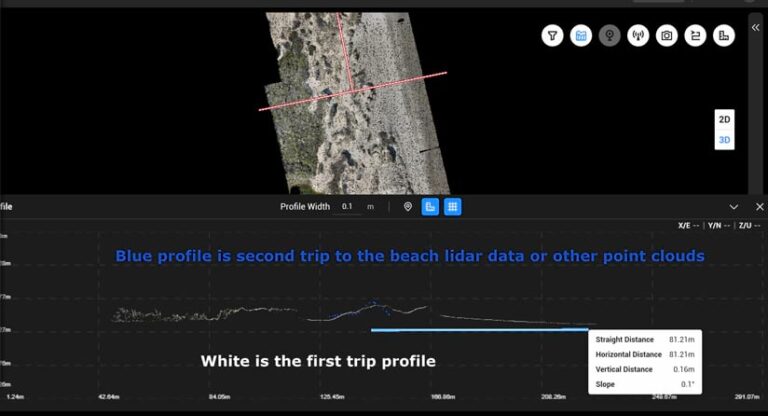
The program’s emphasis on temporal analysis—teaching students to collect data repeatedly at the same locations over time—distinguishes it from other university drone courses.
“I don’t know of any other program that teaches you how to go out and fly repeatedly and compare the data over time, utilizing a high-resolution dataset like you get from one of these aircraft drones,” Blanchard said.
This approach enables temporal and spatial saturation. While Landsat satellites pass over locations every 16 days, students flying drones weekly can triple the sampling frequency with higher resolutions, helping identify cause and effect relationships with greater confidence. Even basic consumer drones can capture imagery with detail surpassing that of the best satellite sensors. This enables micromapping—studying environmental features in such fine detail that subtle change indicators become visible.
“Correlation to true causes can be discovered using frequent data collection and well-conceived analysis,” Blanchard said.
Students begin each project by formulating a hypothesis and identifying variables. Then they determine which sensors can measure them effectively. This approach ensures students understand not just how to fly drones but also why they are collecting specific data and what it means.
Building a Competitive Edge
Rather than mandating specific software, Blanchard provides students with three options: Site Scan for ArcGIS, ArcGIS Drone2Map, or advanced tools in ArcGIS Pro. Site Scan for ArcGIS—a cloud-based platform that processes drone imagery without requiring powerful local computing resources—enables students who are limited by hardware capabilities to participate.
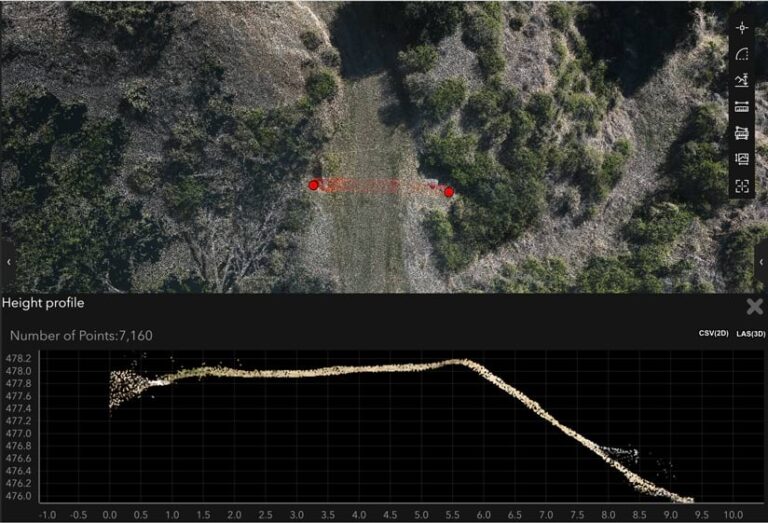
“We use Site Scan because it basically enables the lowest level of computer skills of students in my program, and that way nobody’s left out of the process of learning how to interpret the results,” Blanchard said, noting that about half his students use Site Scan. Its elevation profile and point cloud volumetric tools proved essential for coastal dune projects, allowing precise measurements without disturbing sensitive environments.
The program emphasizes communication skills, as students must articulate scientific conclusions clearly during online meetings and in final assignments.
“Without the ability to verbalize the complex points of their work, they won’t be able to get feedback from me during the course meetings on Zoom,” Blanchard said.
This extends to field operations, where students work in teams using crew resource management—collaborative protocols that professional pilots use for safe, effective operations.
During the four-day field portion, students progress from supervised training to autonomous team operations. Days one and two cover basic flight skills and mission planning. By day three, students operate unsupervised in teams, collecting data for research projects. Students then present their final projects with ArcGIS StoryMaps. The stories later become portfolio pieces students can share with potential employers. Project topics have included shoreline erosion, stormwater management, and invasive species assessments.
“Our students have an advantage because they have a story map that they can link to in their job application. If they’re applying for a flight job or a GIS job that’s focused on turning data into actionable information, they’re going to be able to provide an example of their work,” Blanchard said.
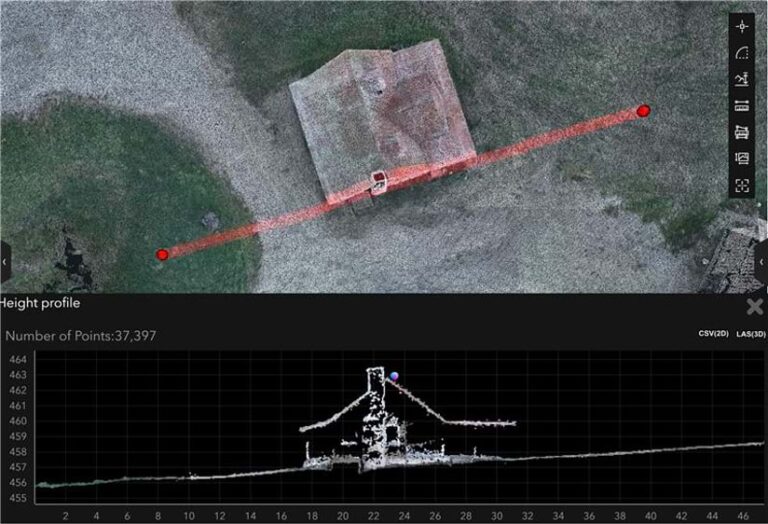
One former student became a special assistant to a state governor, coordinating drone adoption across state agencies. Another was hired to map roads leading to bridges, using high-precision vertical measurements to detect early structural change indicators.
For Blanchard, the goal extends far beyond teaching students to operate drones.
“I teach that the flying isn’t the reason you get certified,” Blanchard said. “It’s all about turning data into information, which humans then can turn into knowledge. That’s the strategic pathway. Having a drone pilot certificate is just the stepping stone.”
This reliance on analytical thinking guides the program’s emphasis on scientific methodology. Students learn that understanding what maps reveal, collecting data safely and legally, and knowing which sensors to deploy for scientific questions matter more than piloting skills alone. The competitive advantage Johns Hopkins students gain comes not from their ability to fly, but from their capacity to transform aerial observations into geospatial insight.