In 2011, the Utah Department of Transportation (UDOT) began developing a comprehensive inventory of its roadway assets to address the serious transportation challenges presented by the landscape. With Utah’s high mountain passes and deep valleys, the state’s rapidly growing population is concentrated in a confined area. Winters bring heavy snow to major highways, while summer heat stresses infrastructure. Traveling along state roads, UDOT vehicles equipped with lidar and photogrammetry equipment captured everything from signs and barriers to rumble strips and striping.
When UDOT’s planning division sought a way to share this unprecedented collection of data across the organization, ArcGIS Online was the solution, enabling users to create maps and manage their own data. What started as a platform called UPlan for sharing roadway assets eventually became the foundation for an enterprise-wide geospatial program.
What distinguishes UDOT’s program is not any single technology deployment, but rather a deliberate, holistic approach to the business of GIS—transforming scattered data and static maps into an integrated digital foundation that keeps people in Utah moving safely and efficiently through challenging terrain and often harsh weather conditions.
Moreover, UDOT exemplifies the five components of Esri’s Path to Geospatial Excellence framework: aligning business strategy with organizational goals, establishing robust governance frameworks, architecting flexible systems, driving broad engagement, and building organizational capacity through training and career development. This makes the department a textbook example for other agencies or organizations that aim to go down the same road.
Business: Aligning Technology with Organizational Strategy
Building a strong geospatial foundation requires alignment with organizational mission and vision. For UDOT, this meant establishing a geospatial strategy with specific business goals and objectives that ensured that GIS would support core departmental functions tied to the linear referencing system that anchors a wide variety of projects and more than 500,000 assets.
“By having this live picture, we’re better able to get people where they’re going safely,” said Corey Unger, GIS program manager at UDOT. The department’s strategic direction emphasizes innovation and collaboration, with geospatial technology providing the spatial context needed to optimize processes and support data-driven decisions across planning, design, construction, and maintenance operations. This directly contributes to the organization’s overall success.
Governance: Establishing Frameworks for Quality and Trust
Early success with ArcGIS Online brought unexpected challenges as it freed users to create maps and manage their own data.
“It started to become a victim of its own success,” Unger explained. ArcGIS Online became so popular at UDOT that it evolved into what he described as a chaotic mess. “It became a dumping ground where we had copies and copies of data and a lot of it was old and out-of-date,” he recalled.
UDOT’s response was to establish a formal approach to decision-making consisting of policies and procedures that enabled positive change. The UDOT Central GIS Group implemented robust governance frameworks with administrators across each system along with coordinators who could share content at certain levels, addressing leadership, authority, decision-making, and accountability. To ensure that public-facing content met quality standards, UDOT implemented a formal review process tied to department policy.
“Anything that’s shared publicly needs to fit certain standards,” Unger explained. Governance requirements now specify that content must meet metadata standards, have configured pop-ups, and follow proper theming guidelines before administrators approve it for public sharing. This has dramatically increased content quality and reinforced senior leadership’s trust in the geospatial program through effective governance and holistic business alignment.
Systems: Building a Flexible, Well-Positioned Architecture
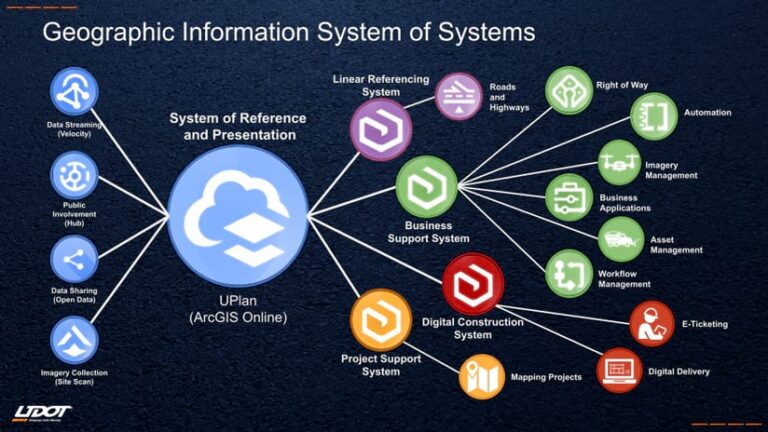
UDOT’s GIS technology evolved from a single server to what Unger calls a “system of systems,” which consists of four distinct ArcGIS Enterprise environments supported by ArcGIS Online as the central system of reference and presentation. This architecture reflects a systematic mindset—multiple purpose-built ArcGIS Enterprise environments operate independently yet are integrated through ArcGIS Online to support scalability, resilience, and diverse business needs.
The four enterprise environments serve specific functions. The Linear Reference System environment, supporting about five users, manages routes and reference posts that form the backbone of departmental data. The Business Support System serves central office functions including right-of-way management, server automation, and workflow management. The Digital Construction System handles everything from preconstruction planning through construction execution. The Project Support System serves UDOT’s four regional offices, which manage day-to-day operations and projects with needs that are distinct from central office or construction groups.
“By developing this architecture where we have these separate systems, we’re able to cater them to support the specific needs of these programs and groups,” Unger said. This flexible approach ensures a well-positioned system designed to meet diverse organizational needs.
Engagement: Driving Adoption Across the Organization
The department gained adoption across all areas that could make the most of a geographic approach by clearly articulating benefits and highlighting ways GIS improves processes and decision-making in focused areas.
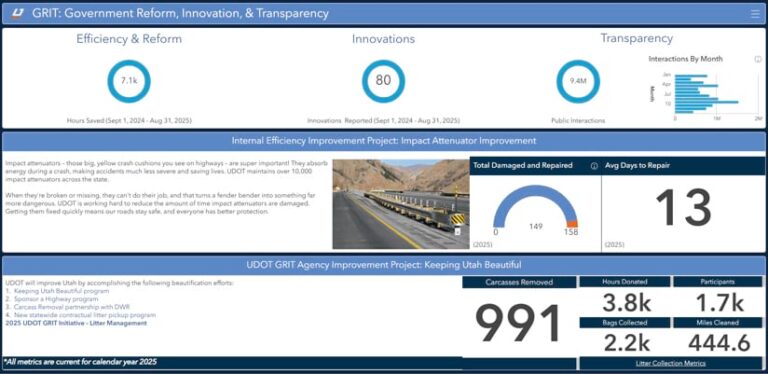
“We look at GIS as providing not just a map but a solution,” Unger said.
This engagement strategy led to innovative use cases across divisions. UDOT’s legislative tracking solution, which monitors potential laws affecting transportation, is one example where GIS technology solved a problem with minimal spatial components. This streamlined processes for the entire department and boosted the GIS program’s reputation for innovation.
“UDOT gives out innovation awards every year,” Unger said. “Last year, three out of four of those awards were for GIS-based solutions.” This widespread adoption demonstrates truly successful use of GIS across the organization.
Capacity: Training Requirements and Career Development
UDOT recognized early that technology alone wouldn’t drive adoption; instead, people needed the skills and motivation to use GIS effectively. The department now requires training—frequently from Esri Academy—before granting system access to staff, assessing their current proficiency levels and tailoring development opportunities to meet specific needs.
“When people request accounts to our systems, we require that they take certain training so that we know that they at least have this basic level of competency before they are allowed access,” Unger explained.
Training varies by role, whether the user is a GIS analyst or a maintenance worker. For example, staff using the Mobile Worker user type must complete training modules for ArcGIS Field Maps, ArcGIS Survey123, and ArcGIS Online editing, while those with a Creator user type are required to take courses on ArcGIS Experience Builder, ArcGIS Dashboards, and other ArcGIS applications.
Beyond initial training, UDOT also established a career ladder that provides GIS analysts with a clear path for advancement. This capacity-building approach helps UDOT retain trained staff, maintaining institutional knowledge and supporting quality standards. This enables teams to execute projects, better leverage technology, and make valuable contributions.
Delivering Measurable Impact Through Geospatial Excellence
Integrating all five components of the Path to Geospatial Excellence has given UDOT a strategic edge and a proven framework that drives exceptional effectiveness and sustained success. Asset tracking is one example. The department can now assess the condition of road signs, identify those in poor condition, determine their locations, and estimate replacement costs.
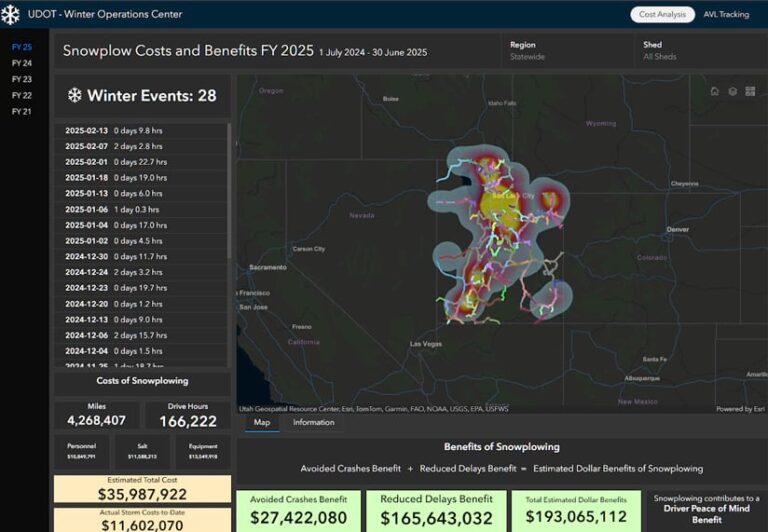
In addition, a winter weather dashboard shows the benefits of integrated data analysis. By combining automated vehicle location data from snowplows with maintenance information and weather data, UDOT can estimate storm-related costs such as personnel time, salt usage, and equipment. This helps the department plan for future storms, Unger said.
UDOT’s digital data delivery initiative continues expanding to more projects, driving the need for proactive infrastructure scaling. A planned migration to Linux will reduce costs and improve scalability, Unger said. Collaboration with Utah’s Department of Technology Services and Esri Professional Services remains central to the strategy, with annual planning meetings that establish goals such as digital twins, cloud migrations, and infrastructure optimization.
“It has taken a while to set it all up this way,” Unger reflected, noting that the evolution from enthusiastic adoption to structured enterprise system required patience, strategic planning, and consistent focus on geospatial excellence.
UDOT’s experience demonstrates that building a strong geospatial foundation requires balancing all five components of the Path to Geospatial Excellence. Together, these elements create what Unger describes as sustained trust that “allows innovation to flourish at organizational speed,” making UDOT a model for organizations seeking to maximize the impact of their GIS programs.