Traffic on the Trans-Caspian International Transport Route (TITR), a multimodal transport network connecting China and Europe through Central Asia, has intensified since 2022. Since Russia’s invasion of Ukraine, this middle corridor has become a vital pathway for cargo and freight. Parts of the route are currently under development using existing roads, railways, and port facilities. But much of this infrastructure needs to be repaired or upgraded to keep up with the increased flow of traffic.
The central part of this corridor is located in Türkiye, making the country a lynchpin for the TITR. Fortunately, Türkiye already has over 90,000 kilometers of road, including more than 100 four-lane national highways that will serve the middle corridor. Other major roadways include province highways and secondary motorways, comprising an extensive roadway system that is planned, designed, constructed, and maintained by the General Directorate of Highways (KGM).
As the TITR is built out across multiple continents, it has been an opportune time for the KGM to improve on its road maintenance process. The agency has relied on ArcGIS technology for more than 15 years, but the KGM is now employing AI tools that interface with software such as ArcGIS Pro and ArcGIS API for Python to maintain and repair its vast road network.
AI and Automation

“Because of the high volume of traffic on our roadways, both domestic and international, maintenance is an expensive and ongoing process for the KGM,” said Özgenç Uslu, director of the KGM’s GIS department. “This is compounded by the country’s geographic location between Europe and the Middle East, which increases the volume of goods being transported using heavy commercial vehicles.”
Fourteen different types of cracks require identification and categorization for repair in the roadway system. In many cases, these varied cracks contain sub-structures that are difficult to distinguish visually, making manual inspection both time-consuming and prone to human error.
As a result, AI and deep learning techniques provide an ideal solution to detect subtle highway deterioration that cannot be easily identified by visual inspection.
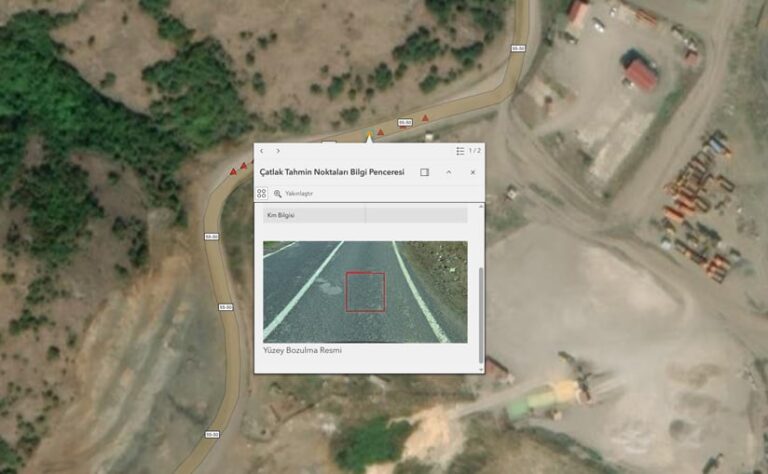
“Artificial intelligence is able to accurately classify each type of crack by processing large amounts of data during the training process,” said Uslu. “Deep learning works with this complex data to provide continuous, consistent, and much faster analysis of those cracks, all without human intervention.”
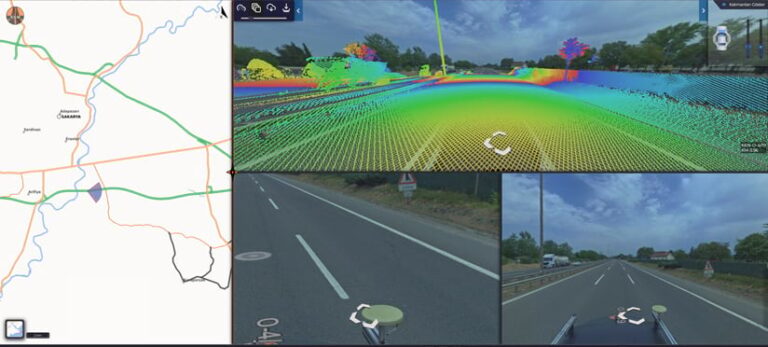
The KGM created a custom vehicle with specialized equipment to collect the data necessary to train models in the identification of pavement cracks and specify necessary repairs. This included lidar imagery of highway surface conditions and panoramic views of the roads. Nearly 2.5 million panoramic images and the related five terabytes of lidar data were collected and geotagged during a four-month period in 2024. Each image was stored simultaneously with its coordinates so that crews could easily find the cracked pavement in need of repair.
The KGM team used ArcGIS Pro for data processing and visualization, with the ArcGIS Image Analyst extension for advanced imagery processing and analysis. ArcGIS Notebooks was used for rapid modeling and prototyping, while ArcGIS Enterprise allows crack detection data to be published as a service.
Additionally, ArcGIS API for Python automated data preparation for deep learning workflows by applying transformations and augmentations to training data.
The team also used Python and ArcPy to automate processes, as well as the deep learning libraries of fast.ai and PyTorch, plus LabelImg for image labeling. PostgreSQL and PostGIS allowed the KGM to store panoramic image coordinates as well as lidar data, and LAStools and PDAL were used for point cloud processing.
“With the Single Shot Detector algorithm, model training was performed using the deep learning capabilities of ArcGIS Pro,” said Uslu. “The model was optimized to accurately detect cracks. On the completion of its training, it identified cracks on the panoramic images and saved these data with their coordinates. The cracks were then analyzed with lidar data to determine their depth. The resulting data were used to assess the severity of the cracks.”

Expanding the Network
Improving Türkiye’s roads with AI didn’t begin and end with crack identification, however. The KGM recently completed three other projects using ArcGIS and AI.
A speed limit map analyzed road type, pavement data, toll plaza locations, and residential area boundaries for a nationwide highway analysis. This was used to create a speed limit prediction model.
The KGM also used AI and a lidar-generated point cloud to sort road terrain into three categories according to slope for land structure classification. Processed terrain data was published as a GIS feature layer.

For a traffic safety study, deep learning models were trained to detect curve points and their start and end positions in the roadway network. The radii were then calculated using the existing road centerline.
“In the future, we plan to use artificial intelligence algorithms to detect and classify the deformations and distortions of our bridges using high-resolution images captured with a drone,” said Uslu.
The possibilities for AI-augmented GIS projects are myriad—and crucial—when it comes to Türkiye’s road network. And with the heavy traffic coming through, the KGM is more determined than ever to ensure that its roads are well-maintained and well-equipped to handle the load.
About the author