How many housing units did we build last year in our county? Where were they built? How many were built the year before that? How many lots do we have available for development?
As communities across the United States grapple with a lack of available and affordable housing, being able to answer these questions is vital for county governments. But in Kenton County, Kentucky, answers were difficult to come by. Tackling these questions required plats from the engineering department, zone change approvals from the planning department, and final building permits from the building inspection department. Then, the GIS department needed to map that information. Multiple data silos, five internal departments, four permitting sources. The development and permitting process worked well, but the reporting side was agonizingly slow.
Located directly across the Ohio River from downtown Cincinnati, Kenton County has attracted a strong portfolio of development projects, large and small. While beneficial for the local economy, frequent development activity has added complexity to the already complex task of managing development and permitting for the county and its 19 cities.
Within Planning and Development Services of Kenton County (PDS), individual departments used their own tools, workflows, and software platforms to manage their respective parts of the development process effectively. What was lacking was a comprehensive way for PDS leadership, elected officials, and the public to view the entire development activity picture in the county on demand.
Beginning in fall 2024, PDS staff set out to change this. The goal was to develop a tracking system centered on the location of developments across the county. The backbone of this tracking system would rely on GIS to address the questions that spreadsheets and permit reports can’t answer. The result was the Kenton County Development Tracker, an ArcGIS Experience Builder app that leverages ArcGIS Online, ArcGIS Server, ArcGIS Enterprise, and extensive Python automation to provide a near real-time view into development activity throughout Kenton County. By mapping development plats, new subdivisions, and building permit data, PDS has developed a tool that makes this data the most accessible to the public it has ever been.
From Data to Display
The development process begins with two types of data—plats and permits. For the Development Tracker, plats represent the land area of the development project. A plat can be a subdivision of land or a planning commission action (land rezoning) if a subdivision of land is not required. Within these plats, final building permits (certificates of occupancy) are tracked for each individual home, apartment, or suite.
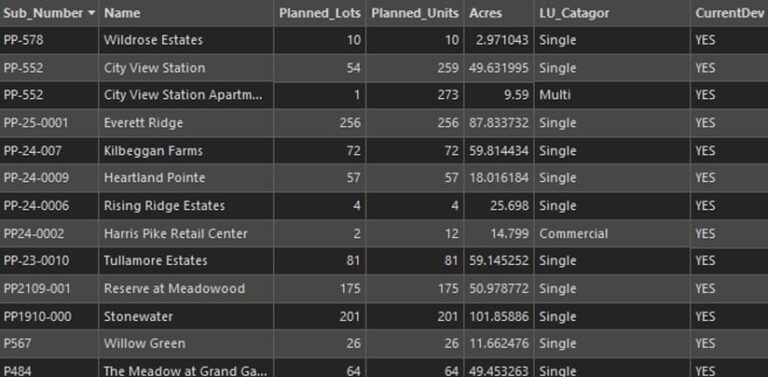
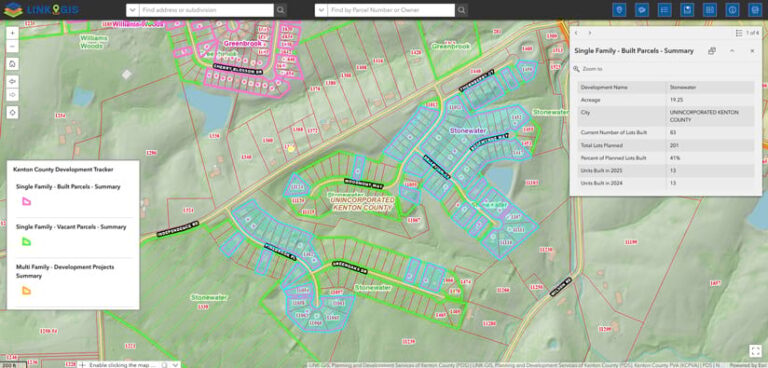
Through Python automation and the use of geoprocessing tools, the data within each development is aggregated and the tracker displays a summary of the development area that shows units built, units planned, lots built, lots vacant, units built last year, units built so far this year, and percentage of full build-out. The end result is a one-click solution that makes it easy to see development progress and relevant information for a particular project.
However, developments are constantly evolving, and each project has unique features that must be accounted for. Sometimes a developer includes a pocket park as a recreation feature on a parcel within the subdivision, a parcel is reserved for a monument sign, or a building already exists on the parcel of land that is being further developed. Each of these situations can negatively impact the ability of the automation to recognize the status of a development or the individual parcels within a development. To solve this problem, certain parcels are excluded from being summarized in the automation process.
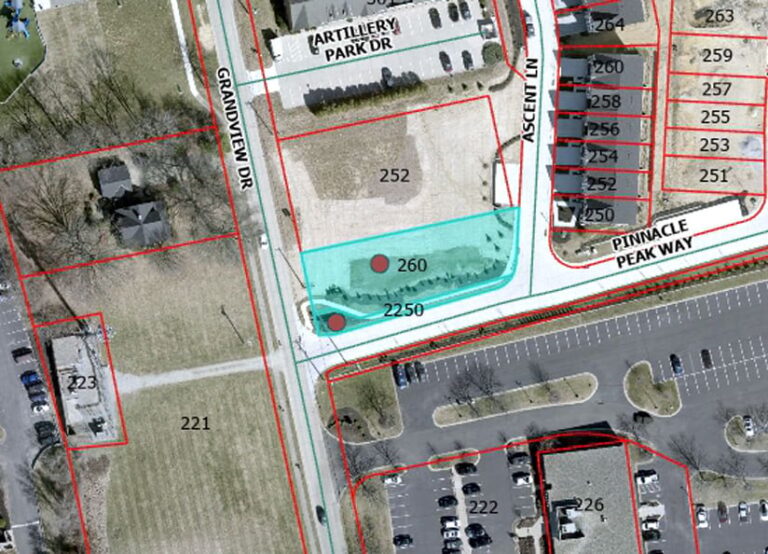
For example, the Pinnacles of Fort Mitchell is a recent development with a mix of townhomes and single-family detached housing. The plat submitted to PDS showed 50 total lots in the development. However, two of those lots were nonbuildable lots (reserved for a monument sign and an homeowner-association-owned property with entrance landscaping) and were flagged as such in the GIS. The total planned lots was automatically revised down, allowing the total build-out to be calculated based on 48 lots and 48 units. This is important because the Development Tracker reports the percentage of planned lots built as a metric for the entire development. Without this adjustment, full build-out would appear to be incomplete, rendering an inaccurate picture of the development by incorrectly showing lots available for future building activity.
Moreover, not all projects fit cleanly into predetermined categories. For example, some cities use a request for proposal (RFP) or request for qualifications (RFQ) process to unlock development opportunities. In most cases, RFP/RFQ projects lack the specific details that development tracking is geared toward—for example, total planned lots and total planned residential units. The Development Tracker takes these future opportunities into account by including them as a separate map layer, allowing a comprehensive look at the entire development picture—vacant, built, planned, and future—and placing future development opportunities into the context of active developments, all within a single map.
Behind the Automation
Extensive automation is crucial in keeping the data that feeds the applications current. The Development Tracker relies on a number of feature classes that are edited daily through Spatial Database Engine (SDE) and SQL Server in a versioned editing environment. From there, ArcPy scripting and geoprocessing run on the SQL database feature classes to create new analysis-derived feature classes that are specific to development activity in Kenton County. The newly created data is then transferred from the internal network to an external Amazon Web Services (AWS) cloud environment, via Simple Storage Service (S3) buckets. Using ArcPy and Windows Task Scheduler, the data processing and data transfer are automated to run on a set schedule, with the most important tasks running nightly.
Once the data has been transferred to AWS, ArcPy automation updates the geodatabase that serves as the source data for the ArcGIS Enterprise map services, including the updated Development Activity layers. ArcGIS Pro is used to set the feature class symbology and labels, then the projects are shared out as map services in the hosted ArcGIS Enterprise environment.
Once established, the map services are added to an ArcGIS Online web map by their URL REST endpoints. The web map is used to create pop-ups from the map service layers. This includes the use of ArcGIS Arcade expressions to run calculations and to select and count point data, which is also shown in the configured pop-ups. The web map is then loaded into an Experience Builder application. Experience Builder is used to configure navigation tools, add widgets, and determine the functionality and appearance of the app. Finally, the app files are downloaded from Experience Builder and copied to the website host server, where the application is served out for public consumption.
To maintain the most current inventory of active and future projects along with any other unreported developments, PDS has also developed an application called CivicScope. This app uses ArcGIS Dashboards, ArcGIS Survey123, ArcGIS Instant Apps, and Microsoft Power Automate to allow local officials from all 20 jurisdictions in the county to report missing or incorrect development information to PDS for review. CivicScope is a credentialed application that allows authorized users to submit updates to known and future development activities with a high level of authoritative confidence. This solution allows PDS to close the feedback loop on development processes throughout the county.
A Suite of Solutions
With the tracking process, automation, and reporting mechanisms in place, the focus turned to how PDS could take this geographic data and turn it into actionable information for PDS leadership, elected officials, and the public.

Enter the PDS Development Hub, a site created with ArcGIS Hub to do just that. The site is a one-stop destination for all development-related information in Kenton County. It includes the Kenton County Development Tracker, the Active Subdivision Dashboard, dashboards tracking nonresidential economic development projects, and reports from local agencies, all working together to paint an accurate and near real-time view of development across the county.
The automation involved in the Development Hub follows the same early steps as the Development Tracker. The site contains map viewers that are fed by the same map services as the Development Tracker, and also combines data from the ArcGIS Online environment to power additional housing dashboards and key performance indicator dashboards hosted on the Development Hub site.
Each of these solutions—the Kenton County Development Tracker, the PDS Development Hub site, and CivicScope—is a powerful stand-alone tool. But the pieces work together to form a comprehensive suite of solutions that prioritizes public accessibility and data transparency. By implementing a more robust suite of solutions, PDS has used GIS to inform and engage its leadership, stakeholders, and the communities in Kenton County.