Florida, with its warm weather and abundant access to freshwater and salt water, is sometimes called the boating capital of the world, with over one million registered recreational vessels in the state. Some owners, however, neglect or abandon their boats when they can no longer afford to maintain them. Severe weather or accidents can also damage the boats, leading to abandonment or dereliction.
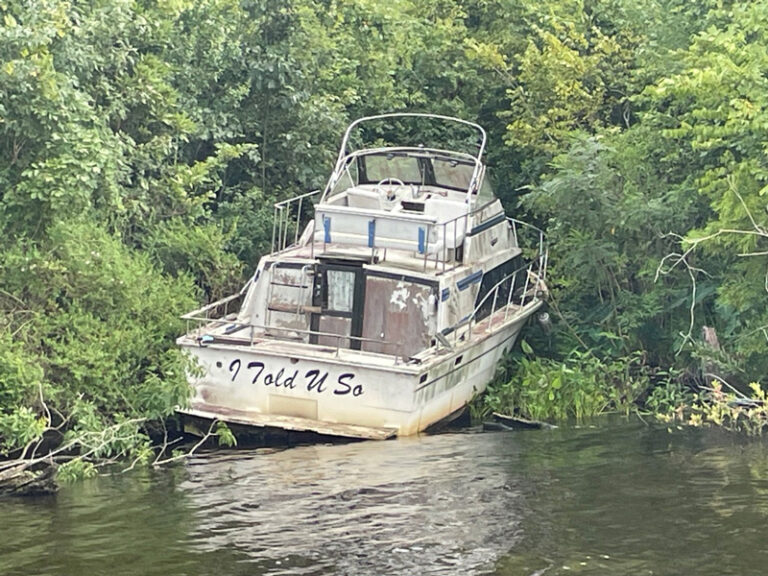
In Florida, a vessel is considered derelict when it is left stored or abandoned in a wrecked, junked, or substantially dismantled condition on public waters or on private property without the consent of the property owner. These vessels threaten boater safety, pollute the water, damage marine resources, and cost taxpayers millions of dollars each year in removal and disposal costs.
St. Johns County—located in the northeast portion of the state, between the St. Johns River and the Atlantic Ocean—is home to over 337,000 residents, 17,443 of whom were registered boat owners in 2024. But until recently, the county had no process or system in place to monitor which derelict vessels were being investigated and which agency was investigating them.
The solution was the Derelict Vessel Tracker, an application created with ArcGIS Dashboards and ArcGIS Survey123 that has streamlined the way that city, state, and county agencies investigate these vessels. In the process of creating the app, the St. Johns County GIS Division staff realized they could do more—much more.
A Decentralized Investigation
Previously, abandoned or derelict vessels could be processed by either the St. Johns County Sheriff’s Office, the St. Augustine Police Department, or the Florida Fish and Wildlife Conservation Commission. Each investigating officer kept a notepad with information about the derelict vessel for their specific investigation. They might meet with the other agencies every few weeks or run into another agency on the water while patrolling and compare notes, but there was little or no information sharing. When they came upon a new vessel at risk, they might spend 30 to 45 minutes making phone calls to other officers to see whether anyone might have already started working the vessel.
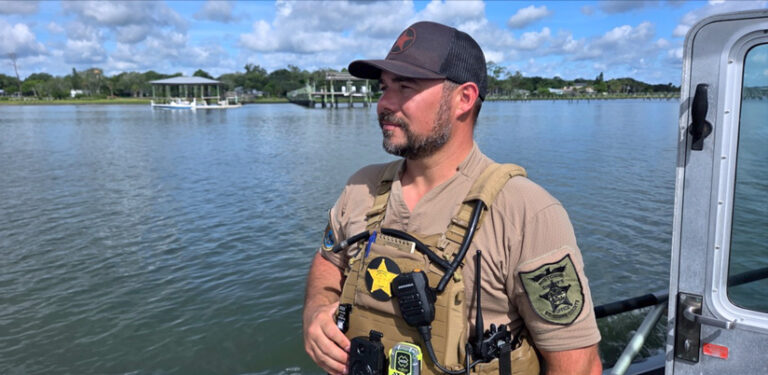
“A list on a whiteboard at the office did not help when in the field. It was always an ordeal, especially when multiple agencies were working the same area or even the same vessel,” said Sergeant Aaron Braddock of the St. Johns County Sheriff’s Office Marine Unit.
Braddock submitted a request to the county’s GIS division to create an application that would assist in keeping track of the derelict vessels, which the unit is responsible for maintaining.
The GIS division staff had created surveys and dashboards for other projects and felt confident that they could create a solution that every participating agency could take advantage of.
“[It had to be] something that would unify all our efforts and present the information in a way we could all use,” Braddock said.
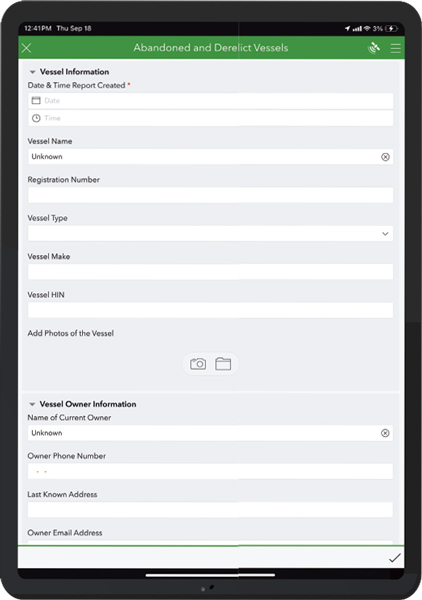
The GIS division first created a survey with ArcGIS Survey123 that captures information such as a vessel’s name, registration number, type, make, Hull Identification Number (HIN), and location, as well as photos of the vessel. Also collected are the vessel owner’s information, current status of the vessel (At Risk, Derelict Vessel, Ready for Removal, Vessel Removed, and In Compliance), course of action, report number, officer’s name, and agency making the report.
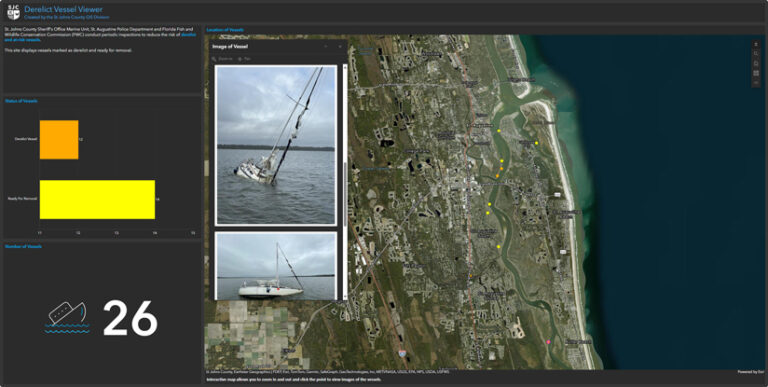
Next, the team created a dashboard with ArcGIS Dashboards to display the information collected in the field. The dashboard consists of a map of the location of the vessels, along with lists and charts illustrating the information from the surveys. The map pop-up shows information pertaining to the individual vessel, including photos taken in the field and a hyperlink to send updated vessel information back to the survey, as well as a link to create a new survey.
A second dashboard, which does not include the ability to edit an existing survey or create another survey, is for other agency members who simply want to view the information collected in the field.
In less than a month, the survey and dashboards were completed. After a testing period, the app went live for the agencies to start entering information about abandoned and derelict vessels.
Expanding the Operation
Shortly before the Derelict Vessel Tracker went live, Braddock had another request for the GIS division. The marine unit needed a reliable way to monitor vessels on the St. Johns County waters before and after storm events. The solution was another GIS application—the Hurricane Vessel Tracker.
Prior to a storm, the St. Johns County Sheriff’s Office Marine Unit, St. Johns County Fire/Rescue Department, St. Augustine Police Department, St. Augustine Fire Department, and the Florida Fish and Wildlife Conservation Commission survey vessel owners to determine if they will be leaving or staying on their vessel during the storm. Like the Derelict Vessel Tracker survey, this survey records vessel and owner information and includes photos and the location of the vessel.
After the storm, the vessels are checked and an update on their condition is provided. Before and after images of the vessels that attempt to ride out the storms are often heartbreaking, and many of these vessels ultimately end up listed in the Derelict Vessel Tracker.
As the project evolved, the marine unit identified the need for a feature to record the condition of both public and private boat ramps after a storm. The GIS division created an additional survey to record the inspection date, the inspector’s name, photos, and the condition of the boat ramp (Functional, Obstructed, Damaged, or Unchecked).
Later, a third survey was integrated into the application to allow the tracking of debris that found its way into the water during the storm. This survey includes the type, description, photos, location, and size or dimension of the debris.
The information collected in the three surveys is shown in a single dashboard. Again, like the Derelict Vessel Tracker app, the Hurricane Vessel Tracker has two dashboards: an editor dashboard with links to create and update surveys, and a viewer dashboard that does not have survey-editing capabilities.
The agencies involved saw the possibilities unfold with each app, and after the completion of the Derelict Vessel Tracker and Hurricane Vessel Tracker came the Marine Sanitation Device Investigation Tracker application.
A marine sanitation device is a piece of machinery or a mechanical system that is dedicated to treat, process, or store raw, untreated sewage that can accumulate onboard water vessels—not including devices such as portable toilets. Discharging raw sewage is prohibited in Florida waters. As with the previous applications, the GIS division created a survey and dashboards to record information and keep track of the status of vessels’ compliance.
The St. Augustine Port, Waterway & Beach District then requested a public-facing dashboard to display the information, status, and locations of derelict vessels, hoping to reduce the number of inquiries received about them. This resulted in a new dashboard called the Derelict Vessel Viewer. This dashboard uses the same data as the Derelict Vessel Tracker but doesn’t include sensitive information used by law enforcement agencies to conduct investigations.
“In addition to helping keep boaters and residents informed, it has significantly reduced the number of follow-up calls that we receive for derelicts,” said Matt Brown, chair of the St. Augustine Port, Waterway & Beach District. “Once people know where to look for the information, they can just keep referring to the Derelict Vessel Viewer for updates as vessels make their way through the process. It’s been a game-changer.”
A Common Picture
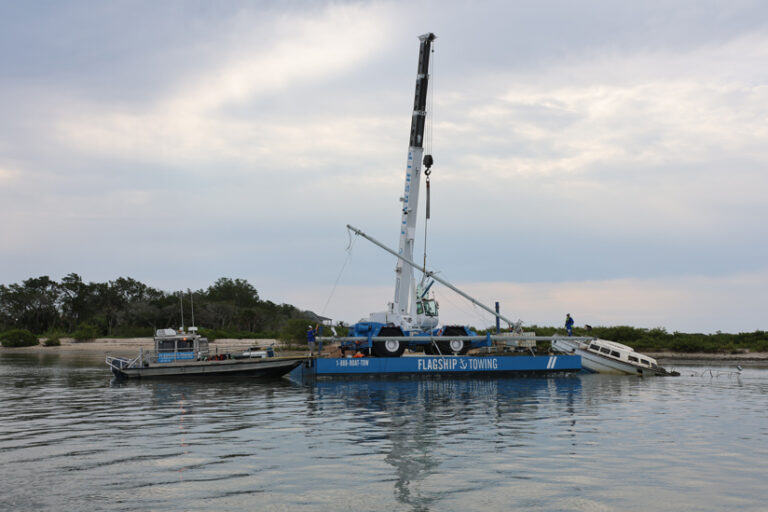
The new process of using surveys and dashboards to track derelict vessels has resulted in creating a common operating picture for all agencies involved. As staff start compiling information about a vessel, they can track who is working on the investigation and at what stage they are in the process. Approximately 65 vessels have been removed since creating the Derelict Vessel Tracker survey and dashboard.
“Where the dashboard really comes into play is that the community and the networking of the local law enforcement agencies [are] on the same page to accomplish these investigations,” said Braddock. “It also benefits the community by not wasting taxpayer money on resources trying to track down information that we can easily get off of the dashboard. I think that law-enforcement- and community-wise, the use of the app in the dashboard is a great benefit all the way around.”
With the success of the initial application to track derelict vessels, St. Johns County GIS Division requested other agencies’ ideas and created additional applications to support their tasks. With a blueprint to follow, additional applications could be created in a short time frame. And as the applications see more use in the field, the division continues to refine the tools in response to requests for enhancements and minor modifications.
This collaboration between the GIS division and local agencies has not only streamlined interagency communication but also enhanced transparency, accountability, and public trust. What began as a simple tracking tool has evolved into a comprehensive, adaptable application that continues to grow with the needs of the community.
About the authors

Ivy Lee