Introducing ArcGIS for Autodesk Forma
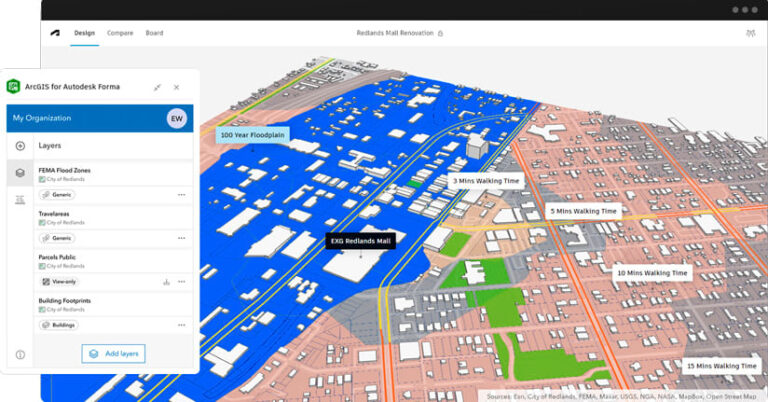
In June 2025, Esri released ArcGIS for Autodesk Forma. Developed in partnership with Autodesk, this app allows users to integrate authoritative data from ArcGIS into Autodesk Forma, providing a way for architecture, engineering, construction, and operations (AECO) professionals to transform their planning and pre-design work with geographic context. ArcGIS for Autodesk Forma allows for a more seamless collaboration between ArcGIS and Autodesk, enabling users to work within a single design environment without switching between platforms.
ArcGIS for Autodesk Forma will serve as an Autodesk extension, incorporating geographic data and geospatial services that enable greater analytics and insights into Autodesk offerings. With ArcGIS as a key part of design and construction, AECO professionals will have a deeper, more holistic understanding of projects connected to the social, built, and natural worlds. This new application elevates every design with ArcGIS content, including ArcGIS basemaps and select data layers from ArcGIS Living Atlas of the World.
Learn more about ArcGIS for Autodesk Forma.
Communicating the State of US Infrastructure
The American Society of Civil Engineers (ASCE) partnered with Esri to present the findings of the ASCE’s 2025 Report Card for America’s Infrastructure, using ArcGIS StoryMaps. Published every four years, the report card serves as a comprehensive evaluation of US infrastructure, using the familiar A through F school grading scale to indicate how well each sector operates for the public. Beyond the grades, the report provides key information on opportunities, challenges, and performance.
Federal, state, and local government agencies rely on the Report Card for America’s Infrastructure as an essential planning resource. Officials at all levels use the report to prioritize infrastructure projects that impact the communities they serve. Because reports have life spans of four years and infrastructure is constantly changing, the dynamic flexibility of ArcGIS StoryMaps makes it ideal for providing incremental data between releases.
Explore the story about the 2025 Report Card for America’s Infrastructure.
Better Awareness of Wildfires and Other Disasters
The University of California, San Diego’s ALERTCalifornia program and Esri have launched a new map layer in ArcGIS Living Atlas of the World that provides instant access to live camera feeds across California. This collaboration comes at a critical time, as the state faces increasingly frequent and severe natural hazards, particularly wildfires, that threaten public safety, environmental health, and economic stability.
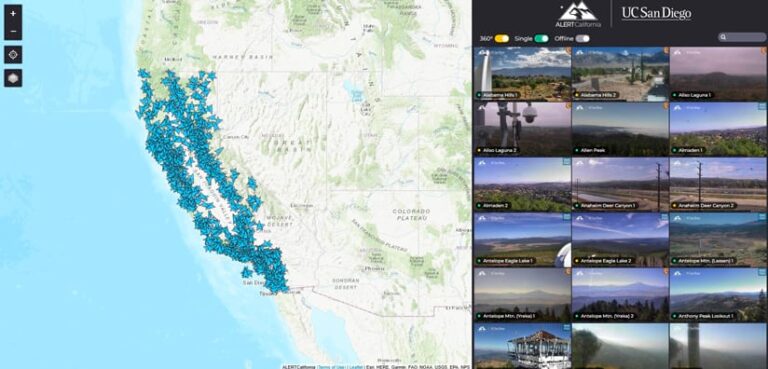
This freely available layer provides access to more than 1,150 high-definition, pan-tilt-zoom cameras and sensor arrays within ALERTCalifornia’s growing network. The layer shows each camera’s location, real-time viewshed, and current image. Organizations can add the ALERTCalifornia feeds into their own maps and dashboards, directly within ArcGIS. The strategically placed cameras provide continuous real-time imagery updated every 15 seconds.
Emergency managers and first responders can use the new ALERTCalifornia layer directly in their ArcGIS applications to get real-time situational awareness. This enables users to access critical data when they need it most, helping them monitor and respond to natural disasters more effectively. The layer can be used with a variety of ArcGIS applications and maps, ensuring that the data is not only available but also actionable.
Learn more about the latest updates and how to use the ALERTCalifornia Live Cameras layer, visit its ArcGIS Living Atlas page.