

By Tammy McCracken and Jim Pardue
In a digital era where location data shapes nearly every industry, spatial intelligence is no longer just a technical capability; it helps support enterprise growth, efficiency, and resilience. Recognizing this shift, Esri introduced the Path to Geospatial Excellence, a practical framework to help organizations manage their GIS program and develop their GIS capabilities to align with core business goals.
This framework can serve as a foundation for creating a geospatial strategy and help an organization unlock the value of location insight to solve business problems, inform smarter decisions, and improve operations.
Define Goals
Before getting into systems or software, step back and ask: What are we really trying to achieve with geospatial technology? The answer will shape every part of the approach. A strong GIS strategy does not come from copying what others are doing; it comes from knowing where the organization wants to go.
The clearer the goals are, the more focused the geospatial strategy will be. Here are a few places to look:
- Revenue growth: Can spatial insight help identify new markets, optimize coverage areas, or introduce new services?
- Operational performance: Can GIS simplify processes, reduce waste, or improve resource allocation?
- Risk reduction: Are there ways geospatial analysis could improve emergency response, support compliance, or strengthen environmental oversight?
- Customer experience: Could location data personalize engagement, reduce friction in service delivery, or boost satisfaction?
The Five Pillars
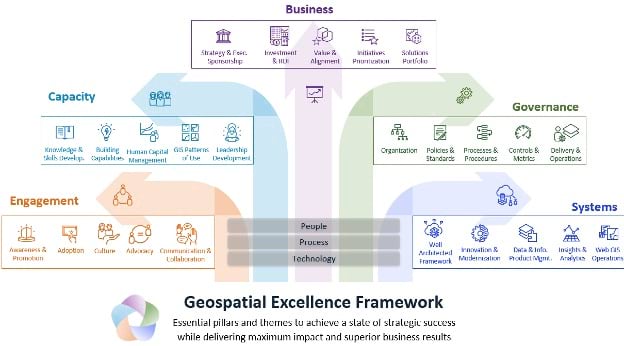
The Esri framework five interconnected pillars. These pillars form the foundation for sustainable, high-impact geospatial programs and help organizations embed GIS as a strategic capability.
- Business: Connect GIS efforts directly to strategic priorities. Identify use cases with measurable value and ensure
- Governance: Define policies, ownership, and accountability. Set expectations for data quality, compliance, and cross-functional collaboration.
- Systems: Build infrastructure that scales, integrates, and supports real-time data across cloud, analytics, and Internet of Things (IoT) environments.
- Engagement: Secure broad buy-in through consistent communication, user feedback, and support networks that drive adoption.
- Capacity: Grow internal skills through training, certifications, and community development.
Turning Vision into Action
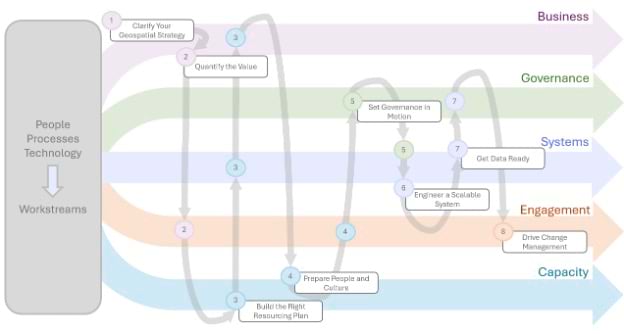
The path to geospatial excellence is about connecting strategy with execution, aligning cross-functional teams, and building capabilities that last. These eight workflows translate the framework pillars into practical focus areas to help organizations make steady, measurable progress.
These workflows can help a business build momentum and stay aligned to the framework:
- Clarify your geospatial strategy: Define what success looks like in business terms. What do you want GIS to help your organization do better?
- Quantify the value: Prioritize a few pilot use cases and track the return on investment (ROI). Early wins build credibility and buy-in.
- Build the right resourcing plan: Identify the skills you have and the ones you’ll need. Decide what should be developed in-house versus sourced externally.
- Prepare people and culture: Design new roles, rethink workflows, and embed spatial thinking across teams.
- Set governance in motion: Identify risks, define guiding principles, and establish clear rules for data, access, and accountability.
- Engineer a scalable system: Build a GIS platform that integrates with enterprise systems and supports real-time data, artificial intelligence (AI), and emerging technology.
- Get data-ready: Inventory your data, assess quality, close gaps, and create repeatable processes for analysis.
- Drive change management and communication: Ensure people understand the “why” behind GIS initiatives. Clear, consistent communication with staff around what’s changing and how it impacts their work helps build lasting buy-in.
Leading with Intention
Location data has the power to transform how organizations operate, plan, and serve. But that transformation only happens when leadership provides clear direction and thoughtful investment and stays actively involved to guide and support the sustained momentum being built.
The Path to Geospatial Excellence offers both a framework and a mindset shift. It helps leaders align technology with their mission, foster ownership across the organization, and build lasting internal capability. The result isn’t just smarter maps; it’s a smarter, more responsive organization that is ready to tackle complex problems and challenges.