
After attending the 2025 Esri User Conference in San Diego, we were impressed by the advancements and practical impacts of Real-Time GIS. From the Plenary session to expert-led sessions, Real-Time GIS was featured prominently throughout the UC, showcasing new developments and diverse applications. This blog summarizes three key takeaways from the conference and explores future directions for Real-Time GIS.
San Francisco International Airport Unveils Airport Integrated Operation Center
A highlight of the plenary presentation was a live walkthrough of San Francisco International Airport’s (SFO) “Dynamic Twin”, a real-time, integrated digital replica of the airport environment. This immersive demonstration brought to life the cutting-edge application of integrating GIS and IoT at SFO, illustrating how the airport leverages ArcGIS Velocity and ArcGIS GeoEvent Server to stream data from over 25 IoT sensors and operational sources. This impressive integration empowers airport staff with a current view to better monitor aircraft movement, assess terminal congestion, coordinate ground transport, and oversee maintenance. As a result, SFO can allocate resources more effectively and respond swiftly to incidents.
SFO gave a live demonstration of their upcoming Airport Integrated Operation Center (AIOC), which will serve as the airport’s nervous center, fusing GIS, BIM, and real-time APIs into a single operational dashboard. From landside traffic to airside operations, the AIOC will provide a common operating picture to support 24/7 decision-making and elevate the passenger experience.
SFO shared practical examples of how real-time GIS is used throughout airport operations. These included tracking traffic flow in parking areas and terminal connectors to help redirect vehicles, monitoring inbound flight delays and weather impacts, tracking baggage carousel status, and keeping tabs on security checkpoint wait times and open lanes, which helps staff adjust schedules and communicate better with passengers. Additionally, SFO showed how they track aircraft movements across runways and taxiways, dynamic gate assignments, and estimated taxi times with clear, color-coded indicators; red for delays, green for on-time, purple for early. Staff can see what’s happening, where it’s happening, as it’s happening. Altogether, integrating real-time spatial data is making airport management more responsive and helping improve the experience for travelers.
New Transit On-Time Performance Solution
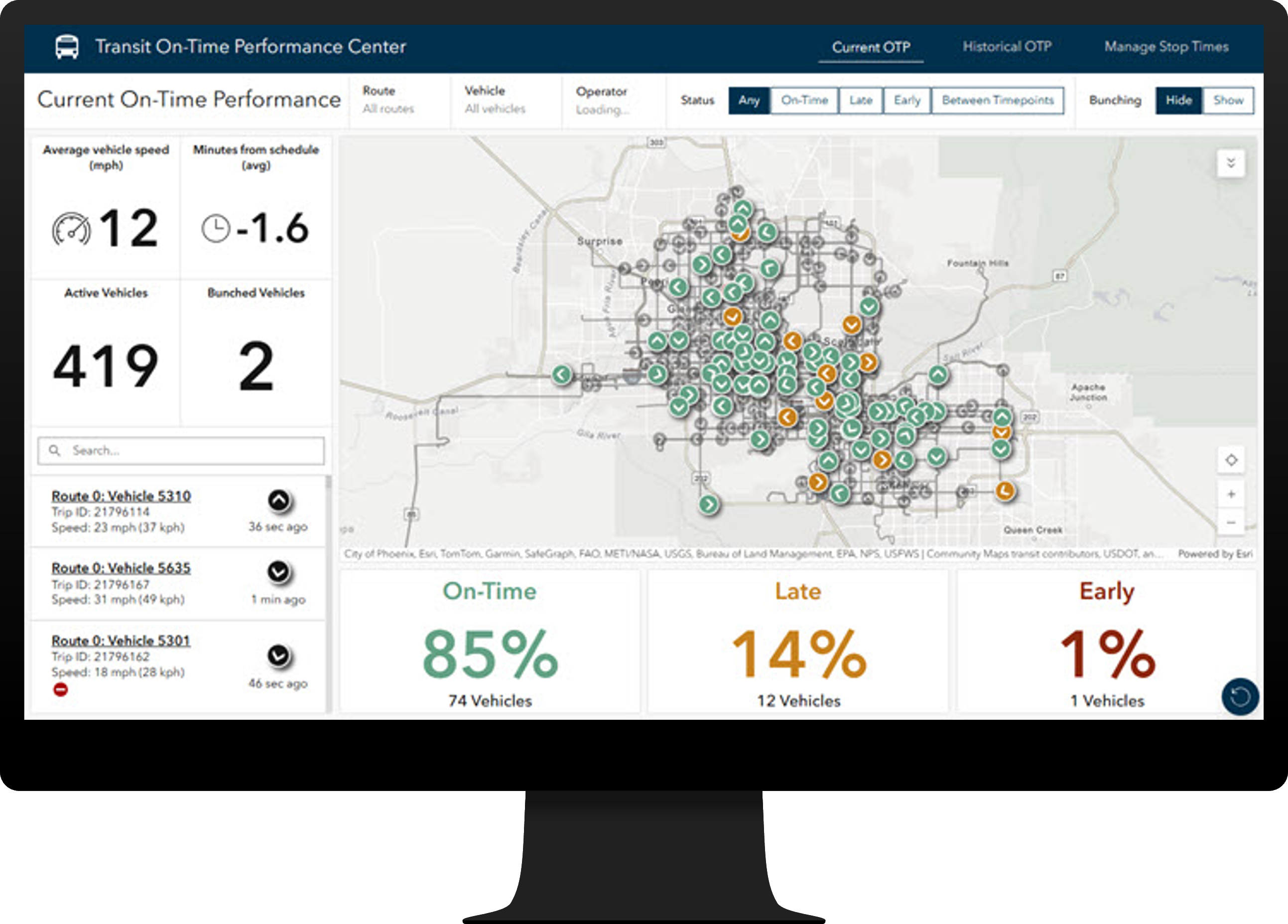
Another highlight of the conference was the unveiling of the Transit On-Time Performance solution from the ArcGIS Solutions team, which is now available in the ArcGIS Solutions gallery. This is the latest in a series of ArcGIS Velocity-powered Solutions and is designed to help transit agencies monitor vehicle locations and performance in real time, this solution empowers organizations to quickly address delays and optimize routes. The solution uses ArcGIS Velocity to leverage real-time vehicle locations to understand how transit services align with published schedules. Understanding where service levels are not being met allows agencies to take immediate action when delays occur. It also reveals patterns and trends in transit system effectiveness and helps agencies refine long-term plans.
Across the UC Showcase, attendees experienced hands-on demos and learned how real-time data can improve both daily operations and long-term planning, ultimately leading to a more reliable transit experience for riders.
To learn more about how the Transit On-Time Performance solution can provide a real-time and historic spatial view into transit performance, read the new blog introducing the solution. For more detail on the other solutions that utilize velocity, explore the common Velocity use cases.
The Future of Real-Time is Bright
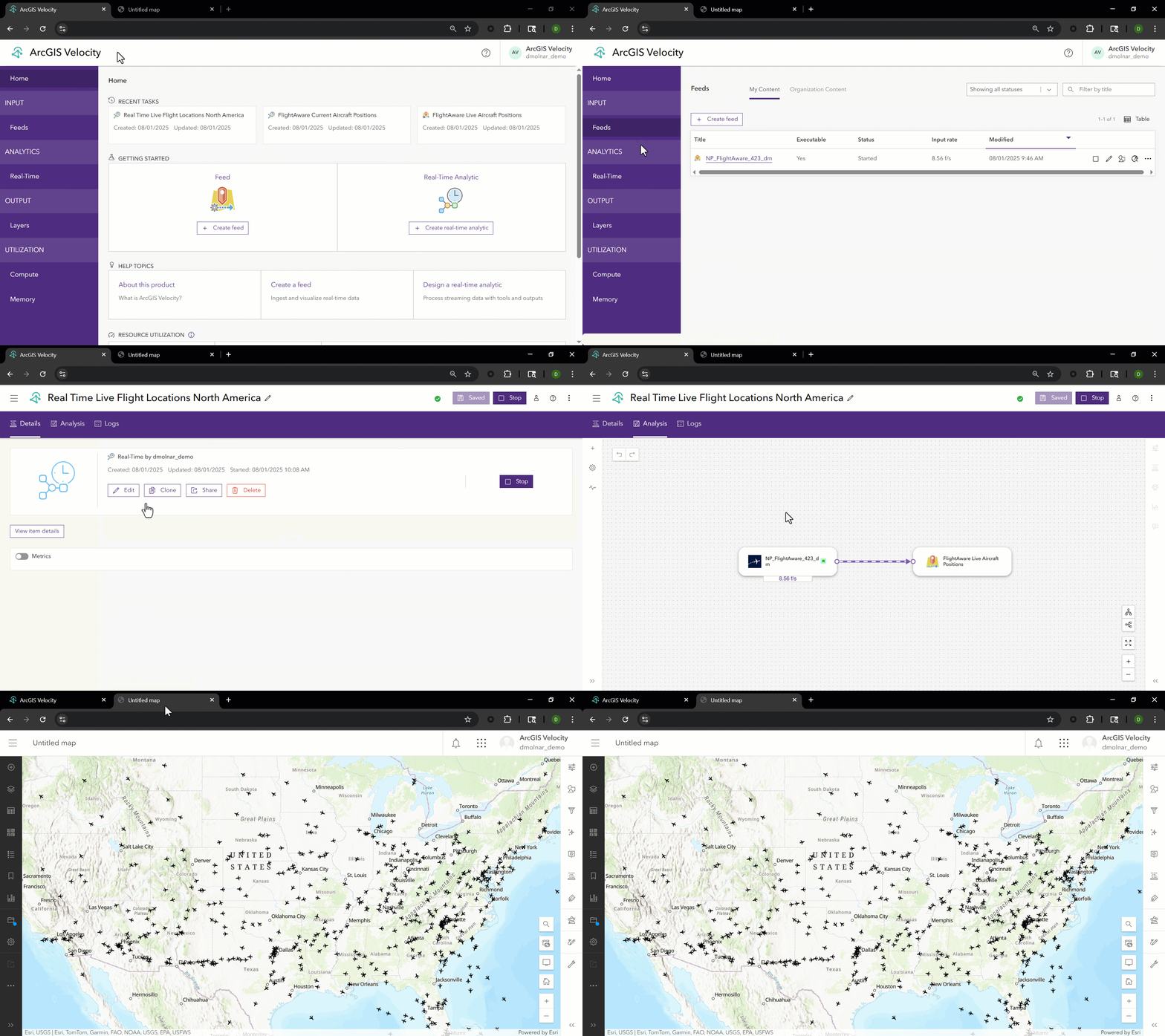
On Thursday afternoon, as the conference concluded, the real-time product team discussed the new deployment pattern – ArcGIS Velocity for ArcGIS Enterprise. They showcased ingesting and analyzing data with Velocity on a Windows operating system, mimicking a set up of running Velocity in your own infrastructure. This set up was representative of running Velocity in your own infrastructure. The application has a near-identical interface and tools for feeds and analytics ArcGIS Velocity deployed in ArcGIS Online today with only minor color variations distinguishing the two. It was impressive to see the familiar workflows and streamlined experience, demonstrating the vision of a unified real-time experience across environments and deployment patterns. The team also highlighted the history of Real-Time at Esri and the on-going research on newly emerging trends, technologies, and patterns in the IoT space.
The most significant takeaway from this session was the announcement that development on Velocity for Enterprise is progressing rapidly and will be available for Windows and Linux deployments next year. During the session the product team announced that the Velocity for Enterprise beta program will take place in early 2026. Be sure to sign up here and stay tuned for updates on the upcoming beta program.
Resources
We hope these takeaways inspire you to bring real-time GIS into your organization’s everyday workflows. Below are some ideas on how you can expand your knowledge about real-time GIS from the 2025 Esri User Conference:
- Did you miss or want to rewatch a real-time presentation? Recordings from live presentations are available here and additional content will be made available in August. You will need to log in with your Esri Events account.
- Watch the video from Jack’s plenary presentation about the latest in real-time GIS.
- Connect to a variety of real-time data providers from trust Esri partners or your own vendors and systems. Explore the Data Providers and Sources webpage here for more information on compatible partners and other vendors.
- Learn more about ArcGIS Velocity on the product page.
- Explore the ArcGIS GeoEvent product page for more information.
- Read the case study to see how the Nebraska Department of Transportation is monitoring real-time Big Horn Sheep locations to improve road safety.
We hope you enjoyed this year’s UC as much as we did, and we have already begun making plans to make next year just as inspiring!

Article Discussion: